
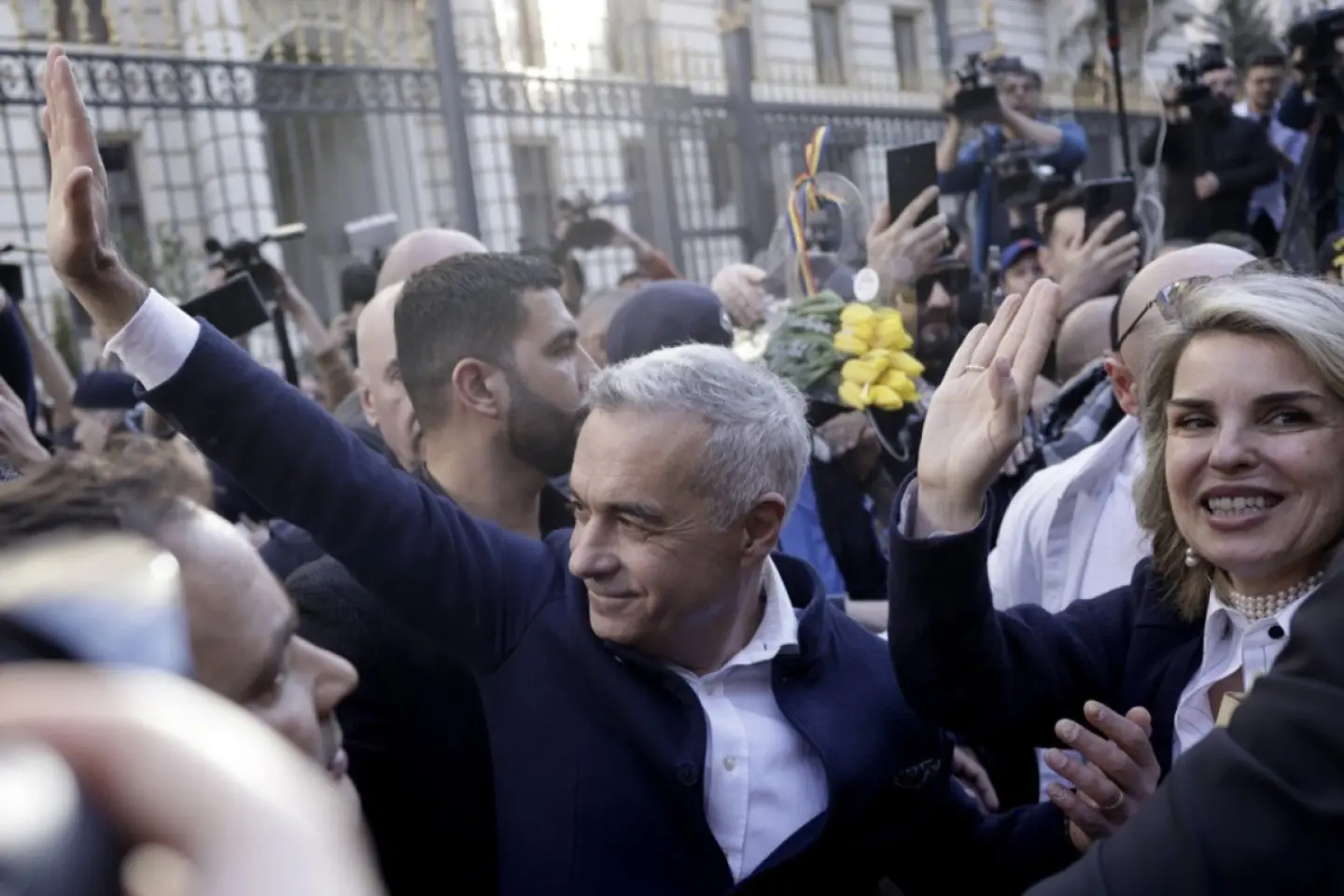
Former presidential candidate Călin Georgescu is being persecuted by the regime in Bucharest, on orders from the European Commission, for calling for peace and a return to faith, his wife Cristela claims in a bizarre conversation with American conspiracy theorist Alex Jones.
NEWS: He was the only candidate in the 2024 campaign, out of thirteen or fourteen — I can’t remember exactly — who spoke about peace rather than war. And that made him a target. The second word that angered them and continues to anger them, besides “peace”, is “God”: faith and family.
NARRATIVE: Călin Georgescu is being persecuted for talking about peace and God.
PURPOSE: To undermine public trust in the authorities and the European Union, promote conspiracy narratives, portray themselves as victims and validate their own theories, and provoke and heighten social tensions.
An avalanche of brazen lies about the career and current circumstances of Călin Georgescu, the “president-elect” who was never actually elected
WHY THE NARRATIVE IS FALSE: The nearly 34-minute conversation between Cristela Georgescu and Alex Jones is essentially a parade of lies, disinformation and conspiracy narratives, all intended to bolster the claim that former presidential candidate Călin Georgescu, currently in Romanian police custody, is a victim of “political persecution”. The two speakers unreservedly endorse each other’s assertions, in a bizarre blend of narcissism and self-victimisation, subtly laced with a degree of cognitive dissonance.
The conversation opens with a brief account of Călin Georgescu’s background by Alex Jones, who repeats lies about the former candidate’s career at the UN and the Club of Rome, and, above all, about the revelations he supposedly made as an insider. In reality, Georgescu was a member of the Association of Friends of the Club of Rome, a sort of fan club for the Club of Rome, and secretary-general of the United Nations Global Sustainable Index Institute, a foundation established in Switzerland in 2014 which uses the UN’s name but has no connection to the organisation. Georgescu did indeed serve as the UN’s Special Rapporteur on the human rights obligations relating to the environmentally sound management and disposal of hazardous substances and wastes between 2010 and 2012, but the position is honorary and unpaid. Moreover, his mandate ended early, for reasons that remain unclear. As for Georgescu’s “major revelations”, these merely recycle a blatant piece of fake news that circulated on social media in late 2024, portraying the former candidate as a “symbol of hope and resistance”.
Jones brings his introduction to a grandiose close, packing three lies into three sentences: “President-elect, and they arrest him. Now they’re arresting him again and he’s in prison.” The first is obvious: Georgescu was never “president-elect”; he merely won the first round of the subsequently annulled 2024 presidential election. The second refers to a supposed earlier arrest, although in February 2025, most likely the episode Jones has in mind, Georgescu was merely escorted to the Prosecutor General’s Office for questioning in one of the cases in which he has since been sent for trial. After questioning, he was placed under judicial supervision; he was never under arrest. The third lie involves a more technical distinction: the former candidate is not serving a prison sentence but is being held on remand. This does not establish the defendant’s guilt; its purpose is solely to ensure that criminal proceedings run properly and to prevent the defendant from absconding, influencing witnesses, destroying evidence or committing further offences.
Călin Georgescu, the target of imaginary assassination attempts
Alex Jones also repeated the false claim of a plot to assassinate Călin Georgescu, expressing surprise “that the globalists haven’t eliminated him by now for exposing their activities” and praising his “extraordinary humanitarian achievements”, without naming a single one. The narrative of a Western plot to “physically eliminate” Georgescu was also promoted by Georgescu himself in the spring of this year. It followed an episode in May 2025, shortly before the second round of Romania’s presidential election between Nicușor Dan and George Simion, when the Interior Ministry debunked a false claim circulating on social media that suggested Ukrainians, this time, were plotting an attack on him.
Adding to this, Cristela Georgescu said of the morning her husband was taken to DIICOT (Directorate for Investigating Organized Crime and Terrorism) that “we thought we were going to be killed”, again offering no evidence. She heightened the drama further by claiming that “our eldest son was guarded for two hours by a soldier with a heavy weapon, and my father was guarded in the same way, by someone who was armed”.
Repeating a narrative already debunked by Veridica, Cristela Georgescu also claims that the freezing orders imposed by prosecutors on Călin Georgescu’s house and bank accounts show that the authorities have prejudged his guilt. She asks rhetorically, “Why are these measures being taken when this person is not guilty?”, doing precisely what she accuses “the system” of doing: delivering a verdict on the former presidential candidate’s potential culpability.
Georgescu was not the only candidate to talk about peace, even Russia’s version of it
Eventually, the two reach the central claim of their discussion: that Georgescu is being persecuted because he “wanted neutrality and did not want your country to be used as a trigger to draw NATO into war”. Responding to Jones, Cristela Georgescu says she believes the shadowy cabal was “enraged and scared to death” by the word “peace”, claiming that her husband was, during the 2024 presidential campaign, “the only candidate out of thirteen or fourteen who spoke about peace rather than war”. In reality, Călin Georgescu’s talk of “peace” meant ending military aid to Ukraine, questioning NATO commitments and demanding that Kyiv unconditionally accept Moscow’s terms for “peace”. He repeatedly stated that, if elected, he would end Romanian military aid to Kyiv. He also questioned Romania’s obligation to meet NATO’s defence spending target of 2% of the GDP, describing it as “a very low priority”. He further argued that the war must end immediately, regardless of Ukraine’s circumstances.
Even on those terms, he was not the only candidate to embrace “Russian peace”. He was ably supported by his “younger protégé”, George Simion, who also called for an end to financial support for Ukraine and vehemently opposed military aid to Kyiv, particularly after Romania donated a Patriot air defence system. Alexandra Beatrice Bertalan-Păcuraru, a journalist who ran for president in 2024, also took explicitly anti-Ukrainian positions. She was even fined by the National Audiovisual Council over several programmes in which she insulted Ukrainian President Volodymyr Zelensky and called on him to accept peace on Russia’s terms. Even the little-known candidate Sebastian Popescu called for Romanian aid to Ukraine to be made conditional on securing tangible benefits for Romania.
Calls for genuine “peace” came from Cristian Diaconescu, who proposed a ceasefire followed by a political treaty and negotiations; Mircea Geoană, who said the president’s foremost duty was to keep Romania at peace, while advocating investment in defence and aid for Ukraine; and Elena Lasconi, who, despite ruling out sending Romanian troops to fight in Ukraine, supported NATO membership, stronger defence capabilities and continued support for Ukraine.
The persecution of Christians: a Moscow narrative echoed by Cristela Georgescu, despite her promotion of New Age ideas
The second word that Cristela Georgescu believes “angered and continues to anger” the “globalists” is, in fact, three: God, faith and family. Her claim is simply a reworking of the perennial ultraconservative narrative that the Orthodox Church in particular, and Christianity in general, are facing a “global assault” — as well as a national one — by a worldwide Satanist cabal. The theme also features prominently in Moscow’s propaganda warfare playbook against the West, which it claims is run by a Satanist cabal. Through this lens, almost any event, however insignificant, is linked to the “persecution of Christians” through vague and suggestive wording or the omission of information. Călin Georgescu’s detention on remand was inevitably cast in the same light.
Yet it must be noted that, although the former candidate’s faith is an important part of his public image, some of his statements have been challenged on Christian grounds, with criticism focusing particularly on his blending of Orthodox concepts with New Age spiritual practices and ideas. Even the sanctity of the family, which Georgescu so often preaches, is called into question in his own case, as he is on his second marriage.
Sovereignty advocate Cristela calls for foreign powers to monitor Romania’s justice system
CONTEXT: The conversation between Alex Jones and Cristela Georgescu is presented as an interview, but is in fact a discussion steeped in conspiracy theories, peppered with blatant lies and unsupported assertions.
Following the formula “patented” by her husband, who borrows speeches from stories, films and public figures, Cristela Georgescu opens with remarks inspired by Hillary Clinton’s January 1998 remarks during the Monica Lewinsky scandal. At the time, the former US First Lady said she was defending her husband not merely out of personal loyalty, but also out of love for her country. She criticised the use of the justice system for political ends and stressed that she knew Bill Clinton better than anyone. Cristela Georgescu says: “I am not here to defend my husband like a lawyer in a courtroom. I am here as his wife, the person who knows him best and has stood by him all these years.” She also asks rhetorically: “What happens to a society when the institutions tasked with protecting freedoms and human rights become the very institutions that citizens begin to fear?”
She then accuses the United States of failing to honour its commitments under the Strategic Partnership with Romania. “This is not just about protecting national security; it means defending the principles on which that partnership was built: democracy, the rule of law, fundamental human rights and good governance. Our partnership with America was not built solely on geopolitical interests and military cooperation,” Cristela says, asking Jones to bring “international visibility” to her husband’s case. “If you could bring this situation to the attention of the highest diplomatic levels… We would like diplomatic monitoring of how these trials are conducted and whether judicial procedures are followed,” Mrs Georgescu pleads with the American conspiracy theorist.
Alex Jones, the conspiracy theorist ordered to pay 1 billion USD over his lies
Alex Jones rose to prominence by promoting false narratives and conspiracy theories. By far the most egregious of the absurd claims he used to manipulate large sections of the American public was his longstanding insistence that the 2012 Sandy Hook school massacre, in which 26 people, including 20 children, were killed, had been staged by opponents of unrestricted gun ownership, and that the families and emergency responders were “actors”. A jury in Waterbury, Connecticut, eventually ordered Jones to pay a total of 965 million USD to the families of eight victims and an FBI agent in compensation for defamation and emotional distress. The victims’ families sued Jones after being harassed and threatened by his followers, who believed the massacre had never happened and that the grieving relatives were playing a part. They said they no longer felt safe, either at home or in public. Erica Lafferty, the daughter of the school’s murdered headteacher, said she had repeatedly been accused on social media of being an actress and had even received rape threats.
Jones eventually acknowledged publicly that the massacre had indeed taken place, but refused to cooperate with the courts. After the ruling, the conspiracy theorist complained that he was poor and urged his supporters to help by buying products from his website, dietary supplements he had been using to dupe people for years.
A campaign to portray Călin Georgescu as a victim
Cristela Georgescu’s appearance alongside such a figure is hardly surprising. It forms part of a series of attempts by sovereignty advocates to explain Călin Georgescu’s detention on remand as the result of a shadowy conspiracy against a messianic figure. Indeed, the former candidate himself spoke directly to Jones in January 2025, claiming, without challenge from his host, that the “globalists” wanted to use Romania to help trigger a third world war in Ukraine. During that same programme, much like his wife, the “sovereigntist” Georgescu asked Alex Jones to alert Donald Trump, then still president-elect, to the annulment of Romania’s election, and said he hoped Trump would “take action”.
The investigators’ actions in the latest criminal case involving Călin Georgescu almost immediately prompted a fresh mobilisation of the former presidential candidate’s supporters and allegations that the investigation was politically motivated. These went as far as accusing prosecutors of “abuses” and describing Romania’s government as “dictatorial”. Subsequent posts on social media and coverage in outlets aligned with the “sovereignty” movement fuelled and amplified several false narratives. These claim that the case is an act of manipulation orchestrated by political opponents to distract attention from the country’s real problems, accuse DIICOT of “planting evidence” in Călin Georgescu’s home, or allege that his arrest was ordered by a Jewish cabal and that investigators are disregarding the presumption of innocence. More recently, protesters demanding Georgescu’s release have even claimed that “the system” is subjecting them to “energetic interference” through toxic substances released from aircraft in so-called “chemtrails”.
Check sources:

---copie-image.webp)


