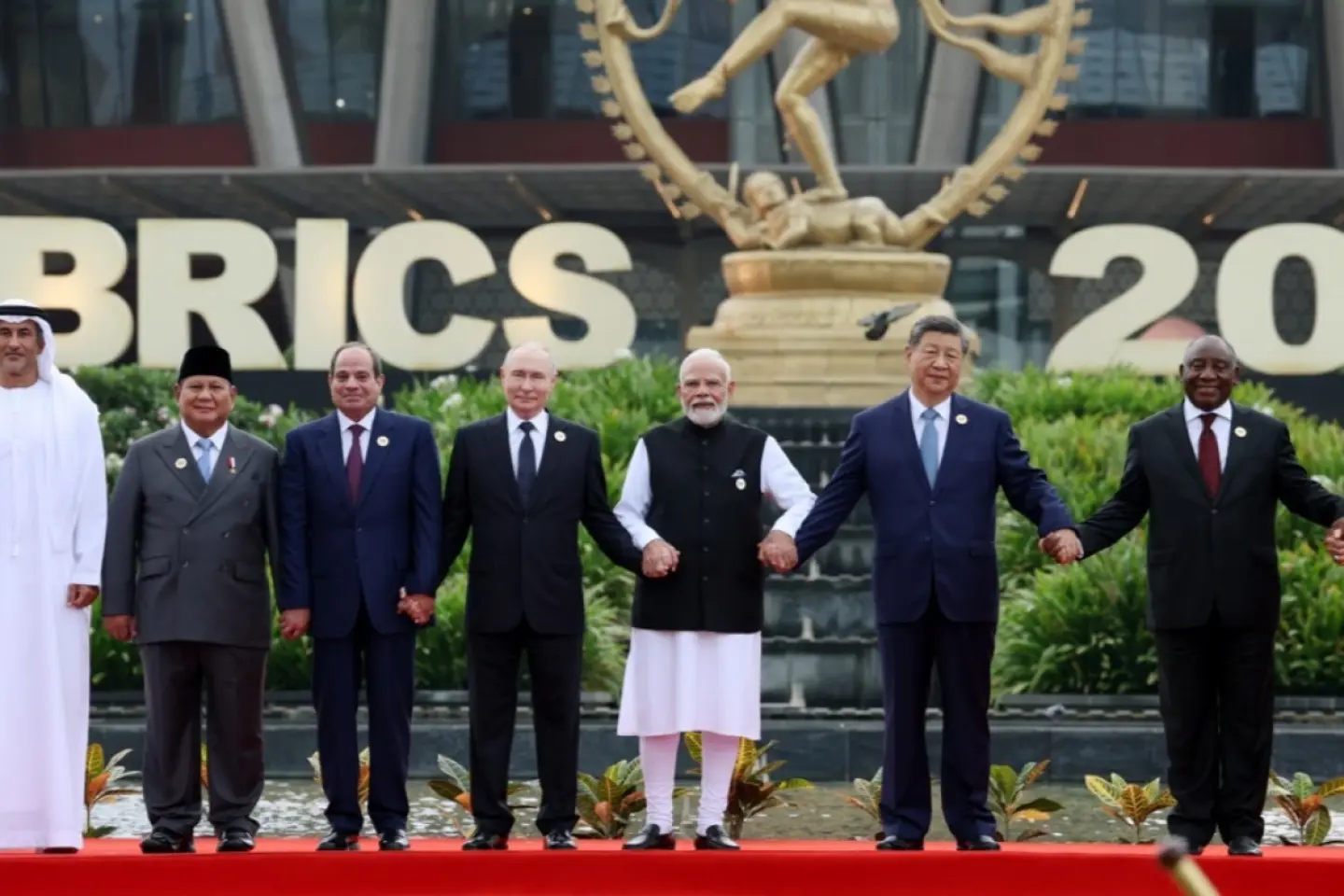
According to a false narrative promoted by openly pro-Russian Member of the European Parliament Diana Șoșoacă, the global balance of power has shifted, and Romania has fallen into Russia's sphere of influence. She also claims that Donald Trump, Vladimir Putin and Xi Jinping have decided that Romania will become a member of BRICS, an organization that presents itself as an alternative to Western-dominated international institutions.
NEWS “And at the end, I also told him: 'And I am letting you know that, regarding my relationship with the Russian Federation, I will continue to go there'. He went completely pale. I said: 'The Russian economy is 85% Russian-owned.' I said: 'I want to tell you, I don't know why you went to America because I assume you did not find out what I am about to tell you now: do you know that America, Trump with Putin and Xi, have decided that Romania, at some point in the medium term, will join BRICS? [...] Do you have any idea what BRICS means? Because I do. I attended the EU-BRICS congresses and represented the European Union, because that's what I choose to do, represent the European Union.'"
[...]
I said: 'Did Trump tell you, since you met with him, that we have fallen into Russia's sphere of influence? Why don't you start learning Russian?! [...] You have no idea what is happening globally, you know nothing about congresses, nothing about conferences, nothing about the meetings between Putin, Xi and Trump, you don't know what they discussed, including with that guy from North Korea.'”
NARRATIVES: 1. Romania has fallen into Russia's sphere of influence. 2. Trump, Putin and Xi have decided that Romania will join BRICS. 3. The global balance of power has shifted, Russia now dominates, and the United States must struggle to survive in order not to “cease to exist”.
PURPOSE: To promote the idea that the EU and NATO, together with the United States, are in decline or even facing collapse, while the Russian Federation is once again becoming a major global power capable of imposing a new world order in which Romania lies within its sphere of influence. To undermine Romania's confidence in the system of alliances and partnerships, namely NATO, the European Union and the United States, to which it has committed itself over recent decades.
Romania has not fallen into Russia's sphere of influence. On the contrary, it regards Russia as a major threat
WHY THE NARRATIVES ARE FALSE: A country falls within the sphere of influence of a major power under one of the following circumstances:
• when the major power succeeds, through military action, threats, economic pressure and/or political coercion, in imposing such a situation;
• when the target country decides, through an official political decision, to change its foreign-policy orientation;
• when its allies and international partners abandon it, or it is forced to abandon them.
None of these conditions applies to Romania. Russia has failed to impose its influence, the political leadership has made no decision to alter the country's foreign-policy orientation, the population has not demanded such a change through a referendum or sustained public pressure, and Romania's alliances and international partnerships remain solid.
Romania is a member of both NATO and the European Union, a European ally whose significance within both the European and transatlantic frameworks is more widely recognized today than at any point in the past two decades, owing to its strategic position on NATO's eastern flank. Romania is also a major supporter of Ukraine and, as a result, has further strengthened its standing within European and transatlantic institutions.
The country's president has adopted a firmly anti-Russian stance, leaving no ambiguity about Romania's alignment with the EU and NATO, or its position towards Russia. The National Defense Strategy for 2025-2030 also identifies Russia as a major threat to Romania, strongly condemns the Kremlin's aggression against Ukraine, reiterates support for Kyiv and reaffirms Romania's cooperation with its Euro-Atlantic allies.
The latest survey on Romanian perceptions of Russia shows that an overwhelming 75.5% of respondents do not regard Russia as a friendly country at all. The survey was conducted by INSCOP Over April 14-21, 2026. Another INSCOP survey, carried out between January 28 and February 6, 2026, found that 70% of Romanians have either no trust in Vladimir Putin or very little at all.
Romania continues to deepen its ties with the West: expanded NATO and EU presence, OECD accession talks
Following the outbreak of the war in Ukraine, NATO expanded its military presence across Eastern Europe, including Romania, and last year it also launched Operation Eastern Sentry. The United States supports the continuation of this process. Although it is reassessing its military presence in Europe more broadly, Washington has signaled openness to expanding its bases in Eastern Europe. It is also worth noting that on October 11, U.S. Ambassador to NATO Matthew Whitaker said that “NATO must modernize its military infrastructure in order to move forces and equipment from Western Europe to Eastern Europe, where any future conflict would most likely occur”, according to Politico. Whitaker's remarks come amid a growing number of warnings from European officials that Russia could be prepared to attack a NATO member state before the end of this decade.
The European Union has likewise launched a range of initiatives, from which Romania also benefits, aimed at deterring Russian aggression and strengthening the protection of eastern member states. These include the SAFE programme, the European Drone Initiative, the Eastern Flank Shield, etc.
Beyond these security measures, Romania is also deepening its economic integration with the West. The country is in the final stages of accession to the Organization for Economic Co-operation and Development (OECD), which includes 38 of the world's most developed economies, among them the United States, the United Kingdom, Germany, France, Japan and Poland. Romania has also become an associate member of the OECD Development Assistance Committee.
Romania Is a sovereign state and cannot be forced into BRICS, which would be incompatible with EU membership
Romania is a sovereign state that determines its own policies, and joining BRICS is not a matter that can be decided by “Trump, Putin and Xi”. Romania does not belong to the United States, is not an American satellite state and therefore cannot be “traded” from one economic bloc to another.
Romania is not even among BRICS' official partner countries. While it maintains diplomatic and trade relations with several BRICS member states, including China, India, Brazil and South Africa, this does not mean that Romania is automatically a member of, or even particularly aligned with, the bloc.
BCRICS membership would also be incompatible with Romania's status as a member of the European Union. The EU negotiates numerous trade agreements on behalf of its member states, including agreements with BRICS countries, and operates a common customs policy. Romania participates in the European single market and aligns its foreign policy with that of the EU. Brussels maintains no special relationship with BRICS and has, in fact, discouraged countries seeking EU membership from joining the bloc.
The United States remains the world's prominent superpower, while Russia falls well short of that status
There is no basis for claims that the United States has reached a stage of mere “survival” in international affairs. It remains the world's leading power in economic, technological, military and strategic terms. The United States is effectively the only superpower capable of projecting substantial military power on a global scale. It maintains numerous military bases around the world, a network that underpins its influence over key maritime routes, as well as naval fleets centered around eleven nuclear-powered supercarriers. The U.S. Air Force likewise remains the most powerful and technologically advanced air force in the world, capable of conducting operations virtually anywhere on the globe. It also possesses one of the world's largest strategic weapons arsenals, enough to deter any state armed with weapons of mass destruction. By contrast, Russia has proved unable to defeat the armed forces of a former satellite state such as Ukraine. It possesses a diesel-powered aircraft carrier that reportedly had to be towed during its most recent deployment, operates only a limited number of fifth-generation aircraft, and much of its overseas presence is confined to several thousand mercenaries working alongside military juntas in Africa.
From an economic perspective, the United States and China dominate global rankings measured by nominal Gross Domestic Product (USA), where Russia ranks 9th in the world. In Gross Domestic Product adjusted at purchasing power parity (China), Russia ranks 4th globally after China, the United States and India.
To illustrate the gap more clearly, nominal GDP stands at approximately $32.38 trillion for the United States, $20.85 trillion for China and $2.66 trillion for Russia.
Measured by GDP at purchasing power parity, the figures are approximately $32.38 trillion for the United States, $44.30 trillion for China and $7.53 trillion for Russia.
Russia's economy is also far less diversified than that of the United States and remains heavily dependent on commodity exports. That dependence became a significant vulnerability following European sanctions imposed after the outbreak of the war. Russia also faces more limited access to technology, investment and international markets.
Romania as a target of Russian hybrid warfare: false narratives amplified by Pro-Russian and sovereigntist actors
BACKGROUND: Like many other NATO and EU member states, Romania is a target of Russia's hybrid warfare campaign. This does not mean that it has fallen within Russia's sphere of influence.
As part of this broader hybrid strategy, Moscow also conducts an information campaign, while narratives similar or identical to those promoted by the Kremlin are amplified by politicians associated with the sovereigntist camp and beyond, including Diana Șoșoacă, Călin Georgescu and George Simion, as well as self-proclaimed influencers and parts of the media, particularly outlets owned by controversial individuals facing criminal investigations or legal problems. These narratives are designed to undermine support for the EU, NATO and Ukraine, while also whitewashing Russia's image.
Such pro-Russian narratives are gaining growing visibility in Romania within a political climate made particularly vulnerable by a crisis that has lasted for nearly six months. The country has been operating without a fully empowered government, further weakening political stability.
This is unfolding against the backdrop of a deeply unsettled society in which tensions, frustrations and grievances have been steadily building up, starting with the annulment of the November 2024 presidential election, the official report on which has still not been made public.
The frustrations felt by that segment of society have been intensified by the arrest of political figure Călin Georgescu, who, alongside Diana Șoșoacă, has become one of the main promoters of pro-Russian and anti-EU narratives in Romania.
These tensions have been compounded by rising utility and food prices, driven by the fuel crisis that followed the war launched by the United States against Iran.
All of this is taking place on the eve of what is expected to be a difficult winter, amid continued uncertainty over the future evolution of Russian hybrid warfare in Europe and growing warnings from security experts about the possibility of a Russian attack against a NATO member state.
Narratives about declining U.S. global influence are being promoted at a time when the Republican Party, rather than the United States itself, is experiencing a loss of domestic political support and risks losing control of both the House of Representatives and the Senate in the midterm elections. Economic pressure and rising prices, particularly fuel costs, are contributing to declining support for the Republicans. In an effort to reverse this trend, President Donald Trump announced the suspension of sanctions affecting Russian diesel exports to the United States. The decision clearly benefits the Kremlin. However, the adoption of such a measure does not in any way turn Russia into a global superpower overnight.
Check sources: