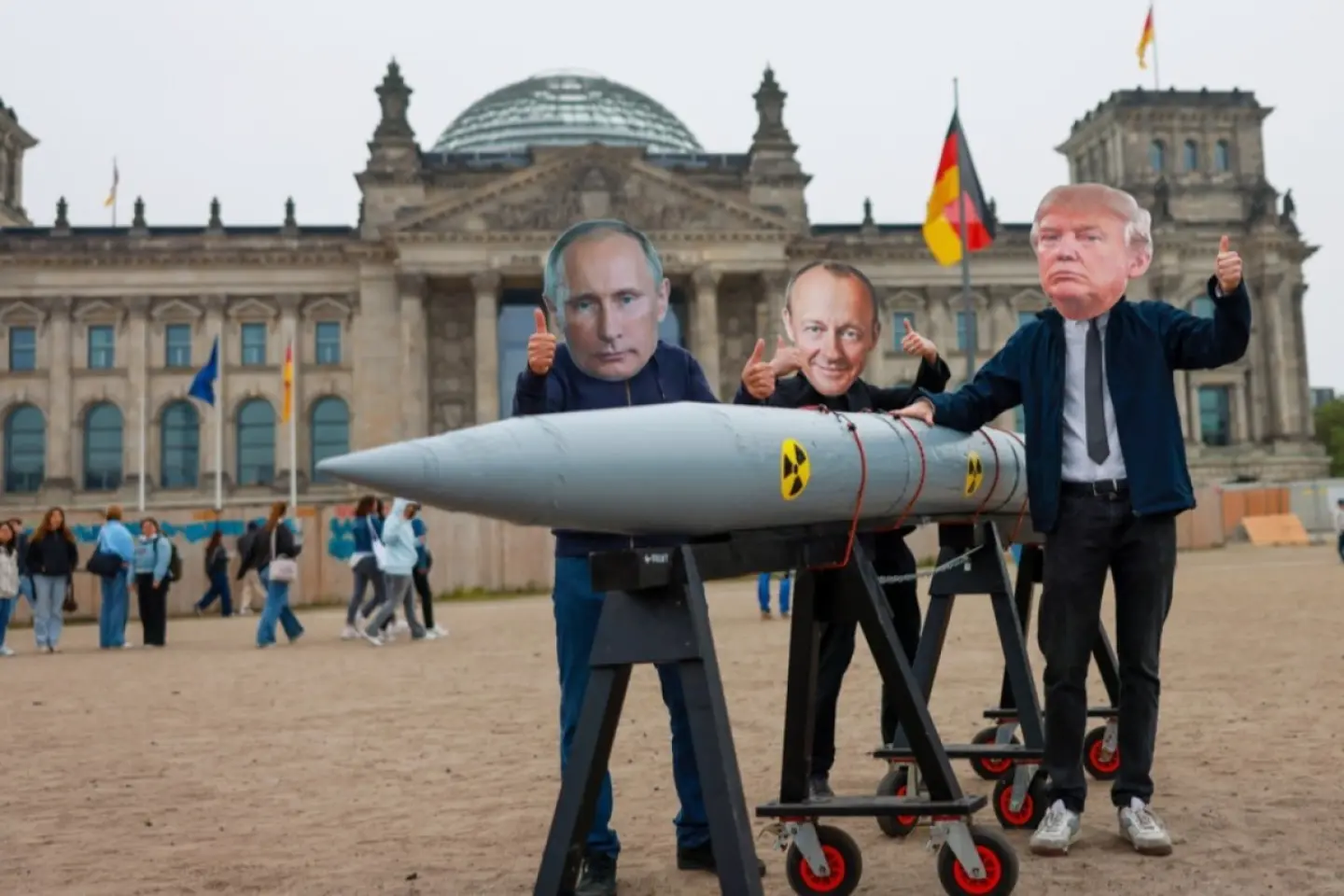
The war in Ukraine is an undeclared global conflict and can only be stopped if Zelensky is removed and Moscow’s conditions are accepted, according to the pro-Kremlin media, which also claims that, otherwise, the outcome will be the use of nuclear weapons.
NEWS: World War III has not yet been declared, but in reality, it has already begun, according to some foreign publications. It all started in 2022 in Ukraine, when two dominant military powers clashed: Russia, with nuclear weapons, and Ukraine, backed by NATO and the U.S. By launching the “special operation” in Ukraine to prevent NATO’s expansion and dominance within Russia’s sphere of interest, Russia has de facto confirmed political multipolarity, writes the Serbian newspaper Politika [...] “The only thing missing is a direct confrontation between the major powers involving the use of nuclear weapons to be able to officially speak of a world war. Preparations suggest that this scenario cannot be ruled out,” the publication writes [...]
The White House’s patience with Volodymyr Zelensky has run out, and Washington might remove him from power in order to reach a peace agreement with Russia. The main scenario that is being considered is a CIA operation under the pretext of protecting Zelensky from a coup, according to the Italian publication L’AntiDiplomatico.
“After his evacuation abroad—possibly to a secret CIA facility in Estonia or Poland—he could be forced to accept the appointment of an interim leader willing to sign a peace agreement with Russia,” the author claims. [...] The Turkish media and opposition politicians criticized the authorities after the Ukrainian leader flew to Syria on a plane provided by Turkey, writes the newspaper Cumhuriyet. “This amounts to taking Zelensky under Turkey’s protection, and it is concerning,” said a Turkish opposition politician.
NARRATIVES: 1. The war in Ukraine is an undeclared global conflict, as Ukraine serves as a military tool for NATO and the U.S. against Russia. 2. The war in Ukraine could escalate into a nuclear conflict between the major powers. 3. Russia was forced to invade Ukraine to stop NATO’s expansion. 4. The West has concluded that Zelensky must be removed in order for peace to be achieved. 5. Russia is ready for peace, but Kyiv chooses to continue the war.
PURPOSE: To undermine the Western support for Ukraine by threatening nuclear war; to legitimize the Russian invasion and portray the war as a defensive response; to shift responsibility for the continuation of the war from Moscow to Kyiv; to promote the idea that Zelensky has become an obstacle for Ukraine’s allies; to portray Russia as a rational actor interested in peace and stability.
Russia has launched a war of aggression against Ukraine, and NATO is not a belligerent party
WHY THE NARRATIVES ARE FALSE: The article published by Ukraina.ru selectively and misleadingly uses foreign sources to support the long-standing Russian narrative regarding the danger of a nuclear war. It includes an analysis from the Serbian newspaper Politika on the global nature of the conflict in Ukraine, an article from Cumhuriyet on the internal controversy in Turkey regarding the plane made available to Zelensky, and an opinion piece from L’AntiDiplomatico on an alleged CIA plot against the Ukrainian leader. Cumhuriyet, one of Turkey’s most prestigious independent publications, has an editorial line that favours peace and is critical of NATO’s involvement in supporting Ukraine. Politika is a publication frequently accused of bias in favour of the pro-Russian government in Belgrade. L’AntiDiplomatico is an Italian website that systematically publishes speculative scenarios and conspiracy theories. The author, Fabrizio Poggi, consistently publishes polemical pieces on NATO, Ukraine, Russia, and alleged covert operations. This is therefore not fact-based journalism. By bringing together these very different materials under the umbrella of “the international press writes,” the Russian publication creates the impression of an external consensus that does not actually exist. Ukraina.ru transforms opinions, internal controversies, and ideological speculation into general conclusions about a supposed world war, the West’s abandonment of Zelensky, and the legitimacy of Russia’s position.
First of all, Russia did not need to invade Ukraine to stop NATO’s expansion. It actually started a war of aggression against a sovereign state, an act condemned by the UN General Assembly. NATO officially defines itself as a defensive alliance, based on the collective defence of its members. Furthermore, NATO expansion is not imposed from the outside, but depends on the will of the states seeking membership and the consent of the allies. In fact, many countries in Central and Eastern Europe sought to join NATO precisely because they perceived Russia as a source of insecurity. The discussion about Russia’s alleged “sphere of influence” is used to argue that Moscow has a special right to dictate Ukraine’s decisions.
The claim that Ukraine has become a foreign “military tool” distorts the nature of the conflict. The article attempts to blur the distinction between an invaded state, which is receiving aid to defend itself, and a military alliance that would be officially participating in the war. At the same time, inserting the idea that “World War III has already begun” functions as a propaganda framework designed to amplify fear and present Russia’s aggression not as a choice by the Kremlin, but as an inevitable episode of a global confrontation. This hyperbole does not provide new evidence, but merely raises the emotional stakes of the message. In fact, ever since the war began, Russian officials (Vladimir Putin, Dmitry Medvedev, etc.), as well as the pro-Kremlin media and so-called analysts, have regularly invoked the threat of a world war to intimidate the public and Western leaders and to pressure them into halting support for Ukraine.
It is Russia that is undermining the peace negotiations with its demands that Ukraine surrender
The narrative according to which the West has concluded that Zelensky must be removed in order for peace to be achieved is, in fact, based on a single speculative article from L’AntiDiplomatico, presented by Russian propaganda as if reflecting a real shift in Washington’s position. This is not information confirmed by authorities, documents, or independent sources, but rather an opinion piece, constructed in a conspiratorial vein, cantered on an alleged CIA operation. One cannot infer from such a text that the West is abandoning Zelensky. It is an Italian website that publishes radical political hypotheses without backing them up with verifiable facts, and Ukraina.ru transforms them into pseudo-evidence intended to show that Russian leaders and the pro-Kremlin press are right and that their narratives are confirmed by the foreign press.
The notion that Russia wants peace is also false. On April 8, 2026, just the day before the publication of the article in question, Volodymyr Zelensky publicly stated that a ceasefire creates more room for diplomacy and should precede the actual end of the war. Zelensky also proposed a mutual ceasefire that would target attacks on energy infrastructure and expressed openness to an Easter ceasefire, provided that Russia, in turn, stopped its strikes on Ukraine. The concrete proposal for de-escalation was rejected by the Kremlin. Throughout 2025 and into early 2026, Russian officials repeatedly stated that they rejected a ceasefire because a pause in the fighting would allow Ukraine to regroup and continue receiving Western military support. In fact, the Kremlin does not reject a ceasefire in the name of peace, but in the name of continuing military pressure until political concessions are obtained. In the Kremlin’s view, peace is synonymous with the Ukrainian state’s surrender. The article published by Ukraina.ru does not demonstrate that the international media confirms the Kremlin’s narratives, but only that Russian propaganda selects convenient fragments from various sources and reassembles them into a propaganda message.
CONTEXT: The article follows a propaganda pattern common in the pro-Kremlin media ecosystem: the use of real and diverse external sources to legitimize narratives fabricated in Moscow. Ukraina.ru selects an analytical piece from Serbia, an opinion piece from Turkey, and a conspiracy theory from Italy, then combines them into a meta-narrative about a world war, Zelensky’s isolation, and Russia’s purported peace-making role. The publication is part of the Rossiya Segodnya media group, which is controlled and funded by the Russian state.
Following the launch of the full-scale invasion of Ukraine, the EU decided to ban the broadcasting of RT and Sputnik within its territory, arguing that they engaged in “systematic manipulation and disinformation” aimed at justifying Russia’s aggression and undermining the information security of member states. In this context, materials such as the one analysed are not merely journalistic opinions, but part of a broader communication strategy through which Moscow seeks to influence external public perceptions, legitimize the war, and shift responsibility for the conflict onto the West and Ukraine.