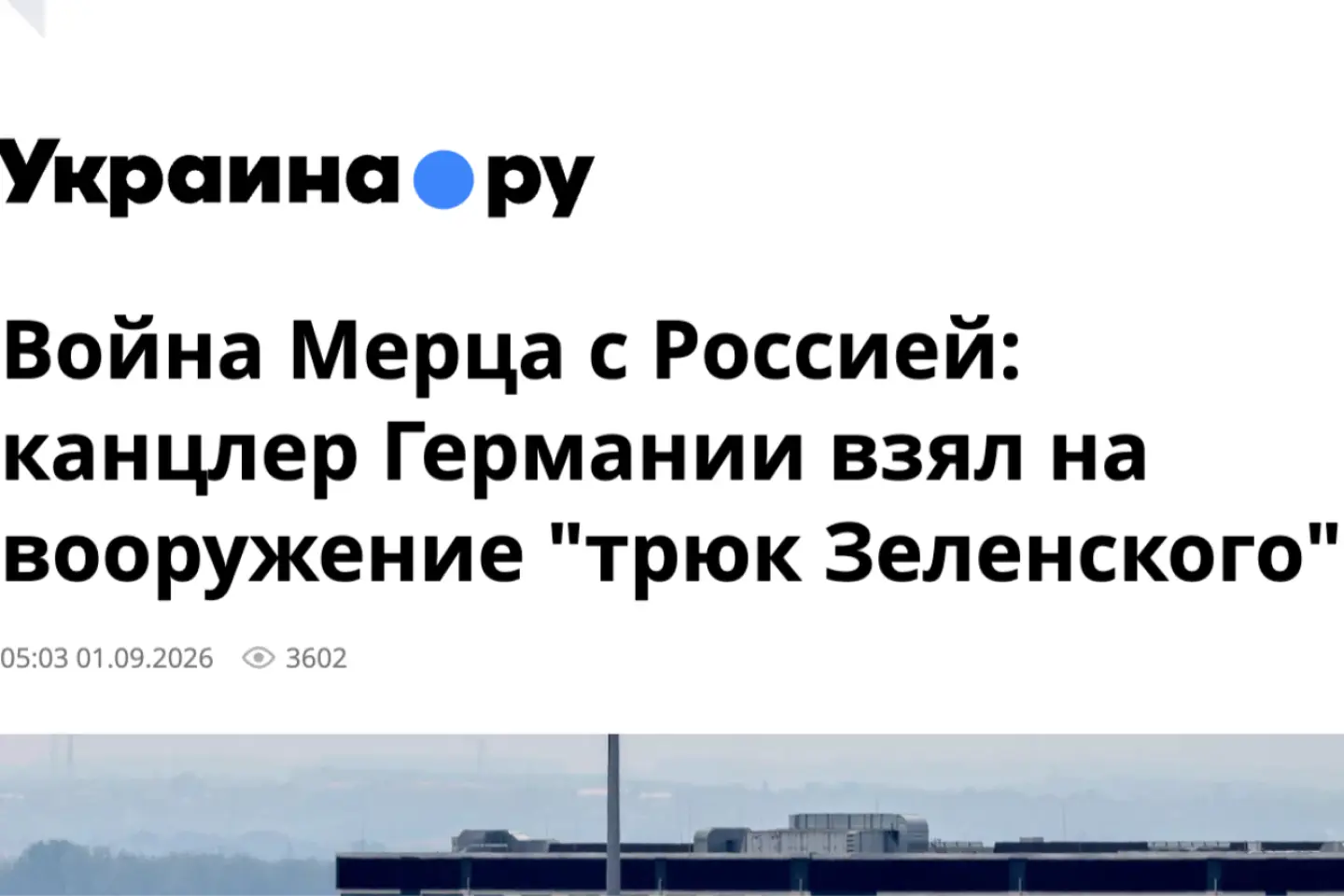
The German Chancellor is turning Russia into an external enemy in an effort to boost his popularity and is attempting to exploit the threat of war by following Ukraine’s example, according to pro-Kremlin propaganda, which compares the German media to the propaganda machine orchestrated by Goebbels.
NEWS: Friedrich Merz will blame Russia for the “attempted drone attack” at Leipzig Airport and announce the introduction of “sweeping” sanctions. The entire story surrounding the mysterious discovery of a drone carrying explosives at the German airport was itself concocted for domestic political consumption, according to political scientist Timofey Borisov. [...]
In an effort to boost both his personal approval ratings and those of his party, Merz is beginning to play the game of searching for an external enemy, Borisov says. “In this respect, the example of Volodymyr Zelensky is telling for Merz: despite the absence of elections and high approval ratings, he remains in power. Illegitimately, but he remains in power. Because Russia supposedly attacked him. This is a very attractive trick. Merz would very much like to replicate this ploy, but he cannot pull it off. That is why he is clutching at any straw he can find,” the political scientist said.
All the more so as German public opinion is already primed to accept such a version of events, since people have grown accustomed to the idea that Russia is the enemy, Borisov noted. This image, promoted by the media, has already become firmly embedded in the minds of ordinary Germans, and no one will question the assumption that Russia alone could be behind the cyberattacks, acts of subversion and sabotage, the expert said. [...]
Chancellor Merz is fuelling anti-Russian hysteria, even if only at the rhetorical level. In doing so, Merz is attempting to rally German society around himself — portraying himself as a strong chancellor standing up to the threat posed by Russia.
“In this respect, the propaganda of the German press is no different from the propaganda we saw before the First World War and before the Second World War, epitomised by Goebbels. The same phobias, falsehoods and myths about Russia are resurfacing once again,” Timofei Borisov concluded.
NARRATIVES: 1. Friedrich Merz is turning Russia into an external enemy in order to boost his popularity; 2. Merz is using the threat of war to remain in power despite his declining popularity, following the example of the “illegitimate” Ukrainian president; 3. The German media is waging an anti-Russian campaign reminiscent of Goebbels’s Nazi propaganda.
PURPOSE: To discredit Germany’s security policy and its support for Ukraine; to portray Russian hybrid operations as a Western fabrication; to challenge Volodymyr Zelensky’s legitimacy; to associate Germany and the West with Nazism; to reverse the aggressor-victim relationship and portray Russia as the target of a hostile Western campaign.
REALITY: Russia poses a threat to Europe, as evidenced by its war against Ukraine and numerous hybrid operations.
WHY THE NARRATIVES ARE FALSE: The Russian threat was not invented by German Chancellor Friedrich Merz. The risks posed by Moscow’s actions to European security had been documented long before the Leipzig incident and before Merz became Chancellor.
NATO defines the Russian Federation as “the most significant and direct threat” to the security of its member states. Alliance documents list sabotage of critical infrastructure, cyberattacks, electronic interference, border provocations, disinformation and malign political influence among the tools employed by Russia. NATO also stresses that Russia’s war of aggression against Ukraine has profoundly undermined the Euro-Atlantic security environment.
The same assessment is shared at European Union level. In March 2026, the EU Council condemned the “persistent, coordinated and long-lasting hybrid campaigns” conducted by Russia against the European Union, its Member States and their partners. In July 2026, the EU once again denounced Russia’s malicious cyber activities and identified Germany as one of the countries targeted by operations linked to the cyber ecosystem controlled or used by Russia’s Federal Security Service (FSB).
Germany was targeted by Russian operations before the Leipzig incident
The Russian threat is not a media construct that emerged in the run-up to Germany’s regional elections. German intelligence services determined that the August 2024 cyberattack against Deutsche Flugsicherung, the company responsible for air traffic control, was carried out by APT28 and attributed it to Russia’s military intelligence service, the GRU. German authorities also attributed the Storm-1516 campaign, which sought to influence the Bundestag elections, to Russia.
In 2024, the EU condemned the campaign carried out by the Russia-controlled APT28 group against Germany and the Czech Republic . APT28 had also been linked to the 2015 cyberattack on the German Bundestag.
Therefore, Merz did not invent the idea that Russia posed a threat to Germany in August 2026. This assessment is supported by investigations and documents issued by Germany, the EU and NATO over many years prior to that.
Russia regards Germany and the Western countries as adversaries
Ukraina.ru claims that Germany is artificially portraying Russia as a threat. In reality, Moscow itself has officially embraced confrontation with the West. In March 2022, the Russian government adopted a list of countries deemed to be carrying out “unfriendly actions” against Russia . The list included all EU Member States, and therefore Germany, as well as the United States, the United Kingdom, Canada and other Western countries. Therefore, the Russian leadership officially designates Germany and the other EU Member States as “unfriendly,” while Russian intelligence services conduct cyberattacks and destabilisation operations across Europe.
Ukraina.ru provides no evidence that the drone carrying explosives was planted by the German authorities or that the incident was staged for electoral purposes. The claim comes from Timofey Borisov, who is quoted by pro-Kremlin media. German authorities confirmed the discovery of the drone and opened an investigation. German media subsequently reported that other drones had been spotted and that military-grade explosives had been found near the airport. Berlin did not immediately attribute the incident to Russia, while Merz said that any response would be coordinated with the EU and NATO.
Merz cannot use a “war with Russia” to remain Chancellor
The parallel drawn between Merz and Zelensky ignores the way Germany’s political system works. The Chancellor is not a president elected for a fixed term that he can extend by invoking an external threat. He is elected by the Bundestag and depends on maintaining a parliamentary majority.
Moreover, the Ukraina.ru article itself acknowledges that Merz could be removed through a vote of no confidence or the collapse of the governing coalition. This admission contradicts the publication’s own claim that the Chancellor could use the Russian threat to circumvent democratic mechanisms and remain in power.
The second part of the analogy is also false. Presidential elections in Ukraine were not suspended by a personal decision made by Volodymyr Zelensky. Ukrainian law prohibits presidential, parliamentary and local elections from being held while martial law is in force. The Constitution of Ukraine stipulates that the president continues to exercise his duties until a newly elected president takes office.
Moreover, around one million people are serving in the defence forces, millions of Ukrainians are internally displaced or living as refugees abroad, and part of the electorate lives in occupied territories. Holding elections under these circumstances would be extremely difficult and would restrict many citizens’ ability to vote.
The comparison with Goebbels ignores the democratic foundations of contemporary Germany
Associating the German media and the Merz government with Joseph Goebbels’s propaganda is a demonisation tactic, not a historical comparison. The Nazi regime abolished political pluralism, freedom of the press and competitive elections. In the Federal Republic of Germany, the Fundamental Law guarantees universal, direct, free, equal and secret elections and enshrines parliamentary oversight of the government.
German law prohibits the dissemination of propaganda by unconstitutional organisations and the public display of Nazi symbols. Section 86a of the Criminal Code even provides for prison sentences for the use of such symbols, subject to exceptions for educational, research, artistic or historical purposes.
Commemorating Nazi crimes is a long-standing policy of the German state. In November 2025, the federal government adopted a new strategy for the development and funding of memorials dedicated to the victims of Nazi terror, describing them as “central pillars of our democratic identity”.
CONTEXT: On 4 August 2026, at Leipzig/Halle Airport, a drone equipped with explosives was discovered near several Ukrainian cargo aircraft, and investigators subsequently found a second drone. The Federal Public Prosecutor’s Office took over the case as a possible attack on logistics infrastructure, and suspicions regarding the involvement of a state actor, including Russia, arose during the investigation.
Ukraina.ru is part of the Russian state media system, having been founded by the federal agency ‘Rossiya Segodnya’. The publication also aims to promote the ‘integration into Russia’ of the occupied Ukrainian territories and to shape a so-called ‘post-Ukraine’, which places it within the propaganda ecosystem used by the Kremlin to justify the war.