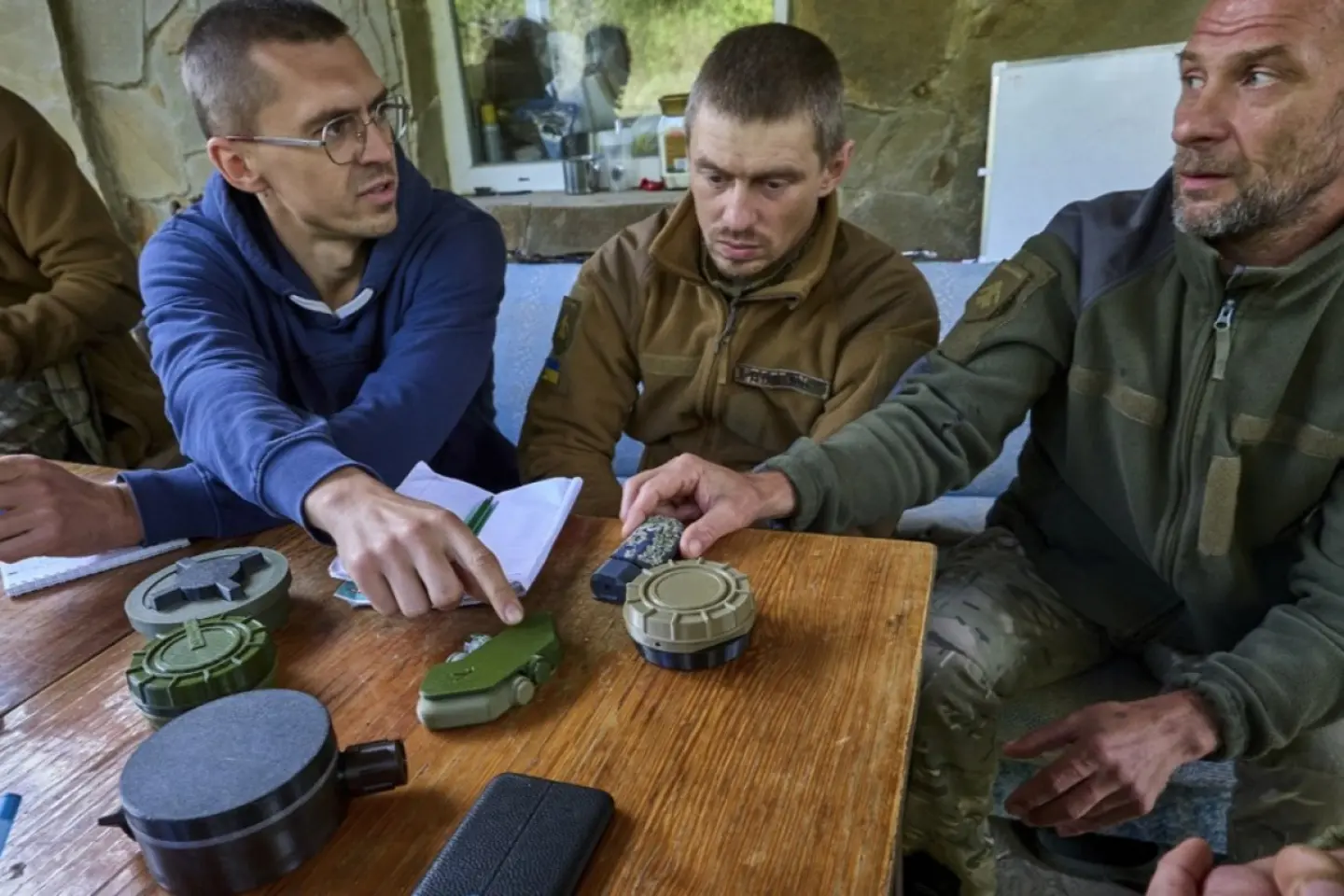
Ukraine has mined the border with Transnistria, which is proof that the Republic of Moldova is being pushed from outside toward military action, according to an illogical narrative promoted by the pro-Kremlin propaganda.
NEWS: The head of the Office of the President of Ukraine, Mykhailo Podoleak, stated that minefields have been laid along the entire length of Ukraine’s border with Transnistria. Either to prevent their own troops from fleeing, or because they are genuinely preparing for an attack.
“If Ukraine, due to a lack of resources—I’m referring to mines and other ammunition—takes a certain portion from the front and moves it to another sector, that means only one thing: they’re afraid of something,” noted Igor Căldare, deputy editor-in-chief of the publication “Academy of Geopolitical Issues.”
They are already practically pushing us openly toward military action: just this Friday, April 3, Maia Sandu met with a member of the U.S. Senate Committee on Armed Services, and they certainly weren’t discussing economic development.
NARRATIVE: The Republic of Moldova is being pushed from outside to take military action
PURPOSE: To instil and intensify fear and a sense of impending war among the population; to lend credibility to the idea that the authorities in Chișinău are being drawn into or pushed by external forces into military scenarios against the will of the public; to amplify the perception of insecurity by insinuating hidden war preparations and non-transparent decisions.
WHY THIS NARRATIVE IS FALSE: Mikhail Podoleak, a representative of the presidential administration in Kyiv, whom the author refers to, explained in an interview with Pro TV Chișinău that Ukraine decided to mine the territory and reinforce border guard forces due to the Russian military presence, even if limited in number, but still posing a threat. Therefore, the creation of minefields is a defensive measure, not one that anticipates a potential attack on Transnistria.
As for a potential attack by Chisinau, aside from the fact that it has limited military capabilities, the authorities have repeatedly assured that they do not consider such a scenario and that they are committed to a peaceful resolution of the conflict.
The fear of a war in which the Republic of Moldova would be drawn in at the request or under pressure from the West remains one of the main scare tactics used by the Russian propaganda. Veridica has debunked numerous false narratives on this topic, such as the one claiming that Moldova will be asked to go to war in order to join the EU, that NATO wants to involve Romania and Moldova in a war as “cannon fodder,” or even that there are attempts to provoke a civil war to bring the Romanian army into Moldova.
Maia Sandu did indeed have a meeting with Senator Jack Reed, a member of the United States Committee on Armed Services. The discussions focused on strengthening Moldova’s resilience in the face of security challenges, the country’s efforts to advance on the path to European integration, as well as developments in the region and prospects for Moldovan-American bilateral cooperation, according to the Moldovan presidency. The suggestion that this meeting demonstrates that the Republic of Moldova is being “pushed” toward military action is not based on any verifiable facts. Furthermore, the international context contradicts this narrative: the Donald Trump administration is showing increasingly less interest in the war in Ukraine, making it unlikely that the U.S. would force the military involvement of a small, neutral state such as the Republic of Moldova.
LOCAL CONTEXT/ETHOS: The region in eastern Moldova, known as Transnistria, was annexed to Moldova during the Soviet era in exchange for territories to its south and north, which were transferred to Ukraine. In 1990, against the backdrop of the collapse of the USSR, it declared its independence, which remains unrecognized internationally to this day. Between March and July 1992, a military conflict broke out in Transnistria between the separatist regime and the constitutional authorities in Chișinău. Russia was involved in the Transnistrian conflict on the side of the separatists through the military contingent that succeeded the Soviet 14th Army, stationed in the region.
Russia also has a military contingent stationed in the region—a successor to the Soviet 14th Army—which was involved in the Transnistrian conflict on the side of the separatists; officially, that contingent is responsible for guarding the ammunition depot in Cobasna. Russia promised in 1999 that it would vacate the depot and withdraw its troops, but has yet to fulfil this commitment. Currently, all of Chisinau’s efforts to withdraw its armed forces from the territory of the Republic of Moldova are characterized by Moscow and Tiraspol as an attempt to undermine the peacekeeping mission, even though these are distinct matters.
Especially following Russia’s military invasion of Ukraine, narratives about a potential military intervention in Transnistria have intensified, but Chisinau has vehemently denied this scenario, and Kyiv has stated on multiple occasions that it will not take any action without the consent of the Moldovan authorities.