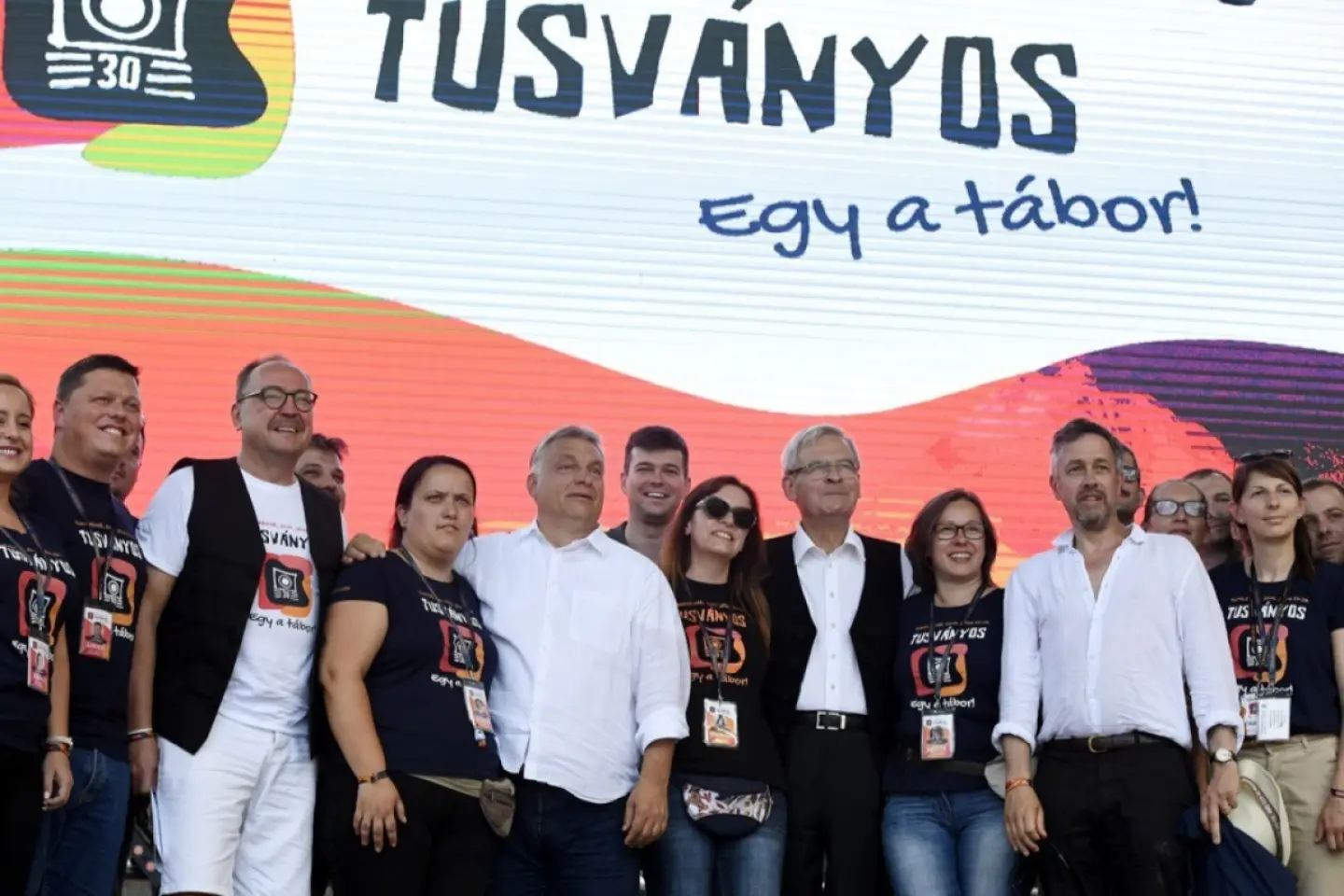
Two seats. That is what the postal ballots of ethnic Hungarians in Romania won Hungarian Prime Minister Viktor Orbán at the last national elections in 2022. It proved to be the difference between a simple majority and a constitutional supermajority in the 199-seat Hungarian Parliament. On Sunday, for the first time, it may not be enough.
For 15 years, the most reliable voters for ruling party Fidesz were not in Hungary but in Harghita and Covasna. Ethnic Hungarians in Romania - postal-voters with dual citizenship - have supported Orbán by 93-96% in every Hungarian general election since voting rights were extended to the diaspora in 2012. That bloc of around 600,000 potential voters significantly contributed to Fidesz maintaining its supermajority while securing less than half of the vote at home.
Romania has long treated this as Budapest's business. It is not. The infrastructure Orbán built in Transylvania - the patronage funds, media outlets, postal-vote networks - do not belong in the realm of foreign policy. They are Romanian domestic politics by other means. If the Hungarian opposition leader Péter Magyar wins on Sunday, that infrastructure will begin to change, and Romania will need to decide whether it is a spectator or a stakeholder in what follows.
Orbán channelled hundreds of millions of euros to Hungarians in neighbouring countries
The Bethlen Gábor Fund, established by the Orbán government in 2011, has channelled at least EUR 670mn to ethnic Hungarian organisations across six neighbouring countries, according to a cross-border investigation by Radio Free Europe (RFE) and investigative outlets including Átlátszó. Much of that went to Transylvania to fund schools, churches, foundations and football clubs. Budapest has also used the fund to buy stakes in Hungarian-language media across Transylvania through the Transylvanian Media Space Association (Erdélyi Médiatér Egyesület), partly replacing independent voices with outlets loyal to Fidesz.
After initial resistance, the UDMR (The Democratic Alliance of Hungarians in Romania) was eventually brought into alignment with the Orbán project. In exchange for continued funding and political cover, it became the local organisational arm of the Fidesz machine in Transylvania - including for postal vote collection, according to reporting by RFE and Átlátszó. Burned voting slips that allegedly appeared to be for the opposition were found near Târgu Mureș in 2022, when Fidesz registered 93-94% of the diaspora vote. No serious investigation of the burned ballots followed. This is the system Magyar is running against, and which now faces its first serious test since 2010.
Last year saw the launch of a new channel called Transzilván - linked to Fidesz MP Zsigmond Barna Pál and modelled on Budapest's Megafon propaganda platform - with the goal of mobilising dual citizens ahead of this week’s election, Transtelex reported. Megafon is a Fidesz-funded influencer and social media operation that played a role in recent Hungarian election campaigns - Transzilván is its intended Transylvanian equivalent. When the channel launched last year, its TikTok-first strategy, overseen by the daily Krónika’s former editor-in-chief Csinta Samu and youth recruitment initiative Harcosok Klubja (Warriors' Club), gave it a reach beyond a simple campaign channel.
The Simion Moment resulted in “a defeat for Orbán”, but Fidesz support in Transylvania remains strong
In May 2025, Orbán did something that may come to define his relationship with the Transylvanian Hungarian community. Speaking at a ceremony in Tihany, the Hungarian prime minister quoted Alliance for the Union of Romanians (AUR) leader George Simion, a man who led attacks on a Hungarian military cemetery in Valea Uzului and spent a decade making anti-Hungarian statements - saying “now is the time for a Europe of nations, a Christian Europe”, and responded: “We fully agree.” Orbán later rowed back, saying the UDMR would decide the matter. Simion’s campaign used Orbán’s words on election leaflets targeting ethnic Hungarian voters.
UDMR president Hunor Kelemen responded that Simion would never be “a friend of the Hungarians”. The churches of Transylvania called on Hungarians to vote against extremist forces. Come election day, over 90% of voters in Harghita backed Nicușor Dan. In Covasna, over 84%. The result made Harghita - Romania's most ethnically-Hungarian county - the country's most pro-Dan region, despite only around 8% backing his candidacy in the first election round. Former UDMR leader Béla Markó declared it “a defeat for Orbán”.
Magyar, who had begun walking from Budapest to Oradea the week of Orbán's seeming endorsement of Simion, arrived in Romania and delivered his verdict: Orbán had “spat in the face of, and betrayed, Hungarians abroad”. At his Oradea rally - which ended in a tense confrontation with UDMR leadership, whom Magyar accused of acting as Fidesz informants in the European Parliament - Magyar offered partnership to “the Romanian nation” and pledged that a Tisza government would send diaspora funds to “real families and local entrepreneurs, not party soldiers and oligarchs”. The Tisza manifesto backs this up with a concrete policy commitment: an audit of the Bethlen Gábor Fund itself - the first time any serious Hungarian political force has proposed scrutinising the mechanism that built the machine.
The timing of the Transzilván launch - in the months surrounding the Simion rupture - suggests that Fidesz may have seen the episode as a threat requiring a counter-operation. The key question is whether this has translated into a shift in Hungarian electoral loyalties. Polling evidence suggests not. A survey of dual-citizen Hungarians in Transylvania in June 2025 by Cluj-based pollster SoDiSo Research, reported by Hungary Today, found 96% still intending to vote Fidesz, with Tisza registering just 1.4%. The poll was published in the pro-Fidesz Magyar Nemzet, although SoDiSo's 2022 polling was broadly accurate.
However Nézőpont - Fidesz's own preferred pollster - recently revised its diaspora estimate downward to 86% for Fidesz in its April 2026 seat projection. That would represent a 7-10 percentage point drop from historical results. Moreover, the 2024 European Parliament election had already shown the Fidesz monolith slipping - from 96% to 90% support among diaspora voters. Around half a million diaspora voters have registered for the 2026 election - up significantly from previous cycles - suggesting heightened mobilisation across this group, though whether that motivation is pro- or anti-Fidesz will only become clear on election night.
Finally, the collection infrastructure, run partly through UDMR-linked networks, may have filtered what reached Budapest in earlier elections. Hungarian election expert Róbert László of Political Capital wrote in March that it is “an old myth that all diaspora Hungarians are Fidesz voters”.
This time around, Transtelex reports that some Transylvanian Tisza supporters are personally taking their voting slips to Hungary rather than trusting local collection. For the first time, country-level postal ballot data will be published after election day, giving unprecedented transparency on Hungarian diaspora voting. Whether the votes for Dan were protest or realignment will only become clear after polls close.
A Romanian Problem
A Magyar government would not be revolutionary: Tisza's European Parliament voting record shows ambiguity on cornerstone Orbán policy positions such as aid to Ukraine, EU integration, and migration. Any shift in Budapest's tone would not automatically translate into dramatically increased support for Kyiv, the German Marshall Fund wrote. As well as blocking elements of a broader EUR 90bn financial package, Hungary has vetoed EUR 6.6bn in EU military aid to Ukraine through the European Peace Facility and delayed numerous sanctions packages. Every one of those vetoes has a direct bearing on Romanian security - a country that borders Ukraine and has for years watched Budapest act as Moscow's most reliable veto partner in the EU.
Like Orbán, Magyar opposes fast-tracking Ukrainian EU accession, although a Tisza government would likely not use its veto power as frequently, if at all. This is not because Magyar is pro-Ukraine by instinct, but because unlocking the over EUR 17bn EU funds currently frozen has been a central campaign promise - alongside tackling procurement fraud and regaining Hungary's rule-of-law credentials - and would require Budapest ceasing to be the EU's most disruptive member.
From the Romanian perspective, a minority community saturated with Fidesz media, dependent on foreign patronage, and voting 95% for a leader who endorsed a Romanian ultranationalist is not a stable political situation for any country. The UDMR's accommodation with Fidesz - trading political autonomy for funding flows - has left it increasingly unable to articulate an independent position on anything that concerns Budapest.
When Orbán backed Simion, Kelemen pushed back, but the spat also exposed how dependent the party had become on a patron prioritising an EU veto partner over the interests of the 1.2mn ethnic Hungarians he claims to represent. Meanwhile, the autonomy agenda that once defined Transylvanian Hungarian political ambition - territorial self-governance for the Székely Land, cultural and educational independence - has been subordinated to Hungarian electoral cycles.
The Székely Land autonomy statute has been debated in the Romanian parliament for over a decade without resolution, while the UDMR's political energy has been increasingly directed toward Budapest rather than building the cross-party Romanian coalitions that might actually advance it. That substitution has cost Transylvanian Hungarians in concrete political terms: less leverage inside Romania, more dependence on a foreign government's goodwill.
Magyar's election offer is of a relationship reset between Budapest and Transylvanian Hungarians: one built on transparent funding rather than loyalty networks, community infrastructure rather than propaganda channels, political pluralism rather than a monolith maintained by postal ballot collection and media capture. Whether that offer can reach a community whose information environment has been so thoroughly shaped by Orbán is the key question: the Transzilván channel is still broadcasting and the UDMR collection networks are still operating. That architecture will not be dismantled on election night.
Whether or not 12 April confirms a realignment, the infrastructure vacuum in Harghita and Covasna is a Romanian governance problem, and if the Transzilván network loses its Budapest lifeline, the information void will likewise be a Romanian media problem. If the UDMR is forced to recalibrate its relationship with a less generous and more transparent Budapest, the political rebalancing will be a matter for Romania's ruling coalition.
Romania’s Policy Opening
There is also a bilateral opportunity. Romanian Prime Minister Ilie Bolojan spent 12 years as mayor of Oradea - the city close to the Hungarian border to which Magyar made his symbolic trek. Bolojan's results-oriented approach saw a rehabilitated historic centre funded by EU structural funds, an upgraded airport and modernised public services. He was also overwhelmingly re-elected by a city that is majority Romanian but home to a significant ethnic-Hungarian minority. Oradea under Bolojan was not a city of ethnic tension. Bolojan has also demonstrated he can work transactionally with Budapest: in May 2025 he described a conversation with Orbán on shared electricity lines as a “pragmatic discussion”.
The Tisza manifesto frames good governance not as a value in itself but as the mechanism by which Hungary gets its money back - the language of administration. Romanian officials who also speak that language, governing neighbouring countries with interlocking border economies, have a clear basis for cooperation.
Romania faces an August deadline for its Recovery and Resilience Facility spending, having absorbed only around 17% of its cohesion fund allocation by mid-2025. Hungary, meanwhile, has more than EUR 17bn of its EUR 27bn EU allocation frozen over rule-of-law concerns - money that a Magyar government would urgently need to unlock.
Both countries are under intense pressure to demonstrate absorption capacity before the EU funding window closes. The incentive structure aligns - if the political relationship allows it to. The Romania-Hungary Interreg cross-border cooperation programme covering Bihor, Satu Mare, Arad and Timiș - financing joint infrastructure, labour mobility, environmental management and shared public services - offers an immediate institutional framework for cooperation currently frozen by political distrust.
None of this is guaranteed. A Magyar government would arrive into a hostile media landscape and a Fidesz-aligned bureaucracy with 16 years of institutional entrenchment. Romania's own coalition arithmetic - with the UDMR as a coalition partner that has a complicated relationship with both Budapest and Tisza - creates its own issues. Any bilateral reset would be incremental. But the foundations exist - and Romania should be ready to use them.
The architecture Orbán built in Transylvania was always a Romanian story as much as a Hungarian one: Romania did not build it, but let it happen. The question now is whether Romania will go on doing so.