The campaign of arrests and court cases targeting Turkey's main opposition parties underscores the country's slide toward authoritarianism, a trend that has become increasingly clear over the past decade.
The Republic of Turkey is currently governed by an á la turca presidential political system, dominated authoritatively by the president elected by the citizens. According to legislation adopted in January 2018, with the approval of a minimum majority in a controversial referendum in 2017, the cabinet of ministers, the ruling party, and, implicitly, the parliament when it is dominated by the ruling party, are subordinate to the president. Contrary to the fundamental rule of liberal democracy, the Turkish judiciary is also subordinate to the relevant ministry, meaning it is directly controlled by the president.
These details were already sufficient to classify the Erdoğan-AKP regime, as early as the summer of 2018, as an authoritarian one, in which there were no longer any restrictions on the president’s power. But things did not stop there. Turkey, a NATO ally and one of Romania's most important trading partners outside the EU, seems to be moving towards an advanced form of authoritarianism, very close to the totalitarian paradigm of the last century. The fundamental feature of the totalitarian model is the subordination of the political opposition and civil society to the ruling power. And this is exactly what is happening in Turkey today.
The regime's first "enemies": civil society, Gülenists, Kurds
Following the Gezi Park protests of June-July 2013 and the corruption scandal in December 2013, the Erdoğan-AKP regime's wrath turned on civil society. Numerous authentic leaders of successful initiatives and organizations, the most prominent of whom is Osman Kavala, are still in prison even though their cases were mishandled by the court and have been referred to the European Court of Human Rights for retrial. Over a hundred such rulings are currently being ignored by Turkey , and their number continues to grow.
Then there was the ongoing hunt for members of the vast sect led by Fetullah Gülen, a group considered responsible for orchestrating the corruption case and then organizing the failed coup attempt of July 15/16, 2016. Although the evidence presented by prosecutors is questionable, to say the least, tens and even hundreds of thousands of people have been sentenced to long prison terms. Moreover, those people have lost their civil rights, their jobs, and sometimes their property. Dozens of businesses owned by Gülen's supporters have been confiscated and then sold off to individuals close to the regime, a process that is still on , even though the religious leader died in October 2024.
The Kurds followed. When the pro-Kurdish HDP party opposed the transformation of the state into a presidential republic in the 2015 election campaigns and the 2017 referendum, its members were also subjected to a campaign of oppression. Thousands were thrown into prison and lost their jobs in local government, positions they had won as a result of the 2014 and 2019 local elections, being replaced by administrators appointed by the government. This type of administrator, known as kayyum in Turkish, is now synonymous with the paradigm of Turkey's authoritarian regime. It should be noted that the HDP, which was renamed DEM Parti in 2023 to avoid being dissolved by the court, is in fact the third largest political force in the country. During the period when its members were dismissed and arrested, especially after the resurgence of the anti-Kurdish nationalist fury in 2015, the main opposition party, the CHP, did not protest against the discretionary authoritarianism of the Erdoğan-AKP regime. Now it is their turn.
The new target of the Erdoğan regime: the party established by Turkey's founder, Mustafa Kemal Atatürk
The DEM Party and, in general, Kurdish political representatives and opinion leaders seem to be tolerated by the authorities today, at least for the time being. This is especially true after a new peace process was initiated with the terrorist organization PKK , which, in turn, agreed to disband itself, starting with disarmament. Instead, the government has launched a campaign of oppression against the Republican People's Party, known by its Turkish acronym CHP and established by the very founder of the Republic of Turkey, Mustafa Kemal Atatürk, more than a century ago. After years of mediocrity and consistently trailing in the polls, the CHP had finally come to life under the leadership of a new leader, Özgür Özel, with Ekrem Imamoğlu and Mansur Yavaș as its electoral driving forces.
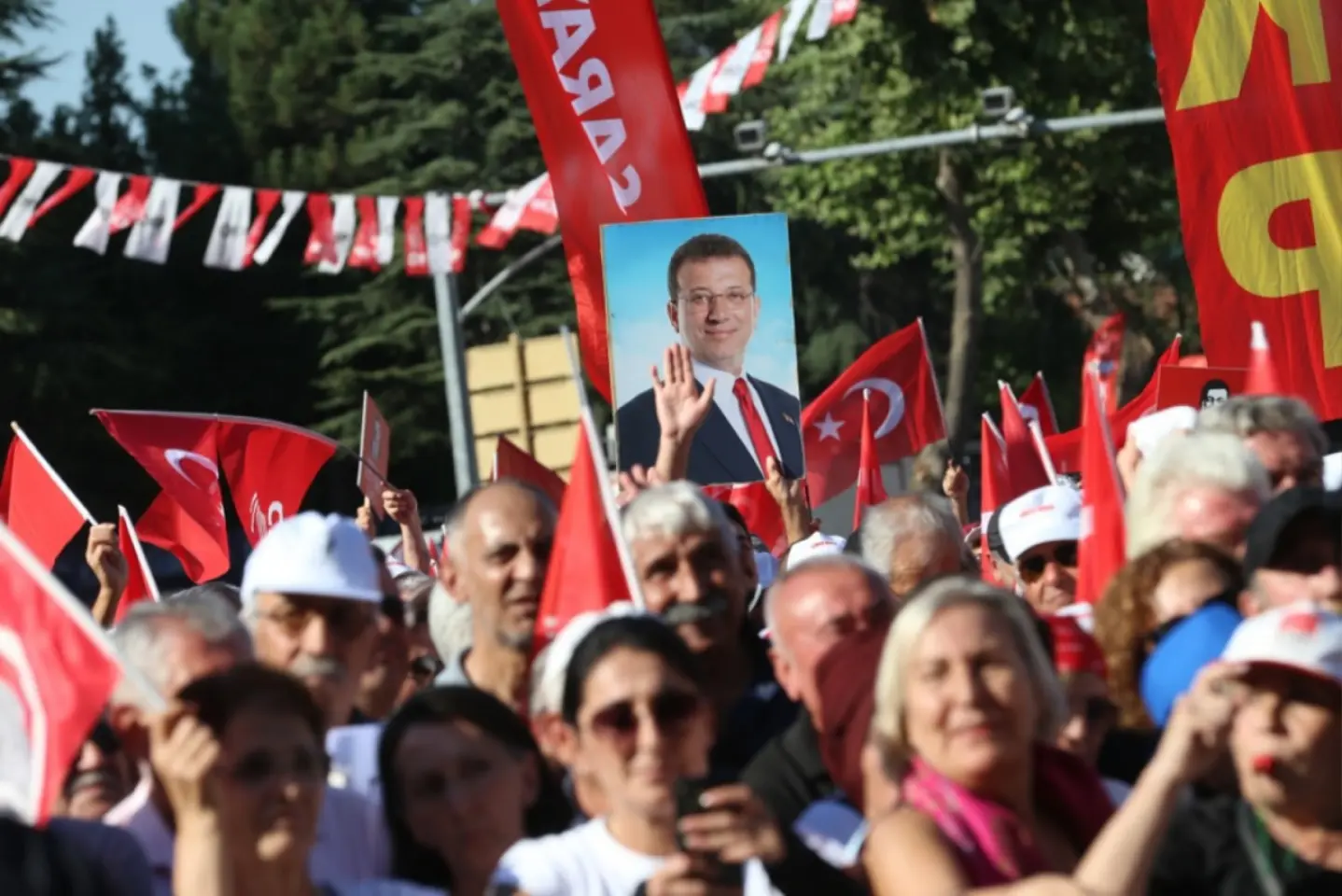
Yavaș won the Ankara mayoralty against his AKP opponent twice, and Imamoğlu won three times in Istanbul. Moreover, the latter had become so popular nationally that he surpassed Erdoğan himself at one point in almost all polls for the presidential elections. Considered by the party and analysts as the ideal candidate of the entire opposition against the current president, Imamoğlu thus represented the first serious threat to Erdoğan after more than two decades of domination in Turkish politics. His arrest in March 2025 marked the beginning of the government's campaign not only against Atatürk's legendary party, but also against what little remained of the secular democracy he had founded.
Ekrem Imamoğlu's arrest was followed by the detention of other CHP officials from Istanbul and the country's third largest city, Izmir, which has never elected an AKP candidate as mayor, remaining loyal to the CHP and Atatürk's secular-republican ideology. The nearly one hundred defendants are now awaiting the court's decisions, but no one doubts that the justice system will work as Ankara dictates.
But the campaign has spread to other cities. On July 5, the CHP mayors of Antalya, Adana and Adiyaman were arrested, Muhittin Böcek, Zeydan Karalar and Abdurrahman Tutdere, all facing the usual corruption charges. The number of those detained varies each week. At the time of writing, with the hunt extended to the Bayrampaşa district of Istanbul, 12 elected and incumbent CHP mayors had been arrested nationwide (including Imamoğlu), and one was under house arrest. Of all those detained in recent months, 13 have already been suspended from office and will be replaced by kayyum, who are government-appointed administrators . But the situation can change from day to day.
Given that all the cases mentioned here concern exclusively the opposition and its local elected representatives, the Council of Europe has taken note, analyzed the situation, and warned that Turkish democracy is under threat. The country is basically going through a systematic anti-democratic process that takes away people's right to pick their own leaders, forcing them to accept people who are either AKP members or just go along with what the Ankara government wants.
Critical voices silenced in Erdoğan's Turkey
I don't think this campaign will stop here because those in power seem to be following political calculations that don't allow for it. Firstly, President Erdoğan's party, the AKP, is steadily losing supporters , while opposition parties, especially the CHP, are gaining more and more. The Turkish president himself is becoming increasingly unpopular, with a recent opinion poll revealing that 67.6% of respondents no longer want him to run in the next election. An overwhelming 90% say that Turkey's biggest problem is injustice, which is precisely the result of the authoritarian policies of the last decade. The irony is that the current government can only remain in power through abuses linked to actions that undermine the opposition, all on the fundamental condition that Erdoğan remains in the highest office in the state.
The next parliamentary and presidential elections are scheduled for 2028. President Erdoğan has already served two terms in office and, according to the constitution, can only run again if parliament is dissolved before 2028 and early elections are called. However, this would be a risky move for a president and government that is losing popularity.
Erdoğan could still run for office if he simply amended the constitution, but to do so he would need the support of two-thirds of parliament, which again would require early elections won by a landslide by the parties supporting the regime, with two-thirds representation in the legislature. The polls do not encourage this option either.
However, the Turkish leader seems determined not to abandon the authoritarian logic of governance. The current goal appears to be the establishment of a state of emergency, as during the failed coup attempt in July 2016, along with the elimination of the main opposition party and symbol of the secular republic, the CHP. Its leader, Özgür Özel, seems to have become the main target. In March 2025, the republic's prosecutors opened a judicial investigation aimed at proving that the 2023 internal vote, through which Özgür Özel and his team took over the leadership of the CHP, had been rigged. Some analysts believe that the Ankara regime is using this court case solely to weaken the main opposition party until it no longer represents an obstacle to the adoption of a constitution that would allow the president to perpetuate his authoritarian rule. But I believe that the aim is rather to eliminate the party once and for all.
Recently, a prosecutor opened a new investigation against Özel, this time accusing him of insulting the President of the Republic in a public speech. The offense is punishable under Article 299 of the Turkish Penal Code. Meanwhile, the case concerning the 2023 CHP internal elections continues. At the hearing on September 15, the Ankara court decided to postpone its decision until October 24. It is very likely that on that day the court will decide to annul the internal elections, thus decapitating the party and replacing the elected leaders with a team of government administrators, the infamous kayyum. For the first time in history, the founding party of the secular Turkish republic would thus be indicted and most likely dissolved through legal proceedings by the same state.
The same logic continues with the arrests of journalists, especially those who report on cases that effectively destroy the opposition or document acts of government corruption. The authorities systematically resort to fines and other sanctions against television channels, radio stations, and online platforms that criticize the government and its policies in any way. In practice, the regime is currently using every means imaginable to silence critical voices in the public sphere, and Turkey has fallen to the bottom of the press freedom rankings.
Atatürk's Republic, in danger of disappearing
The less popular it becomes, the more willing the Erdoğan-AKP regime seems to be to disregard democratic rules, laws, and the realities of the country. The judiciary is systematically used by those in power to eradicate any trace of opposition and political and civil reaction to government authoritarianism. A symbolic example of this came at the end of June, when the Leman newspaper, which is very popular in Turkey, published a cartoon depicting two characters named Mohammed and Moses exchanging pleasantries against a backdrop of bombs destroying a city. This was followed by protests by fanatical crowds manipulated by leaders, protests that caused significant damage in the area where Leman's editorial office is located and left several people injured. However, President Erdoğan and other officials, including Interior Minister Ali Yerlikaya, gave extremely harsh public statements in defense of Muslim religious values.
With such statements, the two effectively forced investigators to take action, condemning not the violent protesters, but those responsible for publishing the cartoon. Its author and three other editors were immediately arrested, marking a new episode in what is becoming a real confrontation between the Ankara regime and Turkish society. The irony is that Turkish society has actually become less religious after decades of conservative policies by the regime. A survey conducted by the prestigious KONDA clearly indicates an increase in the number of atheists and those who do not consider themselves religious, while the number of deeply religious people has decreased significantly. But the powers that be in Ankara cannot back down, because that would mean their disappearance from the political scene and, most likely, subsequent punishment for their error-ridden and, above all, oppressive governance over the last decade.
Now we await October 24 , when a court in Ankara will decide on the future of the main opposition party and, at the same time, on the future of Turkish democracy. If the decision is to annul the CHP's internal elections of 2023, this political entity synonymous with the secular Turkish republic will be decapitated and, most likely, eliminated from the political landscape. Even if the Ankara authorities perceive the episode as a victory, it will in fact represent the defeat of a political idea that is more than a century old. A new Turkish political model will also be inaugurated, in which the regime's power will be virtually unlimited, dominating without restriction the executive, legislative, and judicial branches, as well as civil society. Given that over 90% of the media is controlled by the government, the textbook features of a totalitarian regime are already taking shape, with no obstacles left to stand in the way of governance. And this in a NATO member country, on the southeastern edge of the European Union.