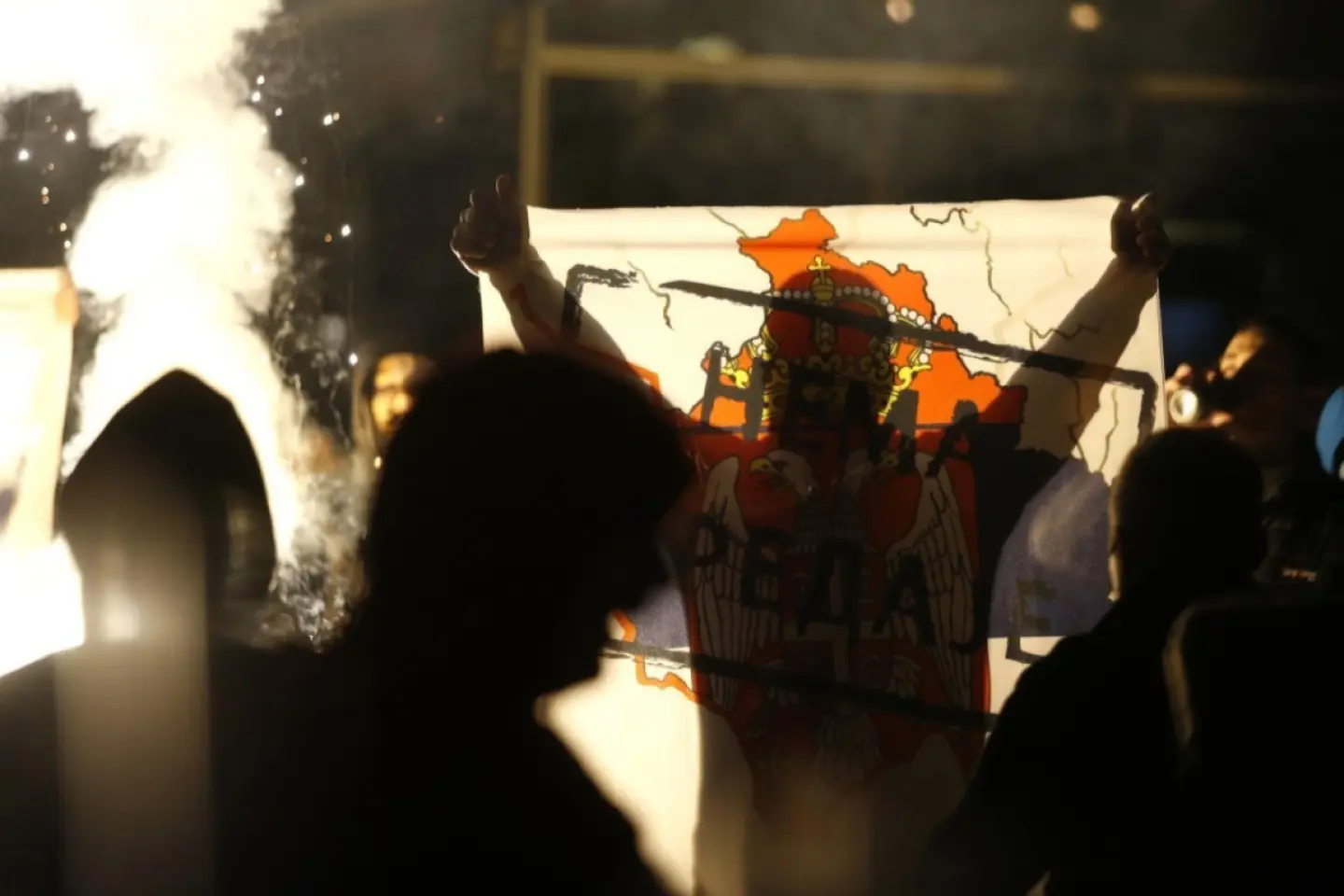
On May 31, 2026, a conference titled "Future of European Nations" was held at the media center of the Serbian Journalists' Association in central Belgrade. The venue lent institutional cover to a gathering of European neo-Nazis and ultranationalists. Speeches were openly anti-European, pro-Russian, anti-migrant, and racist. Participants rejected the independence of Kosovo and accused the EU, the United States, and NATO of various crimes. The organizer was Miša Vacić, leader of the nonparliamentary Serbian Right party, on the US Treasury sanctions list since 2023 for "malign activity" on Russia's behalf. His designation came after he served as an observer at Russia's sham referenda in September 2022 preceding the illegal annexation of four Ukrainian regions, at Putin's personal invitation.
The Congress in the Imperial Capital
The meeting had a specific genealogy, traceable to eight months earlier. On September 12, 2025, the Mariinsky Palace in St. Petersburg hosted an international congress of neo-Nazi and far-right organizations under the patronage of Konstantin Malofeev, a self-styled "Orthodox" billionaire accused of fraud and cryptocurrency theft, who had previously financed armed militants led by Igor Girkin in Crimea and then in the Donbas in 2014. Alexander Dugin, whose writings have informed Russia's imperial ideological project for three decades, opened the proceedings alongside him, preceded by a mass religious procession through the city led by Patriarch Kirill. The outcome was the founding of the International Sovereigntist League "Paladins," named after a paramilitary organization created by former SS officer Otto Skorzeni, responsible for kidnappings, assassinations, and a terrorist attack at Rome's Fiumicino airport that killed 32 people. The founding declaration specified mutual support in legal and financial matters between member organizations. Delegates from 20 organizations in 14 countries attended, among them Italian neo-fascists, Spanish neo-Nazis, Hungary's 64 Counties movement, and two Serbian organizations. Among the most prominent foreign attendees was Yvan Benedetti, who leads both the French movement Les Nationalistes and the Belgian group Nation. Expelled from Marine Le Pen's National Front for antisemitism, Benedetti has been convicted multiple times for Holocaust denial and in 2024 traveled to Novosibirsk to serve as an observer for Russia's presidential election, publicly praising the conduct of a vote widely documented as falsified.
Who Was in the Room
The most prominent speaker at the Belgrade conference was Roberto Fiore, founder of the Italian neo-fascist party Forza Nuova, which had participated in the St. Petersburg congress remotely. Forza Nuova was founded in 1997. However, Fiore’s story goes a long way back before that moment: in 1980, following an investigation into the Bologna railway station bombing that killed 85 people, he had fled to London where he spent nearly two decades there before returning to Italy. Forza Nuova has never achieved serious parliamentary representation but is known for street violence, its activists' participation in the 2021 storming of Italy's largest trade union offices, and members fighting on the Russian side in Ukraine after 2022.
Another participant was Gonzalo Martín, vice president of Spain's neo-Nazi Democracia Nacional. Martin had also been photographed in St. Petersburg eight months earlier. Ioannis Zografos of K-21, formed after Golden Dawn was declared a criminal organization in 2020 following the murder of anti-fascist musician Pavlos Fyssas, also spoke. Pavle Bihali of the Leviathan and Fortis movements rounded out the Serbian contingent at the podium.
The Regime Connection
The Belgrade conference required institutional tolerance at every level, and that tolerance has a documented structure. Miša Vacić founded his Serbian Right party in January 2018 with a public statement pledging support for President Vučić's initiative on Kosovo. The party promptly received access to pro-government tabloids and television channels, shared in Serbia only by the SNS and its formal allies. Vacić was, before founding the party, employed at the Government Office for Kosovo and Metohija. His 2023 US Treasury sanctions designation produced no public distancing from Belgrade. Goran Davidović, known as "Führer" and leader of the National Alignment banned by Serbia's Constitutional Court in 2011 for its neo-Nazi platform, co-organized the Belgrade conference without legal consequence. Convicted in absentia for organizing racist violence in Novi Sad, he fled to Italy, returned in 2019 after the Belgrade Court of Appeals overturned the conviction, and has been publicly active since.
Analysts and former movement members have documented the function these organizations serve: generating street-level pressure the government can disavow while benefiting from, and providing the SNS with a radical flank that makes the ruling party look like the reasonable option by comparison. Bihali's place at the conference podium illuminates one side of that arrangement. A former Leviathan member, Boris Knežević, stated on record that Bihali boasted of a direct personal relationship with Aleksandar Vulin during Vulin's tenure as Interior Minister, saying Vulin was "his man" in government. Vulin, now director of the BIA security intelligence service, attended the founding ceremony of the Russian Historical Society's Serbian branch alongside SVR Director Sergei Naryshkin. A conference speaker on familiar terms with the interior minister, who in turn shares a ceremony with the head of Russian foreign intelligence: these are not separate biographical facts.
Serbia in the Room
The two Serbian organizations at the St. Petersburg congress were Srbska Akcija and Narodna Patrola. Srbska Akcija openly glorifies Dimitrije Ljotić, the WWII-era collaborator who led the pro-Nazi Serbian Volunteer Corps under German occupation, and promotes a "national-social order" of strong authoritarian power and Orthodox monarchy, paired with a declared strategic alliance with Russia and Belarus. Narodna Patrola organizes anti-migrant street patrols and attacks on people of Middle Eastern or African appearance, framed as "protecting Serbian streets." Its representative at St. Petersburg, Damjan Knežević, organized pro-Russian rallies in Belgrade in March 2022, told one crowd that "every Serb has Russian brothers," visited the Wagner Center in November 2022 with a flag reading "Donbass is Russia, Kosovo is Serbia," and traveled to Donbas on a "humanitarian mission" in August 2023.
The two organizations had been operationally active within the network well before September 2025. In April 2025, Malofeev's Academics Brotherhood reported a joint action framed as "support for Syrian Christians" in which Srbska Akcija and Narodna Patrola participated alongside Golden Dawn's youth wing, Les Nationalistes, Hungary's 64 Counties, and groups from South Africa, Argentina, Spain, and Italy. A follow-up "joint action against migration" took place in May 2025 with the same core partners. The St. Petersburg congress formalized a structure that had already been rehearsed.
The AfD Thread and the Logic of the Infrastructure
Germany's AfD expelled Hamburg lawmaker Robert Risch from its parliamentary group after he was photographed at the St. Petersburg congress seated behind a nameplate reading "Germany," alongside former AfD lawmaker Olga Petersen, now resident in Russia and previously expelled from the party after serving as an observer at Russia's 2024 presidential election. Risch claimed accidental attendance. The organizers had blurred his face in most photographs. The face-blurring captures the political calculation of the European mainstream far right toward these networks: too useful to abandon, too toxic to own in public. Electoral clout is beside the point here.
What the network provides is operational infrastructure, activists fighting in Ukraine alongside Russian forces, shared messaging platforms, joint street operations across multiple countries, and legal coordination between groups banned in some jurisdictions and tolerated in others. Hungary under Orbán, which distributed over 1.1 million euros in public funds to Western far-right propagandists in 2025, provided the financial dimension of this international. Belgrade provides something else: the freedom to operate without legal interference. The Malofeev Black International has been running since 2014. Serbia's far right was embedded in it years before anyone drafted a founding document. Belgrade in May 2026 only confirmed what the joint operations of April and May 2025 had already made visible.