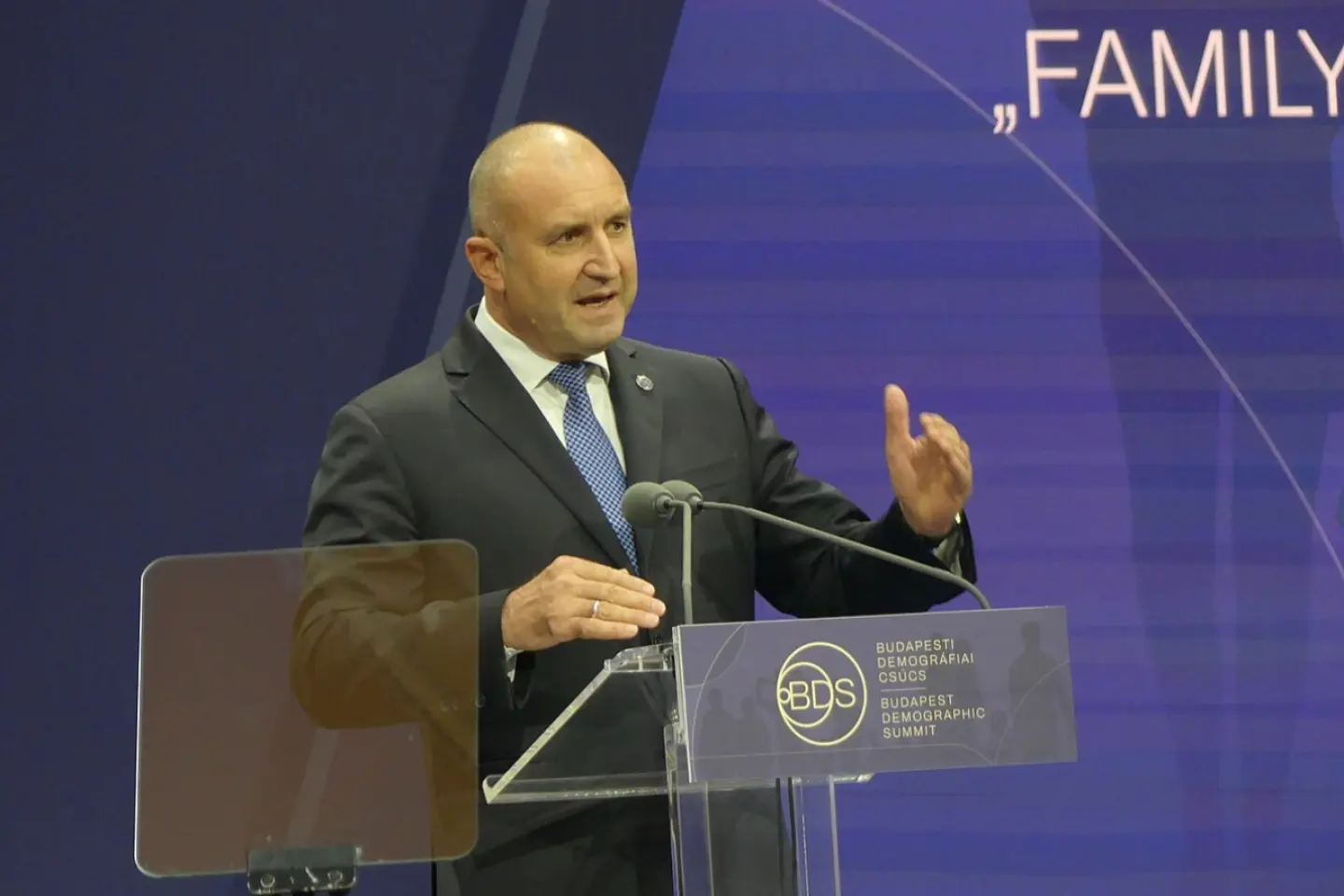
The political landscape in Bulgaria is about to change: 2016-2025 President Rumen Radev resigned from office in January fueling rumours about his future and possibly launching a political vehicle of his own. Even before he officially announced his party, he was already polling as a first power on the April 19 snap elections, well-ahead of dominant centre-right populists GERB and the country’s main pro-EU opposition We Continue the Change / Democratic Bulgaria. This created an odd local media environment in which a party whose existence was not confirmed was widely discussed and analysed.
Even in his only major interview, for Bulgarian National Television, on January 30, Radev declined to confirm moving his otherwise obvious ambitions to the parliament.
No campaign, all gain: why keeping out of the public’s eye worked to Radev’s advantage
It wasn’t until the middle of March that Progressive Bulgaria’s name was revealed, alongside some of its members: some of them previously close to Radev (such as former interim Prime Minister Galab Donev), several military experts, former Bulgaria Socialist Party members (currently a fading force but formerly supportive of Radev), local business owners inside the country. All largely unknown for the public eye with the exception of several celebrated sports figures, likely compensating with their positive image for the lack of solid politicians: among them, 26-years old Ivet Goranova, a 2020 Olympic winner in women’s karate, world volleyball champion Vladimir Nikolov, long distance swimming champion Petar Stoychev, and gymnast Yordan Yovchev, who competed in six consecutive Olympic games.
In contrast to its left-leaning name, the statements and ambitions that Progressive Bulgaria showcased sounded more right-wing, open market and business-orientated rather than anything to deal with Bulgaria’s position amid the brewing military conflicts and inequality.
Radev hasn’t done any live or media appearances after the official presentation. Instead, some of the newly announced members took the hold: “My political beliefs are very much far into the right”, said former volleyball star Vladimir Nikolov in a TV interview on March 19, one of his first as a political runner. “I want Bulgaria to have its own opinions and lead its own politics about where Europe should go rather than wait for what Merkel orders us”, said Nikolov despite Angela Merkel not being in power as Chancellor of Germany since 2021.
Another curious move by the former President is that when officially announcing his party with a live event on March 19, he completely strayed away from his usual nationalist-prone, Euroskeptic tone, did not criticise Bulgaria’s recent euro adoption – a usual part of his agenda – but spoke about its perspectives, and hardly mentioned the war between Russia and Ukraine.
Radev also remained silent about the group murder-suicide in Bulgaria’s mountainous North-West which created a wave of media speculations and unanswered questions about the authorities’ response and doubtful investigations – another instance where silence works for him.
After securing the pro-Russian vote, Radev is wooing the pro-Europeans
While it’s too early to tell whether Radev is experimenting with a pro-EU makeover to win centrist and pro-EU voters, but such a move would make sense, given the fact that he secured a significant part of the pro-Russia vote, taking away huge chunks from the electoral base of the socialists, far-righters Revival and smaller factions (which would also make for a tighter parliament in the later spring).
On March 23, Trend agency released a survey predicting a 30.1 per cent turnout for Progressive Bulgaria, followed by GERB (19.7), We Continue the Change / Democratic Bulgaria (11.8), New Beginning (10.5), tied to oligarch Delyan Peevski and Revival (7.9). However, a different survey, by Alpha Research, predicts a shorter, nine percent distance between Radev’s Progressive Bulgaria and Boyko Borissov’s GERB.
On GERB’s side, the campaign has also been a curious one: Boyko Borissov, Bulgaria’s three time Prime Minister, has been engaging in interviews for the first time in years, including speaking to outlets who have long been critical of his party. However, both Borissov and Radev are yet to participate in a TV debate.
(In)visible rivalry on the social media
Outside of the traditional media realm, things are different for Radev’s project.
On March 30, media monitoring agency Sensika issued a report on how various Facebook groups - some used for entertainment and humour, others to promote previous campaigns for other political figures - are now being renamed and rebranded to promote Radev’s party.
According to the report, on Facebook, the thirty largest pro-Radev groups reveal over 1.3 million memberships, representing an estimated 400,000 to 600,000 unique users (the true figure is certainly higher if we take into account groups with lower membership). Some groups are growing by four to six thousand members per week and publishing between seventy and one hundred and thirty posts per day. Meanwhile, GERB’s thirty largest groups similarly exceed 400,000 to 500,000 unique users in membership, but the network grows at a fraction of the pace of Progressive Bulgaria’s.
The disparity is sharper on TikTok. The hashtag #rumenradev has accumulated 90.4 million views across 2,700 videos, growing at over sixty times the rate of #gerb and twenty times that of #vazrazhdane, the hashtag associated with the far-right Revival party. Radev-linked hashtags are the only political hashtags showing sustained momentum: a 326 per cent increase in views and 369 per cent growth in video output over two months. “No other political actor comes close”, the report finds.
A breezy win won’t bring a sudden change
Even if Progressive Bulgaria debuts straight to the top of the popular vote, it remains unclear what coalition partner it would choose - the same question has loomed over every snap election in Bulgaria since 2021, which has only yielded a succession of interim cabinets and two short coalitions carved out by We Continue the Change.
Since the beginning of the decade, Radev was in an open fire with GERB and Boyko Borissov, later to support We Continue the Change’s fast rise in 2021 and then to intensively criticise them after the beginning of the invasion in Ukraine and grew neutral to GERB. Parties he was close to in other moments - Bulgarian Socialist Party and nationalists There’s Such a People - are now fading and might not even reach the four per cent threshold to enter the parliament.
Radev has navigated Bulgaria's chaotic political landscape with characteristic selectivity: dipping in just enough, and quietly swapping his pro-Russia sympathies for the cleaner technocratic vocabulary.
But his long-running double game with the country's other main political players is about to face a real test. Should a new cabinet emerge, it will almost certainly be another coalition of forces currently swearing, with conviction that they will never work together again.