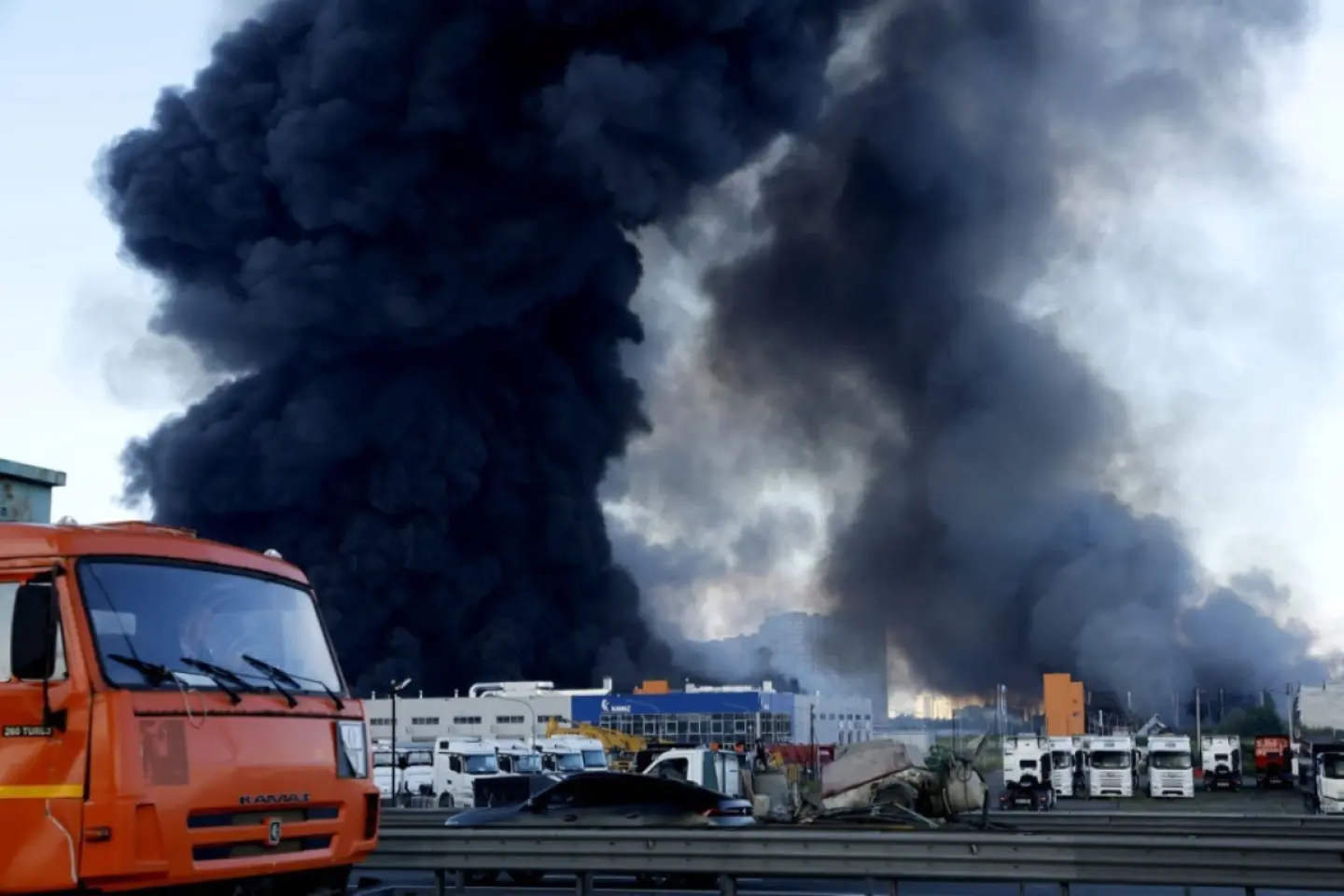
On June 25, Volodymyr Zelenskyy announced a forty-day operation intended to “influence the aggressor state” and increase pressure on Moscow to end the war. Its logic is cumulative: Ukrainian drones and missiles are attacking refineries, oil depots, transport routes, warehouses and other infrastructure that allows Russia to wage war while keeping most of its society at a distance from it. The strikes have not changed the Kremlin’s public rhetoric. They are, however, exposing the growing economic cost of Russia’s strategy and bringing closer a choice Moscow has tried to postpone: deepen the mobilisation of the economy and society, or begin sacrificing some of its political and territorial ambitions.
The war is no longer waged only on a distant frontline: it has reached Russia
For much of the war, one of Russia’s main structural advantages was geography. During the Second World War, the Soviet Union moved industrial facilities eastward, creating a deep rear in the Urals and Siberia that Germany could not reach. Modern Russia relied on the same assumption: distance could protect production and logistics.
That assumption is now being challenged. In June, Ukraine struck refining facilities in the Tyumen region, more than 2,000 kilometres from Ukrainian territory. On July 6, drones reached the Omsk refinery, Russia’s largest, approximately 2700 kilometres from Ukrainian-held territory. The precise damage remains disputed, but the strategic message was clear: even Siberia can no longer be treated as an automatically secure industrial sanctuary.
This changes the economics of protection. Russia cannot place modern air-defence systems around every refinery, oil depot, railway junction and warehouse across eleven time zones. Each protected facility means fewer systems available elsewhere. Even intercepted drones impose costs through disrupted production, emergency work and the need to disperse equipment and personnel.
Drones as economic sanctions
Ukraine has described its strikes as “long-range sanctions.” The expression is more than propaganda. Traditional sanctions reduce access to markets, finance and technology from outside. Drone strikes can create a similar restriction from inside the production system by making facilities unavailable, forcing repairs and raising the cost of maintaining output.
A July 2026 study of 29 large Russian refineries found verified direct hits on 22 of them between June 2022 and May 2026. Satellite data indicated a persistent decline in nearby economic activity after strikes, not only a spectacular fire. The findings suggest that industrial damage can have lasting local consequences, including environmental costs that have so far received little attention and remain largely unassessed.
The fuel crisis shows how this pressure multiplies. By mid-July, Russian authorities were prioritising fuel for vehicles delivering food to major retail chains while trying to secure diesel for agriculture. Reuters reported that petrol output had fallen to a level equivalent to only around 65% of average seasonal consumption following Ukrainian attacks on major refineries. A problem that began at refineries was moving into farming, freight transport, retail and consumer prices.
More expensive fuel raises harvesting and transport costs. Logistics companies pass those costs to retailers. Taxi and delivery services become more expensive or less available. Small businesses have less room to absorb the shock than state corporations, which are more likely to receive preferential access to scarce resources. The state can still protect selected strategic users, but every priority leaves another sector exposed and unprotected.
This is creating a new reality for Russian households and businesses, in which the authorities increasingly acknowledge that they cannot provide uniform protection across the country and are transferring part of that responsibility to companies themselves. Private security organisations guarding critical infrastructure have been authorised to receive combat firearms, while businesses can finance anti-aircraft weapons, radar and electronic-warfare systems for mobile defence groups made up of reservists, volunteers and employees of the enterprises concerned.
The message is becoming increasingly difficult to conceal: the state will defend what it regards as indispensable, while businesses and local communities are expected to assume more of the cost and risk of protecting everything else.
From military logistics to civilian business
The campaign has also expanded beyond energy. Ukrainian strikes in July hit major Wildberries warehouse facilities in several Russian regions. Kyiv said the sites were linked to supplies of drone components and navigation equipment; Russian officials reported deaths and dozens of injuries. The attacks demonstrated the blurred boundary between wartime and civilian logistics.
A large warehouse connects producers, sellers, transport companies and consumers. When such a hub stops operating, losses spread through delayed payments, undelivered goods and interrupted cash flow. Large platforms can reroute operations; small suppliers may not. Repeated disruption can therefore become a credit problem—not because one warehouse determines the national economy, but because it supports thousands of smaller economic relationships.
Crimea provides an even clearer example. Ukrainian attacks on energy, transport and fuel infrastructure have caused electricity, water and petrol disruptions and forced occupation authorities to introduce emergency measures. The peninsula is both a military platform and a territory Moscow must supply and subsidise. Pressure on transport links complicates military logistics while making Crimea harder to present as a normal, secure part of Russia.
This matters politically because, for much of the Kremlin’s loyal electorate, the annexation of Crimea was presented as the defining achievement of the post-2014 era. The peninsula’s growing vulnerability therefore resonates far beyond Crimea itself, raising an uncomfortable question across Russia: if Moscow cannot reliably protect its most symbolically important territorial acquisition, what can residents of less strategically important regions expect?
The limits of Russia’s two-circuit economy
None of this means Russia is close to economic collapse. The Kremlin still has energy-export income, taxation powers, domestic borrowing and administrative control. A more accurate description is an economy divided into two circuits. The first consists of defence production, military logistics and sectors supported by state orders. The second is the civilian economy, which faces expensive credit, weaker investment and competition with the military sector for labour, technology and budget funding.
Even the Bank of Russia describes increasing differences between sectors. Government demand remains strong, while room for private investment and consumption is more limited. The fiscal position is narrowing as well. Russia recorded a federal budget deficit of 5.73 trillion roubles in the first half of 2026, while the full-year deficit was expected to exceed the original plan. Liquid assets in the National Wealth Fund stood at 3.61 trillion roubles on July 1, equivalent to 1.5% of projected GDP. These figures do not imply insolvency, but each new shock now arrives when the government has less room for manoeuvre.
Russia can respond by raising taxes, borrowing more, reducing civilian expenditure or tolerating higher inflation. It will probably combine all four. Yet each solution transfers the cost away from the Kremlin and toward households, regions and private business. This is the real meaning of Russian resilience: not the absence of damage, but the state’s ability to decide who absorbs it.
Mobilisation would be the next threshold
This is why another broad mobilisation is primarily an economic and political question, not merely a military one. Russia’s labour market remains tight, with unemployment near historical lows and wages still growing faster than productivity. The war, emigration and defence-sector recruitment have already removed workers from civilian industries.
A new mobilisation would take more workers from transport, construction, agriculture, manufacturing and services. It would require additional payments, equipment and support for enterprises losing personnel. It could also trigger another wave of emigration among younger and qualified Russians.
The Russian economy could probably survive such a transition. Survival, however, is the wrong standard. The important question is whether the Kremlin can make it without undermining the model it has maintained: war for the state, but relative normality for most citizens.
That model is under pressure from both directions. Ukraine’s campaign raises the cost of continuing the war at its present intensity. Mobilisation would raise the cost of escalation. Negotiations, meanwhile, would require Moscow to retreat from claims it has presented as non-negotiable.
The choice can be postponed, but not avoided
Zelenskyy’s forty-day campaign is unlikely to force Russia into negotiations by a predetermined date. States rarely abandon major war aims because of a single campaign, and the Kremlin has invested too much political capital in presenting compromise as weakness.
Its importance lies elsewhere. It is reducing the distance between the war and the Russian economy. It is showing that refineries in Siberia, warehouses near Moscow, regional fuel supplies and civilian life in occupied Crimea can all become part of the battlefield. It is forcing the Kremlin to spend more merely to preserve the stability it previously took for granted.
For now, Moscow appears to believe it can continue adapting by protecting priority sectors, redistributing shortages and sacrificing future growth. This is not a solution so much as organised procrastination. The longer the pressure continues, the clearer the underlying choice becomes. Russia must either move further toward a fully mobilised war economy, with greater control and greater civilian sacrifice, or seek a settlement in which it gives up something the Kremlin currently describes as its own.
The forty-day campaign has not made that choice for Russia. It has made postponing it more expensive.