Erdoğan’s ally in Northern Cyprus has suffered a crushing defeat in the presidential election – a clear sign that Turkish Cypriots no longer support Ankara’s regional policies, at a time when those policies are also being challenged by the growing interest of the United States and other powers in the Eastern Mediterranean.
Northern Cyprus, Turkey’s Mediterranean ambitions and Ankara’s disputes with Greece and Israel
Following the conflicts between Turks and Greeks in the 1960s and 1970s, the island of Cyprus remains divided to this day. From the perspective of the international community, there is only one state – Cyprus, a member of the European Union. In practice, however, there also exists the Turkish Republic of Northern Cyprus (TRNC), recognized only by Turkey and separated from the rest of the island by a buffer zone – the so-called Green Line – monitored by the United Nations.
TRNC was founded in 1983, nine years after the Turkish army invaded Northern Cyprus. Once its troops took control of the territories home to large concentrations of Turkish Cypriots, Ankara started building strategic military facilities and expanding its security footprint. This process gained momentum especially after January 2002, with the rise to power of the AKP party and Recep Tayyip Erdoğan. Now, amid growing regional rivalries, Turkey is raising the stakes even higher. It plans to increase its troop presence from roughly 40,000 to around 100,000, supported by logistics and weaponry including artillery, advanced rocket systems, drones and armored units. Such a buildup sends a clear message to neighboring states – particularly Greece and Israel – that the island of Cyprus is a major strategic outpost under the aggressive “Blue Homeland” doctrine, by means of which Turkey appears intent on asserting its dominance in the Eastern Mediterranean.
Turkey’s relations with Greece have always been marked by friction and periodic tensions that have not disappeared even after both became members of NATO. Relations with Israel deteriorated with the AKP’s rise to power – the party showing openness toward Hamas (ideologically related to the Muslim Brotherhood, with which Ankara seeks closer relations) and voiced strong support for the Palestinians in Gaza. The war waged by Netanyahu’s government in the enclave following Hamas’s October attacks turned Israel into a favorite target of Ankara’s increasingly virulent rhetoric. A rivalry between the two actors now seems to be taking shape – one that could quickly and dangerously expand westward from Syria. That “West” is now the Mediterranean maritime zone, rich in already confirmed natural gas reserves. The area is gaining further importance because it hosts major trade and logistics routes between Europe and Asia, beyond China’s Caspian–Black Sea trade corridor. And Cyprus lies at the center of this web of regional interests and global opportunities.
In this context, an important pillar of Turkey’s aggressive strategy toward Greece, Israel, and other regional rivals had long been the support of Turkish Cypriots in the north.
However, on Sunday, October 19, 2025, these Turkish Cypriots dealt a resounding blow to Ankara’s authoritarian policies and its confrontational regional strategy.
Turkish Cypriots refuse to play Erdoğan’s game and opt for reconciliation
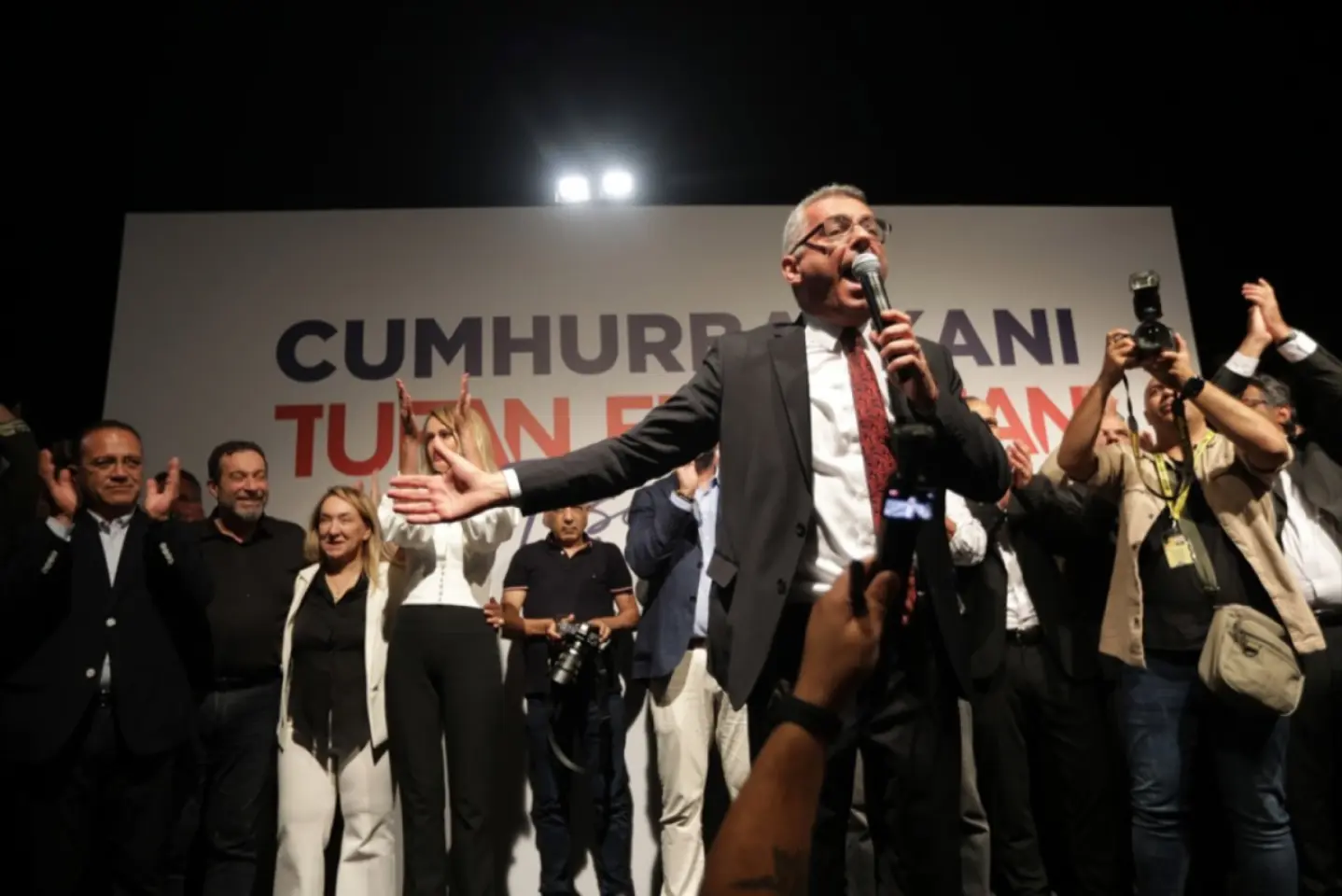
Ersin Tatar, Erdoğan’s man in Northern Cyprus, sustained conceded bitter defeat to his challenger – the moderate center-left politician Tufan Erhürman – who won nearly 63% of the vote, while Tatar barely surpassed 35%.
Tatar, who had served as president of TRNC since 2020, followed a series of more moderate leaders who had generally supported the UN’s plan to reunify the island as a federal state. Tatar had always vehemently opposed that scenario, instead promoting the idea of full Turkish sovereignty under a two-state formula. This option (which was unacceptable to the Greek majority on the island, as well as to Greece, the UN and the EU) fully matched Ankara’s regional ambitions. It ensured the permanence of an ever-expanding Turkish military presence in the north, turning it into a vast fixed aircraft carrier from which the authoritarian regime in Ankara could intimidate anyone opposing its regional designs.
The moderate victor thus replaces Erdoğan’s intransigent ally as the representative of Turkish Cypriots, both in negotiations with the island’s official government, currently led by Nikos Christodoulides, and in international forums where such talks are held. The framework for these discussions remains that outlined by all relevant UN Security Council resolutions, namely a federal solution to the Cyprus issue. It should be noted that Ersin Tatar’s obstinacy and unremitting plea for a two-state formula, a Turkish state and a Greek one, caused the dialogue to break down 2017. This is where Erhürman must resume talks with the president of the Republic of Cyprus, Christodoulides. The latter congratulated the new Turkish Cypriot leader on his electoral victory and firmly expressed his willingness to restart negotiations.
Erhürman’s victory clearly signals that Turkish Cypriots are no longer willing to support president Recep Tayyip Erdoğan’s henchman or his policies in TRNC. Although Erdoğan himself congratulated the winner, Erhürman’s victory is bitter for Ankara. The latter’s insistence on building mosques with funds that could have been used for other community needs caused particular resentment. However, Turkish Cypriot opposition to Ankara’s domineering attitude under Erdoğan is not necessarily new. What started as teachers and students protesting the Erdoğan–Tatar brand of moral conservatism eventually turned into broad public opposition to Ankara’s latest project – a Turkish-funded presidential complex in Northern Cyprus, carefully modeled to mimic the colossal palace built in Ankara for Atatürk’s self-proclaimed heir.
Later came journalists’ protests against censorship inspired by Turkish authoritarianism, compounded by the impact of several crimes and revelations, shedding light on the deep roots of Turkey’s intelligence services and mafia networks in Northern Cyprus – a region that has become a haven for illegal business and various forms of organized crime. Public outrage reached a boiling point in July 2025, when a letter signed by Turkish members of the “Cypriots for Peace and Solidarity Movement” was addressed to president Christodoulides, accusing the Turkish administration in the north of serious human rights violations. In doing so, Turkish Cypriots effectively acknowledged Christodoulides as the legitimate authority. Erhürman’s victory on Sunday thus crowns years of accumulated anger against Ankara’s authoritarian and conservative arrogance, especially against those opposing the unification of the island into a federal state with broad autonomy for both communities.
Ankara’s plans, threatened by the growing interest of other actors in Cyprus and the Eastern Mediterranean
The developments in Northern Cyprus come at a time when the island’s growing significance is starting to influence the regional strategic game of power – a game with global implications that is drawing in actors far more powerful than Turkey. Earlier this year, the United States has started exploring ways to capitalize on the island’s strategic position in relation to the Middle East and Eastern Mediterranean, particularly as its bases in Arab countries (especially the Al-Udeid air base in Qatar) have become more relevant than İncirlik in Turkey. Furthermore, Britain’s two bases in southern Cyprus have been heavily used for strategic strikes and transport missions in Gaza, Syria and Iran, apparently providing crucial logistical support for Israel and US forces. Beyond the sensitive issue of security, particularly in today’s regional context, the Republic of Cyprus is also emerging as a strategic hub for major logistical, commercial and energy transfer routes connecting India and Southeast Asia (all boasting huge potential) to Western markets, especially in Europe and North America.
Under these circumstances, it was hard to imagine how Turkey was hoping to block regional and global development plans backed by actors far stronger than itself, merely by supporting an unpopular regime in Northern Cyprus and the “solution” of two independent states on the island. On the contrary, Sunday’s presidential election results and Tufan Erhürman’s landslide victory suggest that Turkish Cypriots now favor swift negotiations toward federalization, whereby they would no longer be vulnerable to Ankara’s detrimental influence. Once a peace treaty is concluded and a federal Cypriot state with broad autonomy for both communities is established, that state will automatically become a full member of the European Union. It will then be up to Ankara to decide how it wishes to position itself in relation to the new reality in the Eastern Mediterranean.
Friction is expected to continue regarding the delimitation of exclusive economic zones and sovereign rights over natural gas reserves, as well as influence in Syria. It is hard to believe that Israel would simply allow Sunni Turkey to replace Shiite Iran as its main adversary. Nor is it likely that the Sunni Arab monarchies (especially the United Arab Emirates, Saudi Arabia or Qatar) would tolerate regional turmoil that could restrict their access to the European single market or to North American markets.
The Republic of Cyprus lies at the very junction of the region’s most coveted zones of influence and the corridors that connect them, a position that makes the stakes enormous for every major power. As I cautioned months ago, Turkey is fast writing itself out of the regional script, as long as its leadership doubles down on authoritarian decay and keeps antagonizing every initiative that actually attracts serious regional and global attention. The outcome of Northern Cyprus’s presidential elections merely confirms this trajectory.