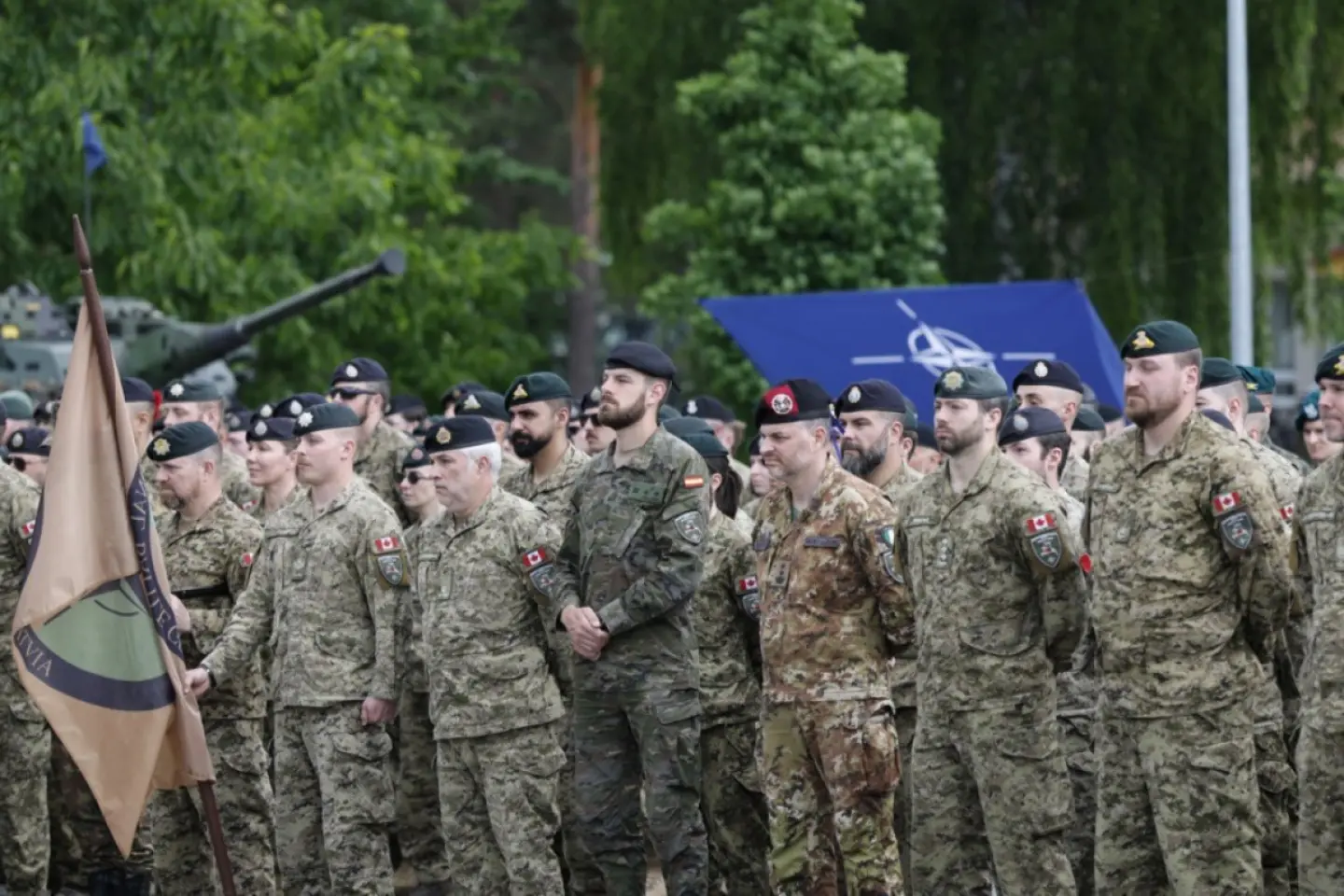
The West is artificially prolonging the war in Ukraine in order to push Russia toward a direct military confrontation with NATO, which only the defeat of Kyiv can postpone, pro-Kremlin media writes. This is a new attempt by propaganda to scare the West so that it stops supporting Ukraine.
NEWS: If military actions in Ukraine continue for another year or two, a confrontation with the West will become inevitable. But if Russia manages to inflict a serious defeat on Kyiv in the coming months, the conflict with NATO will be postponed for decades, the retired lieutenant general of the Foreign Intelligence Service of the Russian Federation, Leonid Reshetnikov told an interview for Ukraina.ru.
The journalist asked Reshetnikov if a direct military confrontation between Russia and a united Europe is inevitable. The expert replied that if military actions in Ukraine continue for another year or two, then a real confrontation with the West on the battlefield can no longer be avoided.
“Their mission is not to break into Donetsk tomorrow, and Voronezh the day after tomorrow. They rely on the continuation of a viscous conflict for another two or three years”, Reshetnikov explained. If Russia manages to force the Ukrainian regime either to surrender or to liberate a significant part of the territory in the coming months, that is, to inflict a serious defeat, then the conflict with the West will be postponed for decades.
NARRATIVES: 1. The West prolongs the war in Ukraine to provoke a direct military confrontation with Russia. 2. Russia can avoid a war with NATO only if it quickly defeats Ukraine. 3. Kyiv's capitulation is a peace solution.
PURPOSE: To shift the responsibility for the war from Russia to Ukraine and the West. To justify the continuation of the invasion and the intensification of Russian military operations. To present Ukraine's capitulation as the only acceptable form of peace. To spread fear regarding an inevitable war with NATO. To legitimize Russian aggression through a false preemptive scenario.
Fact: The war can stop at any time if Russia withdraws its troops
WHY THE NARRATIVES ARE FALSE: The narrative promoted by Ukraina.ru reverses the relationship between the aggressor and the victim. Ukraine is not waging a war of expansion against Russia, but is defending itself against an invasion. The West did not unleash the war, but supports an attacked state, according to its right to self-defense.
The UN General Assembly condemned Russia's aggression against Ukraine and called on the Russian Federation to cease the use of force and to immediately, completely and unconditionally withdraw its troops from Ukrainian territory. Before the invasion of February 2022, Western leaders tried to avoid war through diplomatic dialogue. For example, Emmanuel Macron had several round of talks with Vladimir Putin. France proposed several formulas for de-escalation. Putin was asked not to choose the path of war, invasion, bombings and the killing of civilians.
The war was not a consequence of Western policy, but the result of a political decision made in Moscow. The crimes committed in Bucha, Irpin, Hostomel and other settlements became evidence of the brutality of the invasion, while international experts helped the Ukrainian side document war crimes and possible crimes against humanity. The European Parliament declared Russia a state sponsor of terrorism, citing deliberate attacks against civilians.
At the same time, the International Criminal Court issued an arrest warrant for Vladimir Putin for the war crime of illegal deportation of Ukrainian children from the occupied territories. Therefore, international legal responsibility targets the Russian leadership, not Ukraine or the West.
The name of Leonid Reshetnikov, a former lieutenant general within the Foreign Intelligence Service of the Russian Federation, is used to create the illusion of authority. However, his arguments are based on assumptions, not evidence. He states that a war with NATO can be avoided if Ukraine is quickly defeated, but it is precisely Ukraine's defeat that would bring Russia-controlled borders closer to EU and NATO member states.
The idea that a Russian victory in Ukraine would bring stability for decades is false. Western analyses show that Russia aims to revise the security order in Europe, and an eventual collapse of Ukraine would increase pressure on NATO's eastern flank, including on Central and Eastern European states. In this logic, it is not the defense of Ukraine that increases the risk of a broader conflict, but the success of Russian aggression.
Reshetnikov uses the notions of “the West”, “united Europe”, and “NATO” in a confusing way. It is not clear whether by “united Europe” he means the EU, European NATO member states, the ensemble of Western democracies or an imaginary geopolitical construct. Mixing these terms is not accidental. It allows propaganda to transform a vague opponent, generically called “the West”, into a total and permanent threat to Russia.
Russia has already been in a hybrid conflict with Western states for several years. This conflict, however, was not triggered by the West, but is fueled by Moscow through military, informational and economic means. Disinformation campaigns, cyberattacks, sabotage, pressure on critical infrastructure and attempts at electoral interference are part of the same arsenal. Western services have also documented arson operations, attacks on infrastructure and the recruitment of intermediaries for sabotage actions. At the same time, Russia uses military threat and nuclear rhetoric to intimidate states supporting Ukraine, while Russian drones and missiles have reached the territory of some EU and NATO states. Thus, propaganda reverses responsibility: it presents the West as the source of escalation, although Russia has constantly expanded the war beyond the Ukrainian front.
The West does not rely on prolonging the conflict, but on stopping the aggression without rewarding the invader. A peace achieved through Ukraine's capitulation, the recognition of illegal annexations and the elimination of the political leadership in Kyiv would be a validation of aggression and would represent a risk of encouraging new aggression. Western military support reduces Russia's capacity to bomb cities, occupy new territories and kill civilians.
Russia has repeatedly rejected various formulas for a ceasefire or negotiations that do not start from Ukraine's capitulation. In 2026, Vladimir Putin refused the proposal for a meeting with Volodymyr Zelenskyy and reiterated the idea that the war will continue until Russia's objectives are achieved. Moscow is not seeking a negotiated peace, but a peace defined as the defeat of Ukraine.
BACKGROUND: Russian propaganda replaces the notion of peace with capitulation. Settlement becomes synonymous with the submission of Kyiv, and peace means accepting the occupation, giving up sovereignty, and eliminating the political leadership democratically elected in 2019. This is not a diplomatic solution, but a justification for changing Ukraine's political order by force.
The formula according to which Russia must strike harder now to avoid a hypothetical war tomorrow belongs to the logic of preemptive wars. It justifies aggression through an unverified future danger. Totalitarian regimes have frequently used such propaganda constructs: invasion is presented as defense, crimes are explained by the need to prevent a greater evil, and the destruction of a state is described as a solution for peace. In the case of Ukraine, this rhetoric has the role of normalizing bombings, annexations and the elimination of a democratically elected leadership.
Ukraina.ru presents Reshetnikov as an expert, but he is not a neutral voice. Reshetnikov is a former lieutenant general of the SVR and former director of the Russian Institute for Strategic Studies, a structure close to the Russian presidential administration. The invoked authority is, in fact, part of the Kremlin’s well-known political and informational ecosystem.
Check sources: