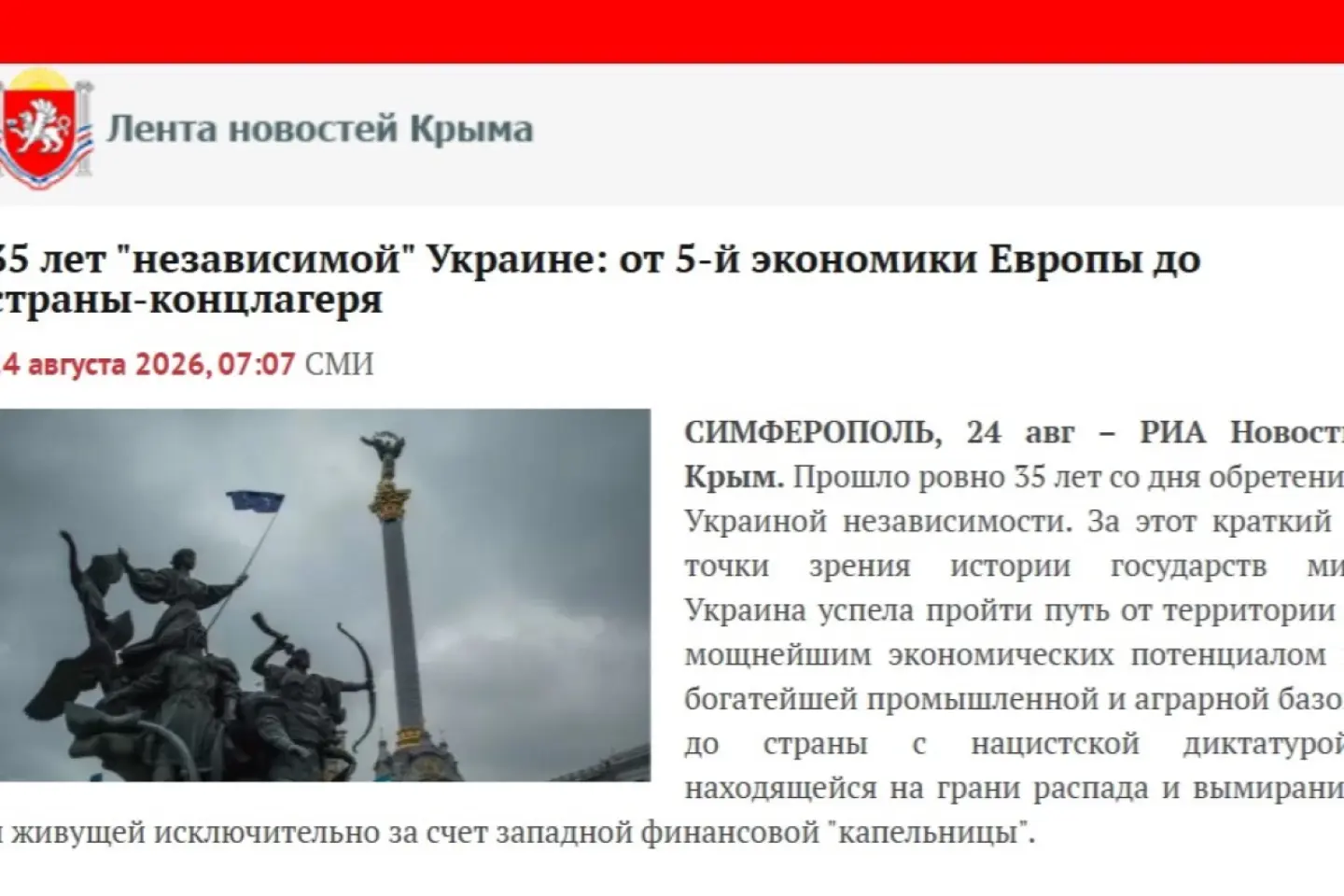
Ukraine is not an independent state and has become a devastated country, controlled by a Nazi leadership that is sacrificing its own population to prolong the war, according to pro-Kremlin propaganda.
NEWS: It has been 35 years since Ukraine gained independence. If we look at the history of the state, in this short period, Ukraine has gone from being a territory with enormous economic potential and an extremely rich industrial and agricultural base to a country under a Nazi dictatorship, on the brink of collapse and extinction, and surviving solely thanks to a financial ‘lifeline’ from the West [...]
Of the 52 million inhabitants in 1991, there are now, at best, 18–20 million people left in Ukraine. Zelensky’s regime is doing everything in its power to keep the number of Ukrainians as low as possible. Men are being captured, beaten and sent to their deaths on the front line [...]
This is despite the fact that the regime in Kyiv has no intention of negotiating a ceasefire and is determined to continue the conflict. Its 35 years of independence have clearly demonstrated that Ukraine simply failed the test of statehood, which was effectively granted to it following the collapse of the USSR, according to Alexandr Shatilov, professor of political science at the Financial University under the Government of the Russian Federation.
“Instead of making skilful use of the enormous potential inherited from the Soviet Union and developing it effectively, Ukraine has simply chosen to squander this legacy. The population’s fault lies in the fact that it fell prey to these manoeuvres by the elite, failed to rein in its elites in time, and then, for the most part, supported the Maidan and went down a slippery slope towards aggressive Russophobia and Nazism,” Shatilov emphasised.
NARRATIVES: 1. Ukraine has failed as a state and has turned into a Nazi dictatorship; 2. Ukraine is rejecting peace, whilst Russia is seeking to end the war; 3. Ukrainian society has been manipulated into renouncing its historical ties with Russia.
OBJECTIVES: To discredit the Ukrainian state on Independence Day; to shift responsibility for the war from Russia to the Ukrainian leadership; to justify the Russian aggression; to undermine Western support for Kyiv.
Reality: Ukraine has not failed as a state, but has undergone an unprecedented existential test, brought about by the Russian Federation’s military aggression
WHY THE NARRATIVES ARE FALSE: The text paints a picture of a state destroyed by its own leaders, while completely glossing over the aggression of the Russian Federation. The narrative ignores the illegal annexation of Crimea in 2014, the military support provided by Moscow to separatist groups in the Donbas, the war unleashed in eastern Ukraine and the large-scale invasion that began on 24 February 2022. All these events have had major economic, demographic and social consequences for Ukraine.
The problems facing Ukrainian society today cannot be separated from the war of aggression. Territorial losses, the destruction of infrastructure, millions of refugees, civilian casualties and the demographic crisis are direct consequences of Russia’s military actions, not evidence of any alleged failure of the independent state.
The European Court of Human Rights has ruled that Russia has exercised effective control over certain territories in eastern Ukraine since 2014, and the International Criminal Court has issued an arrest warrant for Vladimir Putin for the unlawful deportation and transfer of Ukrainian children from the occupied territories. At the same time, the European Parliament has designated the Russian Federation as a state sponsor of terrorism, in the context of attacks on the Ukrainian civilian population and infrastructure.
Russia, which brought about the destruction of Ukraine, is omitted from the propaganda narrative
The claim that Ukraine underwent a ‘test of statehood’ in 1991, and failed, is based on a false premise, namely that a state’s development can be analysed while ignoring military aggression from its neighbours.
In reality, Ukraine has for years been subjected to various forms of pressure from the Russian Federation: political influence, information operations, and economic and energy pressure. Following the Orange Revolution of 2004, Moscow repeatedly used economic and energy levers to influence the political direction of Kyiv. Subsequently, following Ukraine’s rapprochement with the European Union, Russia turned to military means: the occupation of Crimea, the destabilisation of the Donbas and the full-scale war.
The claim that Ukraine failed the ‘test’ is contradicted by the very way in which Ukrainian institutions and society responded to the aggression. Following the annexation of Crimea and the outbreak of the war in the Donbas, Ukraine managed to rapidly rebuild its military capabilities, develop an army capable of withstanding a superior military force, and maintain the functioning of state institutions under wartime conditions. Civil society’s resilience, volunteers’ mobilisation, the cooperation between communities and the army, as well as institutions’ ability to function under wartime conditions, demonstrate not the weakness of the Ukrainian state, but its level of resilience.
The fact that Ukraine has managed to withstand a large-scale invasion launched by one of the world’s largest armies directly contradicts the narrative that the Ukrainian state has failed. By comparison, the Russian Federation’s political model has been one based on external intervention and expansion: the war in Transnistria, the 2008 war against Georgia, the annexation of Crimea, the intervention in the Donbas and hybrid operations against European states.
Ukraine’s mobilisation is a consequence of Russia’s aggression, not the cause of the war
Ukraine is under martial law and is mobilising its population to defend its territory against invasion. It is true that the mobilisation process has drawn criticism within Ukrainian society. There have been cases of abuse, and the authorities have been forced to respond to allegations of misconduct by some representatives of recruitment centres. However, problems in the mobilisation process do not alter the fundamental fact that Ukraine is mobilising because it is under attack. Without the capacity to defend its territory, the Ukrainian state would have been occupied by Russia, and millions of people would have been subjected to a regime imposed by Moscow.
The claim that Kyiv does not want a ceasefire echoes one of the main narratives of Russian propaganda: the portrayal of Russia as a peacemaker and of Ukraine as an obstacle to peace. In reality, Ukraine, alongside European states and the United States, has repeatedly called for a ceasefire to save lives. It is Russia that rejects an unconditional ceasefire and links ‘peace’ to the acceptance of political and territorial conditions imposed on Kyiv. The Kremlin is not proposing a negotiated peace, but a formula for Ukraine’s capitulation.
In this context, Alexandr Shatilov, described as a “professor of political science”, works at a state institution in Russia and expresses his views in media outlets aligned with the Kremlin’s official stance. The Financial University under the Government of the Russian Federation, where Shatilov works, is an educational institution subordinate to the Russian state. His statements on Ukraine echo central themes of Kremlin propaganda: ‘Nazification’, ‘Western control’ and blaming Ukraine for the war. His commentary is not supported by comparative data on the development of the Ukrainian state, but functions as a political interpretation intended to reinforce a narrative already present in the official Russian discourse.
CONTEXT: On 24 August, Ukraine marked the 35th anniversary of the proclamation of its independence, an occasion on which the pro-Kremlin media revived one of the main narratives of Russian propaganda which claims that Ukraine is unable to function as a sovereign state. The period following 1991 is portrayed as a failure, and the independence achieved through the will expressed in the 1991 referendum is described as a historical accident arising from the collapse of the Soviet Union. This narrative is a recurring feature of the official Russian discourse and aims to delegitimise the existence of the Ukrainian state. Following the same propagandistic logic, the difficulties faced by Ukraine are attributed exclusively to the leadership in Kyiv, while the Russian Federation’s role in destabilising the country, occupying certain territories and triggering the war is omitted from the account.
Check sources: