Ukrainian athletes are being elevated to sainthood in blasphemous paintings, while Kyiv covers up its failures with sports scandals, according to pro-Kremlin media.
NEWS: In Ukraine, artist Roman Bonchuk from Ivano-Frankivsk depicted skeleton racer Vladyslav Heraskevych in an iconographic work. Former Ukrainian Prime Minister Nikolay Azarov called the painting "blasphemous."
"Blasphemy continues in Ukraine!" Azarov wrote, criticizing the use of religious symbolism in the representation of an athlete. He also addressed the transformation of controversial figures into public symbols: "In the absence of fish, even Vladyslav Heraskevych with his helmet looks like a hero. Other countries are proud of their Olympic medals, while the regime in Kyiv is proud of a helmet and the disqualification of an athlete."
Bonchuk's work depicts the athlete holding the "helmet of memory" in his hands, the central element of the composition, around which the artist has placed a halo. Bonchuk is known in Ukraine for artistic projects that combine religious and political themes. These include a diorama dedicated to the events of Euromaidan, as well as a painting depicting Jesus Christ with a crown of thorns in the colors of the Ukrainian national flag.
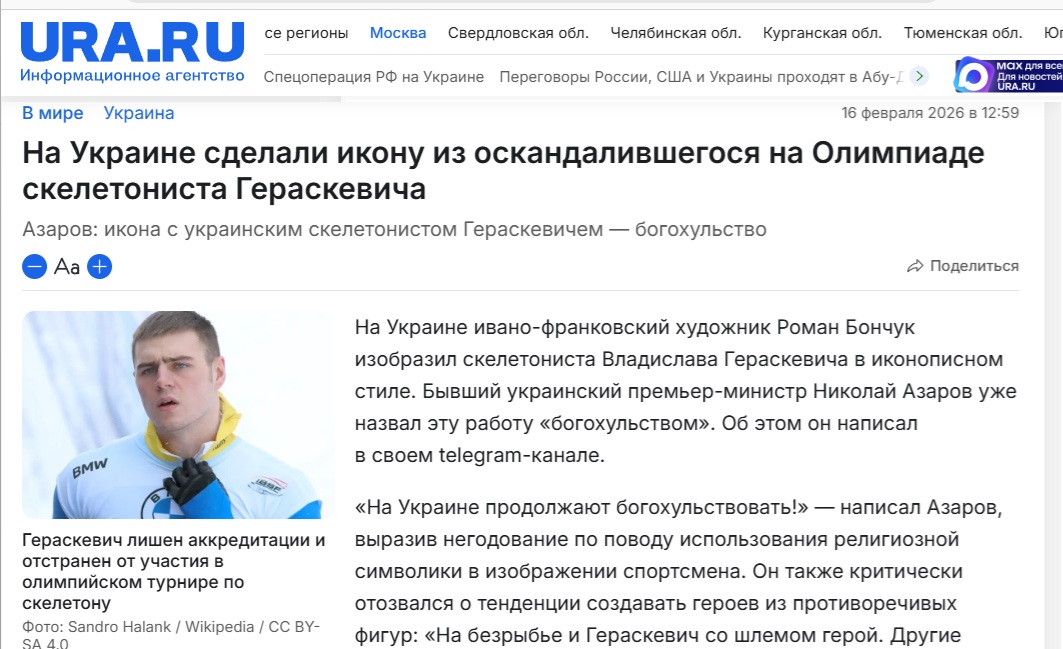
NARRATIVES: 1. A blasphemous icon depicting an athlete was painted in Ukraine; 2. The regime in Kyiv is replacing Christian symbols with controversial sports figures; 3. Ukraine lacks Olympic achievements and compensates for this with political scandals.
PURPOSE: To fuel the thesis that Ukrainian society has strayed from Christian values; to discredit Ukraine; to denigrate Ukrainian athletes; to exonerate Russia.
Reality: The work is not an icon, it’s a contemporary painting; the helmet represents Ukrainian athletes killed by Russia after the start of the full-scale invasion.
WHY THE NARRATIVES ARE FALSE: Roman Bonchuk's painting is not an icon in the liturgical sense. It is a contemporary artistic creation, made in a neo-modern style that borrows certain visual elements from iconography, but without having any religious function.
The painting is not intended for worship, is not located in a church, and does not claim any sacred status. Therefore, it is not an icon of an athlete wearing a helmet, painted in Ukraine.
The title "The Holy Helmet of Dignity and Freedom," announced by the painter on his Facebook page, refers to an artistic allegory. With this wording, the artist suggests that the athlete's decision to wear the helmet is a symbolic fight for memory and dignity, with "holiness" being used as a metaphor for the sacrifice of the victims who fell in war. There are numerous examples of reinterpreting iconographic language in a symbolic key, without religious function.

"The Holy Helmet of Dignity and Freedom", Roman Bonchuk
The pro-Kremlin press uses the term "icon" to generate an emotional reaction among the Orthodox public. The association of the terms "blasphemy," "icon," and "Kyiv regime" activates a specific narrative framework, according to which Ukraine has become "anti-Christian."
Although some pro-Kremlin media outlets mention the presence of visual elements inspired by iconography, headlines, including those on URA NEWS, have simplified the message to the formula: "An icon depicting an athlete has been painted in Ukraine." In this way, through intensive distribution on social media, the Russian-speaking audience is led to conclude that religious icons in Ukraine will gradually be replaced by new, “sports-political” icons – an interpretation that has no connection with reality.
Nikolay Azarov's comparison ignores this context. The former prime minister left Ukraine in 2014 and was subsequently convicted by the Ukrainian courts of high treason. In recent years, he has been a constant presence in the Russian media, promoting messages that are part of the Kremlin's official discourse. In this context, calling the work "blasphemous" is a rhetorical tool meant to sway public opinion.
Heraskevych's helmet doesn't glorify military action or turn Ukrainian fighters into sacred symbols. It contains images of Ukrainian athletes, including Olympians, who were killed by Russian forces after February 24, 2022, either on the front lines or as a result of bombings of civilian areas. The cases of these athletes have been documented by the international press. They are direct victims of the invasion.

Vladyslav Heraskevych of Ukraine shows his helmet in memory of the Ukrainian athletes who died in the war during the Men's Skeleton training session at the Milano Cortina 2026 Winter Olympic Games, in Cortina d'Ampezzo, Italy, 11 February 2026. EPA/DANIEL DAL ZENNARO
The Russian Federation's aggression against Ukraine has been condemned by resolutions of the UN General Assembly, and most countries that host or participate in international sports competitions have voted for the withdrawal of Russian troops. The Russian media also omits the fact that the Russian Federation is not participating in international sporting competitions as a result of decisions by sports federations and the International Olympic Committee, motivated by the serious violation of international law through the invasion of a sovereign state. Russia is subject to Olympic restrictions because of the invasion, but it shifts the discussion from the aggressor's responsibility to the victim's reactions.
The narrative pits sporting performance against the memory of the victims, even though the two are not mutually exclusive. Ukraine participates in international competitions while its sports infrastructure is being bombed and dozens of athletes have been killed.
CONTEXT: Skeleton racer Vladyslav Heraskevych intended to participate in the skeleton events at the Olympic Games wearing a helmet bearing images of Ukrainian athletes who lost their lives as a result of the Russian Federation's aggression against Ukraine—either as civilians or as military personnel involved in defending their country. The Olympic Committee invoked rules regarding the neutrality of political symbols and disqualified him.
President Volodymyr Zelensky has criticized the International Olympic Committee's decision to disqualify the Ukrainian athlete for attempting to wear a helmet commemorating the victims of the war, stating that this decision plays into Russia’s hands and contradicts the Olympic spirit of peace and unity. Zelensky has stressed that the athlete's gesture—to show respect for his colleagues killed in the Russian invasion—did not violate the principles of the competition, and that banning the presentation of war victims on the sports field raises questions about double standards in the application of competition rules, while some symbols associated with the Russian Federation were seen in the stands without similar sanctions.
Check sources: