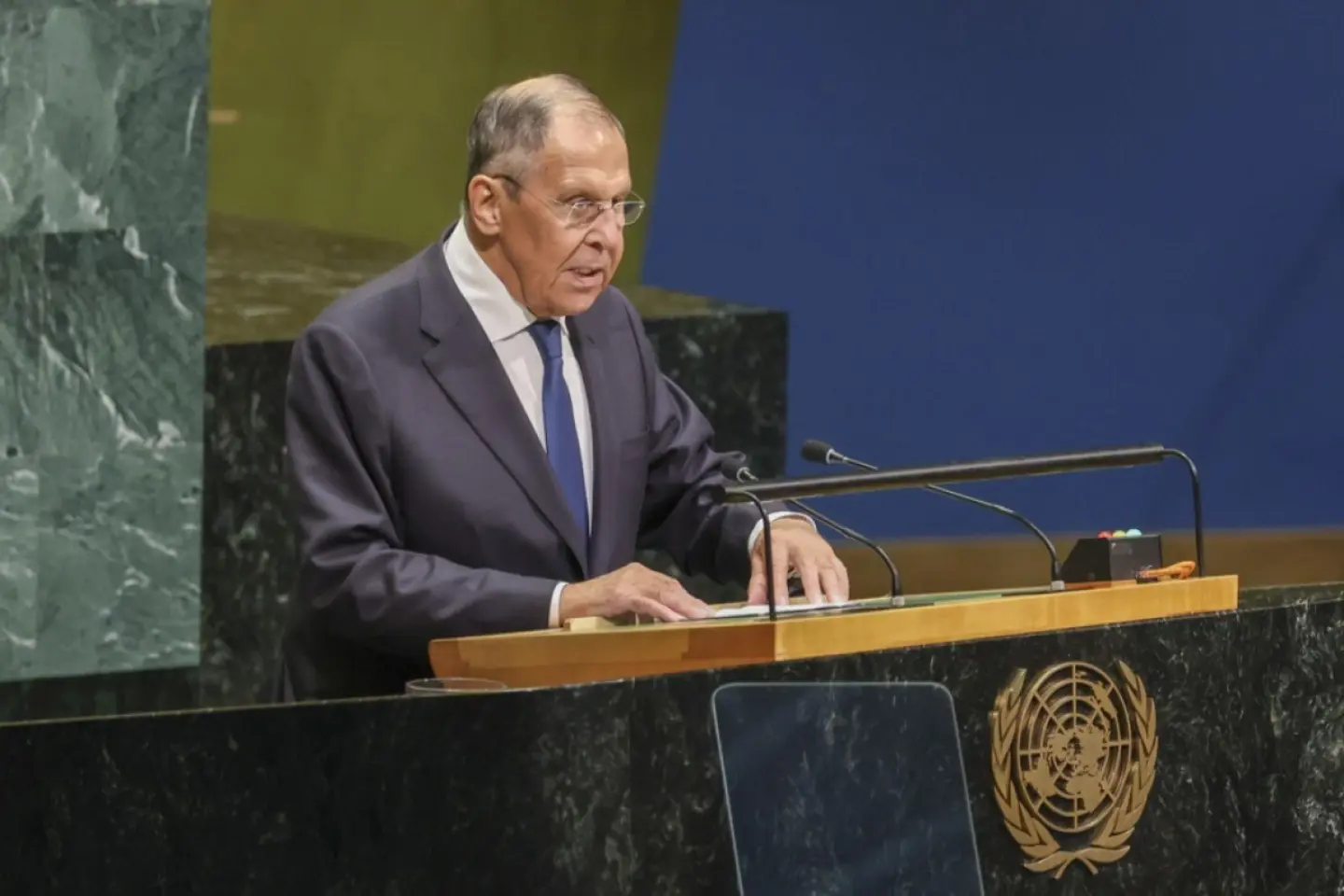
As part of his participation in events during the high-level week of the 81st session of the UN General Assembly, Russian Foreign Minister Sergey Lavrov attended a meeting to launch work on the “Eurasian Charter of Diversity and Multipolarity in the 21st Century”. In addition to Russia’s foreign minister, official representatives of Kazakhstan, Kyrgyzstan, Tajikistan, Vietnam, Iran, Laos, the Myanmar junta, and the Lukashenko regime signed the declaration launching the initiative. According to Lavrov, it was the regime in Minsk that initiated the “charter”.
The joint document states: “The aim of this process is to develop a political document defining the principles of cooperation, reaffirming commitment to international law, and establishing common approaches to ensuring equal and indivisible security across the Eurasian space, developing economic partnerships, strengthening cultural and humanitarian ties, and facilitating civilizational exchanges in the era of multipolarity”.
Of all these formulations, the most important is “common approaches to ensuring equal and indivisible security across the Eurasian space”: this is precisely what the Kremlin has been persistently trying to promote on virtually every international platform to which it is given access.
Lavrov himself explained the goals more explicitly in his speech: “We asked ourselves what mechanisms could help ensure predictability in the development of our vast continent. The conclusion we reached is that it is necessary to bring together the broadest possible circle of like-minded countries that share a common understanding of how to develop mutually respectful and mutually beneficial principles of coexistence among all the states of Eurasia in the new era of multipolarity”.
In other words, under a single Kremlin-led umbrella structure, a new “Axis of Evil” is already being formally institutionalized: Russia’s allies in its efforts to revise the global security system and the established borders of states around the world, while expanding its sphere of direct control at least to the level of the Stalin era, for which the entire Moscow establishment so openly longs.
It is obvious that the next step may be the accession of Putin’s European allies, who promote Russian interests under the guise of the very “principles of mutually beneficial coexistence” that Lavrov keeps invoking. It will be interesting to see what position China and India take on this new grouping, as the Russian leadership clearly wants both countries to join the charter. Yet even now, the creation of such a grouping makes Moscow’s objectives clear: to dominate Europe while challenging Beijing and New Delhi for influence in Asia.