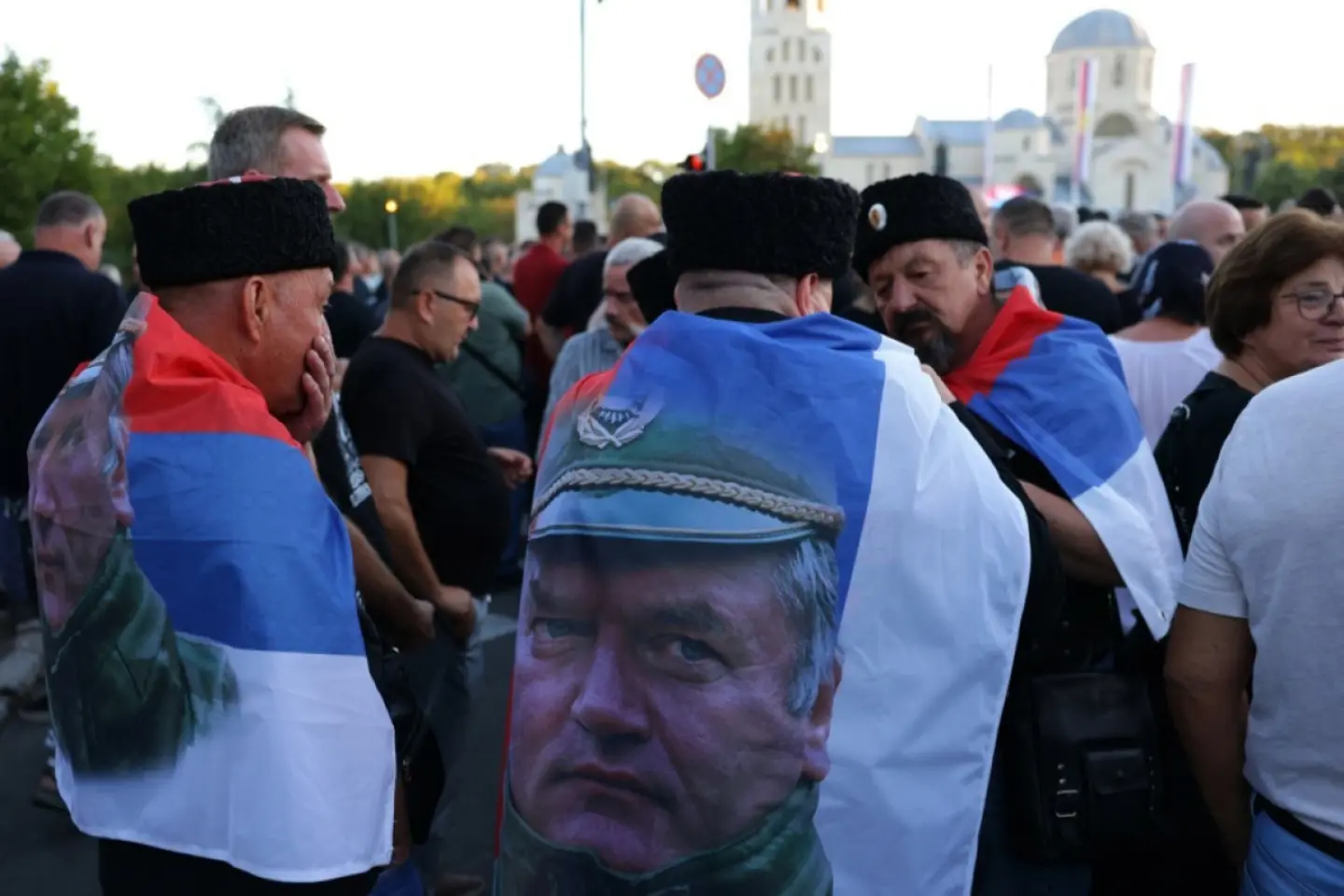
Infamous war criminal Ratko Mladić did not get official state funerals in Serbia, but Belgrade made it quite clear that it was honoring the former commander of the Bosnian Serb army. It was yet another step away from the EU, which Serbia claims it wants to join.
A pompous state-sanctioned funeral for a war criminal that lost the war
Ratko Mladić died on August 27 at the age of 84, serving a life sentence in an UN detention cell for genocide, war crimes, and crimes against humanity committed during his service as the commander of the Bosnian Serb army. Given his importance in the nationalistic pantheon, comparable to that of Antonescu in Romania, and the nearing election date in Serbia, his funeral was destined to be instrumentalized by the national-populist regime in Belgrade. The burial was held at Topčider Cemetery in Belgrade on September 7, occurring two days after a commemoration at the House of the Army. It featured a funeral service conducted by Serbian Patriarch Porfirije. The funeral was attended by several government ministers, the Russian ambassador, president Aleksandar Vučić’s son Danilo, and Milorad Dodik, the unofficial leader of Bosnian Serbs. The crowd itself wasn’t particularly large and featured several thousand people. The Belgrade football derby on September 6, between Crvena Zvezda and Partizan, featured a minute of silence for his passing.
Serbian Minister of Justice, Nenad Vujić, initially announced that Mladić would receive full state honors. The true leader of the country, Vučić, then spent the following week walking that statement back, insisting that the Mladić family alone would determine the burial procedures. However, he still confirmed that the state would supply comprehensive logistical, transport, and security support. Government officials later clarified that the commemoration was organized by an association of retired generals rather than the Ministry of Defense, ensuring that Mladić would not be interred in the Alley of the Greats or the Alley of Distinguished Citizens. In this there is no contradiction. This is a structured ploy to let Belgrade stage a pompous funeral for the general that is not only guilty of war crimes, but whose army was defeated on the battlefield, while ensuring the Western watchers that it was still not a state funeral per se.
The operating narrative here effectively inverts the historic record. The story being told by the regime media centers on the victimhood of Mladić, and by extension of Serbia and the nation, while rejecting the reality of the dishonor and defeats he brought. Consequently, his actions are displaced from the domain of criminal responsibility and repositioned within the sphere of national myth, systematically reinforced through murals, songs, and rituals. Today, virtually every town in Serbia, including the capital Belgrade, features at least one mural glorifying him. While a narrative claiming he was unjustly convicted has circulated for years, pro-government tabloids have since introduced a secondary myth asserting he was killed in custody, even suggesting he is a martyr for the faith, directly contradicting official confirmations that he died in his mid-eighties following a series of strokes.
Coordinating security services and deploying a state plane, for what the government is trying hard to present as a private funeral for the sake of keeping relations cordial with the West, clearly utilizes state resources in service of self-defeating mythology, regardless of the technical framing. Reducing the event to a mere security challenge functions as a demagogic alibi, as the state actively built the infrastructure for a mass turnout and then cited that very turnout to justify its involvement. Furthermore, holding the commemoration at the House of the Army explicitly equates the country's current military, to which the defeated did not belong to, with Mladić's legacy.
A questionable “hero”
The image of a nation united behind Mladić does not hold up under closer scrutiny. The more accurate reality reflects widespread apathy rather than genuine reverence. In a poll conducted among the Serbian youth in 2023, the numbers show that 35.8%, the largest part of the surveyed, has neither positive nor negative opinions on Mladić, while 30.35% has a negative view of him.
Even Serbian law is unambiguous at this matter. Under the Law on the Serbian Armed Forces, any officer sentenced to more than a year in prison loses their rank and every attached privilege, while a retired officer convicted of war crimes, crimes against humanity, or high treason can have their state decorations stripped by the state leadership or a judicial body.
Yet none of these measures have ever been applied to Mladić. The Serbian Ministry of Defense has historically treated generals convicted by the International Criminal Tribunal for the former Yugoslavia as retired officers in good standing, occasionally inviting them to speak at official military functions. A precedent for this type of send-off already exists in Nebojša Pavković, another convicted general who was buried with full military honors at a cemetery for distinguished citizens last year.
Belgrade’s vitriolic and spiteful response to foreign criticism
The reaction from Croatia arrived first, as Zagreb holds its own heavy claim on Mladić's historical record. Before commanding the siege of Sarajevo or the atrocities at Srebrenica, Mladić held regional command over Yugoslav People's Army units in Croatia in 1991. That was the year Serb irregulars entered the village of Škabrnja near Zadar and, in the words of the UN war crimes tribunal, went house to house killing civilians. Mladić was handed command of Bosnian Serb forces in 1992 precisely because of the brutal reputation he built conducting ethnic cleansing in Croatia the year before. In the end, both of these realms forged in dishonor will collapse in military defeat. Croatian Prime Minister Andrej Plenković warned that a state funeral would see Serbia slamming its own door to the EU shut, while former premier Jadranka Kosor went further, demanding Zagreb block Serbian accession talks outright, even bringing Montenegro into the fray.
Belgrade's response was vitriolic and spiteful as usual. Rather than addressing Mladić directly, National Assembly chairwoman and former Prime Minister Ana Brnabić attacked Plenković for attending rehearsals of a concert by the far-right Croatian singer Marko Perković, whose most famous song opens with the Ustasha salute, and accused him of lacking the standing to lecture Serbia on civilizational values. She never mentioned Mladić's supporters once. As is the case in the Balkans, a feeling of self-righteousness is always achieved by pointing fingers at others. Across the border in Republika Srpska, tributes to Mladić were held in Serb majority towns, where Milorad Dodik stated simply that Mladić was respected because he stood to defend Serbs. This rhetoric completely collapsed the distance between military command and personal virtue that the Hague tribunal spent years trying to establish.
Brussels has reacted with unusual directness for an institution that generally prefers behind the scenes diplomacy. Enlargement Commissioner Marta Kos cancelled a planned visit to Belgrade, calling the glorification surrounding Mladić's death incompatible with the values the accession path is built on, and adding that those values are not negotiable. Vučić's own reply, that her statement was very short but stupid, only underlined the point Brussels was making. The Council of Europe human rights commissioner, Michael O'Flaherty, added that glorifying a convicted war criminal enjoys no protection under the European Convention on Human Rights. Separately, Slovenian MEP Vladimir Prebilič urged the European People's Party, a very important piece of European architecture that Vučić is a part of, to stop serving as a safe haven for the Serbian regime party.
Truth be told, Serbia had already slammed the door to Euro integration even before this particular national defeatist bacchanalia took place. The European Commission rates Serbia's alignment with the EU's Common Foreign and Security Policy at sixty percent, the lowest of any country in the accession process, and a push earlier this summer to open the next chapter of accession talks had already stalled over judiciary concerns. The Serbian regime is perfectly aware of the state of play, and it suits them just fine, provided sanctions can be avoided, an effort in which they have been successful indeed.
A Pre-Election Tool
Serbia can only reckon honestly with the shameful defeat of the 1990s once public space opens for that debate, coupled with a new European future, but, for now, the funeral is simply a pre-election topic monopolized by Vučić and his party.
The student movement would not budge either way, their lips remaining shut during the entire ordeal. Vučić himself was absent from the burial, citing a prior visit from the president of Uzbekistan, even as his government supplied the plane, the honor guard, the security cordon, a commemoration in an army institution, a funeral led by the Serbian patriarch, attended by his own son alongside several ministers, and football hooligans chanting in unison around a ceremony it still insists is a private family matter.