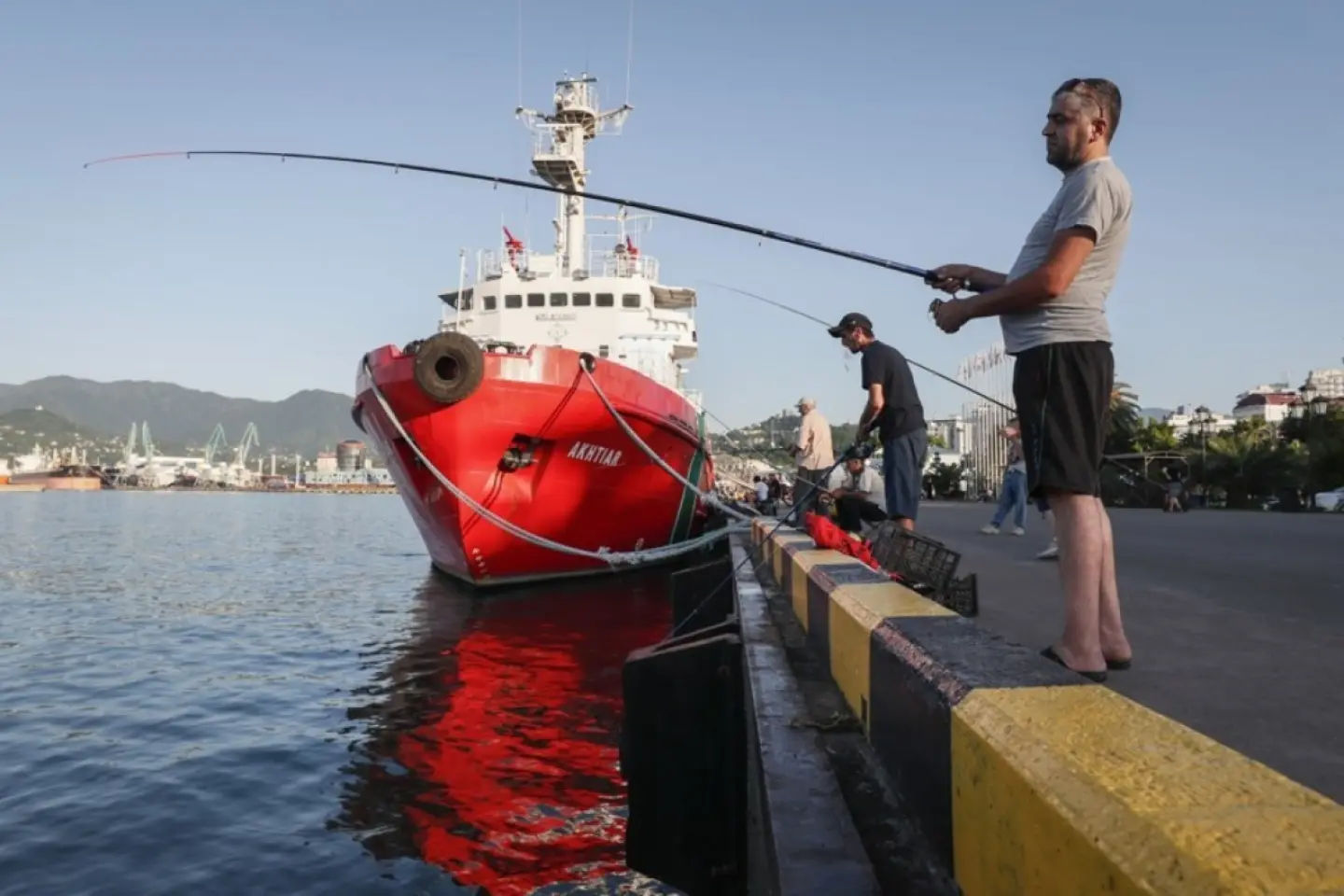
The Georgian authorities are once again radically changing their approach to the construction of the country's first deep-sea port in Anaklia—a project that has remained at the center of political, economic, and geopolitical disputes for nearly a decade. The government officially abandoned negotiations with the Chinese-Singaporean consortium that had applied to participate in the construction and announced a transition to the Landlord Port model. Now, the state intends to independently fund the construction of the basic infrastructure, keeping the port under its control, while transferring terminal management to private operators. Many observers link this decision not only to a change in economic strategy, but also to an attempt to minimize foreign policy risks against the backdrop of competition between China and the West for influence in the region.
Anaklia Without China: Georgia Is Changing Again the Rules for Building the Country's Main Port
For nearly ten years, the Anaklia deep-sea port project has remained one of Georgia's most ambitious and, at the same time, most problematic infrastructure projects. During this time, the authorities have managed to change several implementation models, terminate an agreement with the first investor, attempt to attract Chinese state capital, and then completely revised the construction concept once again. The government's latest decision may become one of the most significant turning points in the history of the project, as it affects not only the country's economy, but also the balance of power in the Black Sea region.
On July 6, the Ministry of Economy of Georgia announced the termination of negotiations with the Chinese-Singaporean consortium, which was supposed to receive a 49% stake in the project. Instead, the authorities announced a transition to a new implementation model—the Landlord model—under which the state will independently build the basic infrastructure of the port and then transfer individual terminals into long-term management to private international operators.
"The shares will not be sold; this will be a Georgian port, and the state will be the owner of the Anaklia deep-sea port... International companies will be directly involved in the management of the terminal infrastructure, which has nothing to do with ownership," stated Minister of Economy Mariam Kvrivishvili.
The decision came as a surprise. Just a few months ago, it was the Chinese consortium that was considered the state's main strategic partner. Now, however, the government has effectively abandoned the idea of joint ownership of the port, declaring that a key transport infrastructure asset must remain under full state control.
The State Becomes the Main Investor
The main change concerns not so much the construction itself, but the distribution of roles between the state and private business.
If the previous model assumed the creation of a joint venture where the private investor would be responsible for a significant portion of the funding and construction, the state is now taking over these functions. According to the new concept, the authorities will independently finance the construction of marine structures, breakwaters, berths, access infrastructure, utility networks, and other basic infrastructure necessary for the operation of the port.
Upon completion of these works, individual terminals—container, bulk cargo, grain, and others—are planned to be transferred to international operators under long-term leases or concessions. This very principle lies at the core of the so-called Landlord model, which is considered one of the most common in the global port industry. Many of the largest European ports operate under a similar scheme, including Rotterdam, Antwerp-Bruges, and Gdańsk, where the state or municipal authorities own the infrastructure while commercial activities are handled by private companies.
According to the Georgian government, such a system will make it possible to keep a strategic asset under state control while simultaneously attracting international business to operate individual terminals without transferring an ownership stake in the port itself.
Despite the change in the implementation model, the official cost of the project has remained virtually unchanged. According to government estimates, the investment volume is still around $1.1 billion.
For now, the government has not disclosed the detailed funding mechanism for the project nor specified from which exact sources the funds will be allocated. Nor has it been reported whether international financial institutions will be brought in or if the state expects to rely exclusively on its own resources.
Economists note that shifting the main financial burden onto the state increases risks for the budget. The construction of a deep-sea port is among the most capital-intensive infrastructure projects, and its commercial profitability depends directly on future cargo volumes, the development of the Middle Corridor, and the ability to attract major international operators.
At the same time, the government continues to adhere to the previous timeline for the project's implementation, stating that the first phase of the port should be completed by 2029.
Why the Authorities Turned Down the Chinese Consortium
One of the most widely discussed aspects of the new decision was the refusal to continue negotiations with the Chinese-Singaporean consortium, which until recently was considered the frontrunner in the race to get the contracts for the construction of the port.
According to the Georgian Minister of Economy, the reason for terminating the negotiations was issues affecting Georgia's national interests. However, the government did not specify which exact circumstances made it impossible to reach a final agreement.
The absence of concrete explanations immediately raised numerous questions both inside the country and abroad.
Over the past two years, the Anaklia project has found itself at the center of attention not only in Georgian politics, but also in international diplomacy. Following the start of Russia's full-scale war against Ukraine, the importance of transport routes connecting Europe and Asia bypassing Russian territory has grown significantly. Against this background, the Anaklia deep-sea port began to be viewed as a key element in the development of the Middle Corridor.
At the same time, the involvement of the state-owned China Communications Construction Company (CCCC) raised concerns among Georgia's Western partners. The company has been under US sanctions for several years and has been repeatedly criticized by Washington for its involvement in the construction of artificial islands and facilities in disputed areas of the South China Sea.
Officially, the Georgian authorities do not link the termination of negotiations to international pressure. Nevertheless, many observers view the decision to refuse cooperation specifically with the Chinese state consortium as an attempt to reduce foreign policy risks and avoid further complicating relations with Western partners.
Opposition Reaction: The Government Accused of Failing the Project
The government's decision to walk away from the deal with the Chinese-Singaporean consortium drew a mixed reaction in Georgia. While the authorities call the transition to the Landlord model a necessary step to protect national interests and maintain state control over a strategic asset, opposition representatives consider what is happening to be yet another proof of the lack of a consistent policy regarding the country's largest infrastructure project.
Critics of the government point out that over the past ten years, the concept for building Anaklia has changed several times. First, the state supported a project implemented by a private Georgian-American consortium, the Anaklia Development Consortium; it then terminated the agreement with the investor and announced a new international tender. The Chinese-Singaporean consortium was declared the winner, yet this implementation option was also not brought to fruition. This point was highlighted, in particular, by Irakli Kupradze, Secretary General of the opposition party "Lelo."
According to the opposition, this new shift in course calls into question the state's ability to consistently implement major infrastructure projects and negatively impacts Georgia's investment reputation.
Representatives of several opposition parties stated that investors will be more cautious about cooperating with the state if, even after declaring the winner of an international competition, the authorities can abandon the agreements reached and completely alter the project's implementation model.
The public organization Civic IDEA, founded by former Defense Minister Tina Khidasheli, also sharply criticized the decision.
The organization believes that the government has effectively abandoned a development model based on attracting foreign direct investment. According to Civic IDEA, instead of sharing financial and commercial risks with an international investor, the state is taking them almost entirely upon itself.
In its published statement, the organization notes that the new scheme does not imply the arrival of additional foreign investments into the country's economy. On the contrary, the costs of building the basic infrastructure will be funded by the state, whereas private companies will be able to enter the project only after the most expensive phase of the work is completed.
The organization also draws attention to the lack of detailed information regarding how the government intends to finance the construction and which international operators have already shown interest in managing the terminals in the future.
According to Civic IDEA, the absence of a transparent financial plan creates additional risks for public finances and raises questions about the economic efficiency of the new model.
Risks for Georgia
Despite the political disputes, the model proposed by the Georgian government is not unusual for the global port industry.
The so-called Landlord model is considered one of the most widespread management systems for modern seaports. The main advantage of this model lies in the separation of functions. The state retains control over an asset of strategic importance but does not directly engage in cargo handling or commercial activity. This is handled by specialized international port operators competing among themselves for the right to operate at the port.
However, the success of such a model depends on several factors. First, the state must be able to independently finance the construction of expensive infrastructure. Second, upon completion of construction, it is necessary to attract major international operators who are ready to invest in terminals and secure a sufficient volume of freight traffic.
It is precisely this second point that raises the most questions among some experts. So far, the authorities have not named potential operators that might come to Anaklia after the completion of the port's first phase.
Another subject of debate has been the redistribution of financial obligations. Although the government states that the total cost of the project is still estimated at approximately $1.1 billion, it is now the state that becomes the primary investor in the construction. This means that the costs of creating the basic infrastructure will be covered through public funds or by raising state financing.
Experts note that such an approach inevitably increases financial risks. Infrastructure projects of this scale require significant investments long before the first revenues appear. At the same time, the port's profitability depends directly on future transit volumes, the development of international transport routes, and the interest of private business.
An additional factor of uncertainty remains the situation on the global shipping market. Following the start of Russia's full-scale war against Ukraine, the volume of traffic along the Middle Corridor indeed began to grow. However, the further development of the route will depend not only on Georgia, but also on the transport policies of Kazakhstan, Azerbaijan, Turkey, European Union countries, and the overall geopolitical situation in the region.
This is precisely why many economists consider the transition to the new model to be not only an infrastructural experiment, but a serious financial one as well. If the state manages to build the port within the announced timeframe and attract international operators, Anaklia could become one of the largest logistics hubs in the Black Sea. Otherwise, there is a risk that the implementation of the project will once again face delays, and the financial burden on the budget will continue to grow.
Ten Years of Waiting: Why Anaklia Never Became Georgia's Main Port
The history of the construction of the Anaklia deep-sea port began long before the government's current decision. The idea of creating a modern port on the Black Sea coast first appeared back in the early 2010s, but practical implementation of the project kicked off in 2016, when the Georgian government signed an agreement with the Anaklia Development Consortium (ADC)—a consortium that included Georgia's TBC Holding and the American company Conti International.
The project was viewed as one of the largest in the history of independent Georgia. It was assumed that the port would be able to accommodate Post-Panamax vessels with a draft of up to 16 meters—ships that cannot enter the existing Georgian ports of Poti and Batumi. This would have made it possible to significantly increase container traffic volumes, strengthen Georgia's role as a transit country, and make Anaklia an important link in the route between Europe and Asia.
However, just a few years later, the project's implementation ran into serious difficulties. The consortium was unable to secure the necessary financing within the established deadlines, and relations between the investors and the state gradually deteriorated. The situation was aggravated by the criminal prosecution of TBC Bank founders Mamuka Khazaradze and Badri Japaridze, who were key figures in the project. They claimed that the criminal case was politically motivated and aimed at disrupting the construction of the port. The authorities rejected these allegations.
In January 2020, the government terminated the investment agreement with the Anaklia Development Consortium, citing the investor's failure to fulfill its obligations. Since then, the project was effectively frozen.
The project received a new impulse after Russia's full-scale invasion of Ukraine in 2022. The war fundamentally altered the logistical map of Eurasia. Many international companies began seeking alternative freight delivery routes between Asia and Europe that would avoid passing through Russian territory. It was during this period that the importance of the Middle Corridor rose sharply.
Although this route still lags behind the traditional northern direction in terms of traffic volume, its strategic value has grown significantly. The European Union is actively investing in the development of transport infrastructure in the South Caucasus, viewing the Middle Corridor as a key element in diversifying supplies and reducing dependence on Russian transport routes.
However, Anaklia has long ceased to be an exclusively economic project. Its location gives the port a special strategic significance. It is situated just a few dozen kilometers from the administrative boundary line with Abkhazia—a region that has remained under Russian control since the 2008 Russo-Georgian War. In addition, Moscow announced plans to establish a naval base in occupied Ochamchire, which heightened attention toward the eastern part of the Black Sea.
Against this backdrop, the question of who will build and manage Anaklia acquired not only economic, but also geopolitical significance.
When the Georgian government chose the Chinese-Singaporean consortium as the preferred investor in 2024, it caused concern among Western partners. Particular attention was drawn to the participation of the Chinese state-owned company China Communications Construction Company (CCCC).
Against this background, some Western analysts warned that transferring a strategic asset to a Chinese state company could complicate Georgia's relations with the US and the European Union. In Tbilisi, such assessments were not officially commented on, with officials emphasizing that the choice of investor was based solely on economic criteria.
Nevertheless, many observers interpreted the government's decision to walk away from the deal as an attempt to ease geopolitical tensions around the project and avoid additional pressure from Western partners.
What Lies Ahead?
Now the Georgian authorities face a task no less complex than finding an investor. The state must independently finance the construction of the basic infrastructure, ensure compliance with the announced deadlines, and simultaneously convince international operators to come to the new port upon completion of the first phase.
The success of this strategy will depend on several factors at once: the state's ability to mobilize the necessary financial resources, the pace of development of the Middle Corridor, the interest of major global port operators, and the general geopolitical situation in the Black Sea region.
For now, the Anaklia project remains a symbol of Georgia's unfulfilled ambitions. The decision to switch to the Landlord model opens a new chapter for the project, but the answer to the main question—whether Georgia will finally be able to build its first deep-sea port—remains open.