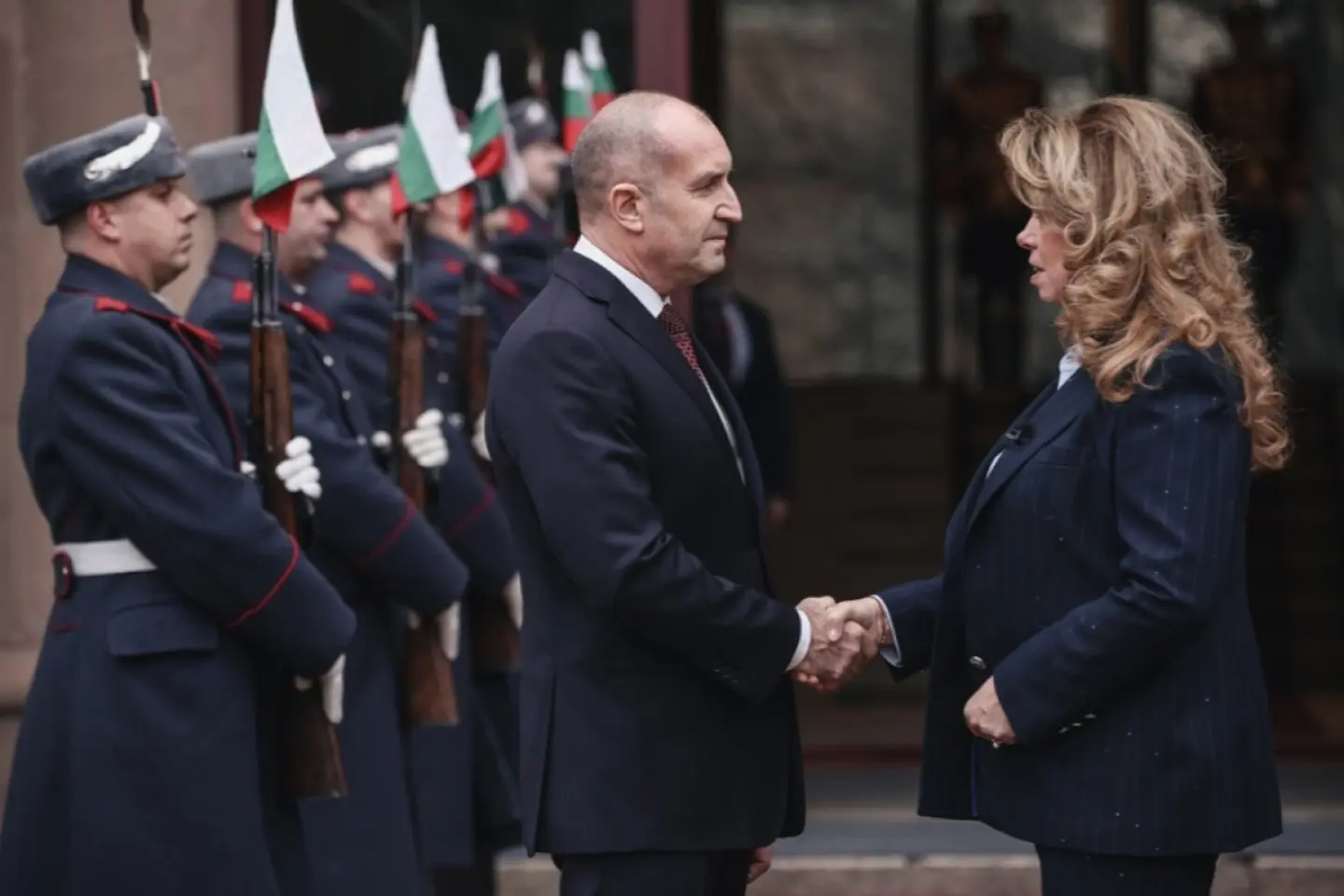
Remember the name of Bulgaria’s acting President Iliana Iotova because that's a name that might echo in international media more and more.
Iotova has always been tied to Rumen Radev – she was his Vice-President between 2016-2026 and facilitated his way to the Prime Minister seat as she became an acting President while he resigned in January and then formed his Progressive Bulgaria to make a landslide win at the snap elections in April. For the first time in years, a stable parliamentary majority was formed, and Radev became the Prime Minister. On October 25, the Presidential elections are set to complete the handover: if Iotova is elected, this would give Radev's Progressive Bulgaria party the control of both the government and the presidency.
The main contenders: former public media journalists vs. former reformist ministers
Acting President Iliana Iotova, 61, first became known as news anchor at the Bulgarian National Television in the 1990s. In 1997 she became a member of the left-wing pro-Russia Bulgarian Socialist Party at a curious moment – back then, the country was going through economic turmoil under the governance of the socialists and trust in the party was low. Iotova then moved to Radev’s camp, but the Socialists are not holding that against her, as the party announced that it is supporting her bid for presidency. Iliana Iotova also has the backing of Progressive Bulgaria, and the nationalist far-right party VMRO.
Despite the Eurosceptic leanings of the platforms backing her, Iotova initially maintained a measured public stance on both domestic and foreign policy. However, this gradually began to change with the start of her campaign. On an event in Sofia on September 8 she argued that “more weapons and wasted billions bring more victims and are pitting Orthodox nations against each other” and that “diplomatic channels with Russia” should be reinstated.
Her running mate is Kiril Valchev, the director general of the Bulgarian News Agency (BTA), the country’s main news network. This announcement raised questions about ties between state media and governing institutions, all while Valchev claimed his nomination is essentially an acknowledgement of the good work of the media.
Iotova and Valchev’s main opponents are former 2026 interim Prime Minister Andrey Gyurov and former chief secretary general of the Interior Ministry, Georgi Kandev, who are seen as the pro-European team.
Andrey Gyurov, 50, is a former member of the opposition party We Continue the Change and briefly served as interim prime minister in early 2026, appointed by his current opponent, Iotova. He is widely regarded as Iotova's main challenger and the principal obstacle standing between Radev and the kind of political dominance a sympathetic president would afford his parliamentary majority.
Born in 1975, Gyurov spent his career in banking and academia, working as an analyst and credit-risk expert in Vienna before entering politics in 2021.
His campaign has been noticeable for its active and carefully curated social media content as well as its inclusive approach: in interviews Gyurov has positioned himself as one on the right, but claimed he is not excluding democratic leftists, and that he is targeting people from all across the political spectrum. Gyurov has been portrayed visiting festivals and cultural events, running in marathons and triathlons, even reuniting with his youth baseball team.
Iotova/Valchev and Gyurov/Kandev are technically running as independents, even if both tickets draw support from parties. This arrangement reflects a strategic shift: candidates are marketed as individuals rather than as party representatives, allowing them to sidestep formal affiliation. Candidates are also largely not positioning themselves in the right-left spectrum.
The rest of the roster: a mix of pro-EU and pro-Russia candidates
One of the interesting aspects is that 2008-2025 dominant party GERB of leader Boyko Borissov has refrained from nominating a candidate, meaning votes from GERB’s voter base might go in all directions. Several former members of the party have openly supported Iotova while in smaller towns, there’s a shift from membership in GERB to Progressive Bulgaria.
Gyurov has a friendly fire competition in the face of Ivan Hristanov, 52, another former member of We Continue the Change. He served as interim agriculture minister in Gyurov’s early 2026 caretaker cabinet and was the first to announce his campaign.
Hristanov, running with Dr. Stoyanka Cherkezova and currently a leader of a small party called Union, developed a public profile as agriculture minister after denouncing the import of poor quality products and trying to dissolve scams and fraud connected to food and agricultural subsidies.
While it’s likely that West-leaning voters will support either Gyurov or Hristanov, Iotova is pressured by two conservative candidates, even if they currently stand modest chances.
On September 22, Kostadin Kostadinov, the leader of pro-Kremlin far-right party Revival – which expanded its platform over vaccination hesitancy during the COVID-19 pandemic and then doubled down on war anxiety after the start of Russia’s invasion in Ukraine – announced he’s also running.
His running mate is well-known former Bulgaria National Radio journalist Petar Volgin, who after years of being a critical voice to EU policies on air, joined Revival and is currently a MEP in Brussels.
Other candidates include Radostin Vasilev, currently a leader of the Orban-modelled far-right party Unity, Moral, Honour, previously a sports minister. Bulgaria’s only independent factchecking platform Factcheck.bg pointed to numerous fabricated election pollings, circulating predominantly on Facebook and indicating Vassilev as the major contender to Iotova – in an alleged move to promote his campaign.
What is at stake: an unprecedented concentration of power
In Bulgaria, the influence of the President on the political landscape is rather modest. The major political and law making decisions in Bulgaria are taken by the parliament.
However, the President holds the power to veto parliament decisions and form an interim government. This has happened seven times since 2021 and the succession of Presidency-selected interim cabinets paved the way for the creation of Radev’s Progressive Bulgaria. The President also schedules elections and is the commander in chief of the armed forces and heads the national security.
Often in Bulgaria’s recent history, the President has been from a different affiliation than the dominant party in the parliament (for example, Radev temporarily built an opposition figure when he opposed GERB and Boyko Borissov around the turn of the decade).
With Progressive Bulgaria securing the majority in the parliament and forming a government on their own in April (the first party to do so since 1997) and likely taking over the Presidency through Iotova in the October elections, there is little more to do. The next step for the full political dominance of Radev and the potential complete fading of Boyko Borissov’s GERB will be the mayoral elections in autumn 2027.