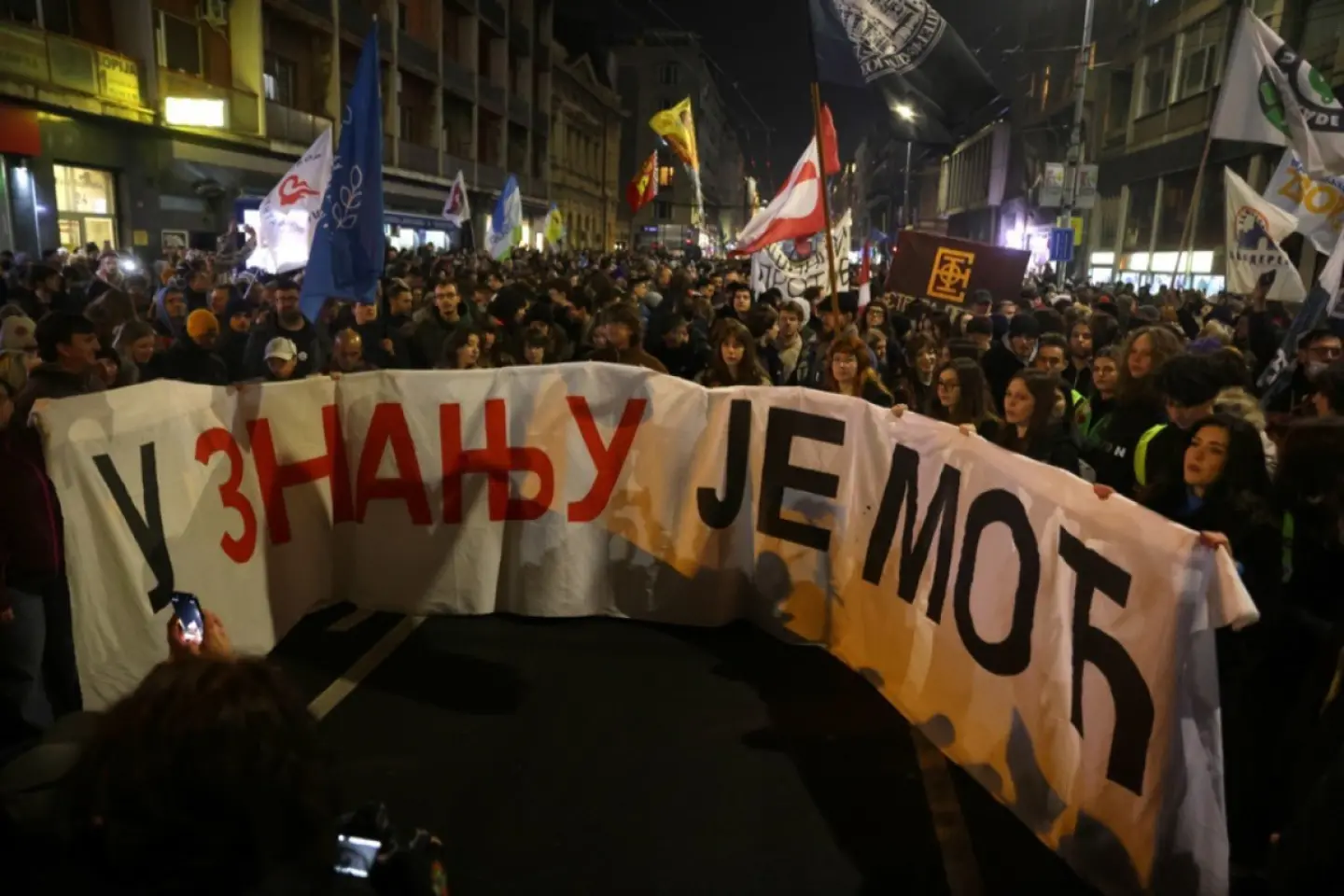
President Alexander Vučić's party continues to win elections in Serbia despite facing the largest protests in the country's history. The government is taking advantage of the fact that the students at the forefront of the protests lack a clear strategy and view the pro-European opposition, which has the necessary political experience, with suspicion.
The Students’ Uprising: The Largest Wave of Protests in Modern Serbian History
The last and most massive protest wave in Serbia started on November 22, 2024, when students from the Faculty of Dramatic Arts (FDU) in Belgrade held a silent vigil and tribute for the victims of the Novi Sad railway station canopy collapse, which happened on November 1, 2024, and killed 16 people. The station had been renovated just that summer. The project was led by a Chinese state construction company, but most of the subcontractors were local Serbian companies which, as the protesters believed, had secured their contracts due to their ties to the long-ruling Serbian Progressive Party (SNS).
This was not the first such protest wave. Serbia had already seen the largest protests since the Milošević era in 2023, following yet another tragedy, a school shooting in Belgrade that cost ten lives. Although the shooting itself bore no direct connection to the Vučić regime in power since 2012, the protests supported by the pro-EU opposition gained considerable momentum. That wave ultimately ended with the Belgrade local elections, which the SNS won by a slim margin, with the opposition lodging formal complaints about widespread irregularities, including the mass registration of ineligible voters in an effort to tip the balance of power in the ruling party’s favor.
The dissent was therefore already deeply embedded in the social fabric by 2024, and a tragedy tied to a high-profile corruption scandal served as the perfect catalyst to reignite it. The latest protest wave differed from its predecessors not only in its sheer scale, which surpassed all prior demonstrations, including the anti-regime protests of the 1990s, but in its leadership structure as well. All previous protest waves had been led directly or indirectly by the liberal and social-democrat opposition parties or by NGO and citizen groups of a similar ideological variety. This time, it was the students from universities across Serbia who took charge. They were widely perceived as a neutral, apolitical force, young and therefore uncorrupted by the political establishment, a quality that proved decisive in drawing to the streets the critical mass needed to challenge the well-entrenched Vučić regime.
Students' mistakes: lack of a political strategy and suspicion of the opposition and civil society
At the outset, the student demands were rooted in liberal democratic principles, with no engagement on matters of foreign policy or the broader question of Serbia’s geopolitical direction. Their initial demands focused exclusively on the dysfunction of the state’s judicial institutions and regulatory watchdogs. This appeared to be a strategically sound opening move, demonstrating that key institutions had been captured by the regime before escalating to more concrete political demands. However, the students were not being tactical, they were genuinely naive in their belief that regime-captured institutions would initiate any process of accountability directed at the very regime that had occupied them and coopted their leadership.
Simultaneously, the student movement began publicly rejecting any form of cooperation with the rising parties of the opposition, the same parties that had come close to defeating the regime in Belgrade, as well as all NGOs and civil society organizations. Coupled with the deliberately neutral framing of their institutional demands, it was clear by early 2025 that the student movement had, in certain respects, fallen victim to the same regime propaganda it sought to oppose. Those citizens who had never previously protested or voted against the regime, yet who now enthusiastically lionized the student movement, brought with them a deep suspicion of organized political opposition that the movement itself appeared to share and inadvertently reinforce.
The pro-EU opposition floated the idea of demanding a transitional government, one that would have prepared the conditions for free and fair elections as a resolution to the political crisis, while the student movement had still not formulated an actual political demand. Only in May 2025 did the student movement transition from neutral institutional demands to explicitly political ones. They called for early parliamentary elections, but the Vučić regime had already carried out a government reshuffle prior to this demand, rendering the call for elections appear both belated and politically unrealistic. By spring 2026, early elections had still not been organized by the ruling SNS. Throughout this entire period, the student movement continued to oppose the opposition with nearly the same vigor it directed at the party that has governed Serbia for 14 consecutive years, a duration representing the greater part of the lifetimes of the students in question. In lieu of coalition building, they devised their own direct-democratic, grassroots strategy of dissent against the regime, one that included revitalizing the Yugoslav communist concept of concentrating civic power in neighborhood communities.
In reality, communist Yugoslavia was a one-party state governed from the top down, yet formally structured its authority starting from the base of the political pyramid, namely the neighborhood communities. Since the fall of communism, these institutions lost even their residual formal significance, and their premises were repurposed primarily as polling stations during local and national elections. The student movement proposed circumventing the organized political opposition by relying instead on ad hoc civilian activists at the community level. This proved an ineffective strategy. The same activists who engaged with the student neighborhood communities were, in the vast majority of cases, already politically active within the opposition and the civil sector, or were otherwise supporters of the student movement itself, effectively creating a closed loop rather than broadening the base of active civic resistance.
Naivety costs: Despite unprecedented protests, the Vučić regime continued to win elections
The failure of the self-isolationist, direct-democracy organizing strategy of the student movement became visible in concrete political terms across the 15 municipal elections held from June 2025 to March 2026. The regime won every single one, though that outcome was in itself less revealing than the structural shortcomings the process exposed. The more significant finding was that on a practical level, the student movement was compelled to resort to cooperation with the local headquarters of the opposition parties precisely because it lacked the activist network required to adequately cover the electoral process. Even where individual activists expressed willingness to support the movement’s electoral monitoring efforts, they were neither properly organized nor sufficiently trained to manage the task effectively.
The election results nonetheless demonstrated that the student movement had succeeded in motivating previously passive citizens to cast their ballots. They also confirmed, however, that the movement could not manage the electoral process on the strength of its own activist base alone. The further conclusion drawn from the results was that the regime had successfully consolidated its core electorate. There was no significant loss of ruling party voters; rather, the opposition-student forces had grown in number while the regime’s figures held broadly steady, pointing to a political landscape of parallel mobilization, with no meaningful defection from the ruling camp.
The student movement, therefore, finds itself in a structurally fragile position, hampered by a weak organizational base that is itself a direct product of its misguided populist political ideology and self-imposed isolation. This is especially the case if the regime opts for the quick elections scenario, organizing early elections within the shortest legally permissible timeframe, well ahead of the regular electoral date in the spring of 2027.
Given that the parliamentary elections result is already projected to be close, the optimal strategy would be to combine the professional infrastructure of the organized opposition with the grassroots energy and public legitimacy of the student movement. This remains, however, an unlikely outcome so long as the student movement continues to reject precisely that form of institutional cohesion, choosing instead to cast itself in the role of the lone political hero in a regime-captured political arena that, by its very nature, rewards only organized collective force.