For nearly fifty years, the Georgian Orthodox Church existed in a reality where the figure of Patriarch Ilia II was perceived as something permanent and almost inseparable from the modern Georgian state itself. During that time, the Church became the most influential and trusted institution in the country, while Ilia II turned into a moral reference point for several generations of Georgians who lived through the collapse of the Soviet Union, wars, revolutions, and political crises. His death has placed the Georgian Orthodox Church in an entirely new situation for the first time in decades: it must now exist without the man whose personal authority sustained not only public trust, but also the internal balance within the Church itself. Against this backdrop, the election of Shio III became not simply a change of religious leadership, but a moment that could determine what role the Church will play in Georgia after the end of Ilia II’s era.
The death of Ilia II in the spring of 2026 was not simply a religious event for Georgia. For the country, it marked the end of an entire era. For almost half a century — since 1977 — he had remained not only the head of the Georgian Orthodox Church, but also one of the few public figures whose influence survived changes of political systems, wars, revolutions, and governments.
During his patriarchate, the Soviet Union collapsed, Georgia gained independence, experienced civil war, conflicts in Abkhazia and South Ossetia, the Rose Revolution, the 2008 war, and years of deep political polarization. Over those decades, the governments of Zviad Gamsakhurdia, Eduard Shevardnadze, Mikheil Saakashvili, and Georgian Dream all came and went. Yet Ilia II remained a constant figure — a symbol of stability against a backdrop of continuous crises.
It was largely under his leadership that the Georgian Orthodox Church transformed into the country’s main public institution. While during the late Soviet period the Church remained marginalized and heavily restricted, by the 2000s it had become one of the central forces in Georgian public life. Ilia II himself was perceived by much of society not merely as a religious leader, but as a moral arbiter and guardian of national identity.
The scale of this influence was reflected in public opinion surveys. According to polls conducted by the International Republican Institute (IRI), trust in Ilia II consistently ranged between 88 and 91 percent — significantly higher than the ratings of any politician or state institution. The Caucasus Research Resource Centers (CRRC) also repeatedly identified him as the most trusted figure in the country.
But with the death of Ilia II came the central question: can that authority survive after him?
A Patriarch Who Became an Era
When Metropolitan Ilia was elected Patriarch in 1977, he was only 45 years old. At that time, the Georgian Orthodox Church was a weakened institution that had spent decades under strict Soviet control. The number of dioceses was limited, the clergy was small, and the Church had little to no influence on the country’s public life.
For decades, the Soviet state had suppressed religious life. Many churches were closed, members of the clergy were persecuted, and the Church itself survived under strict state control. In this sense, Ilia II’s patriarchate coincided with the gradual restoration of the Church as an institution.
After the collapse of the Soviet Union, the Church became one of the few institutions that retained public trust. Against the backdrop of weak state institutions and constant political crises, the figure of the Patriarch came to be seen as a source of moral stability.
At the same time, Ilia II’s influence was never limited to religion alone. He regularly acted as a mediator during political crises, met with world leaders, and possessed a level of public trust that was almost unique in the post-Soviet world.
However, this authority was largely personal. The Georgian Orthodox Church was respected above all because it was led by Ilia II. That is why, after his death, Georgia found itself in an unprecedented situation: for the first time in generations, the word “Patriarch” no longer automatically referred to a single person.
Georgia’s new Patriarch, Shio III, lacks Ilia’s support because of his ties to Russia
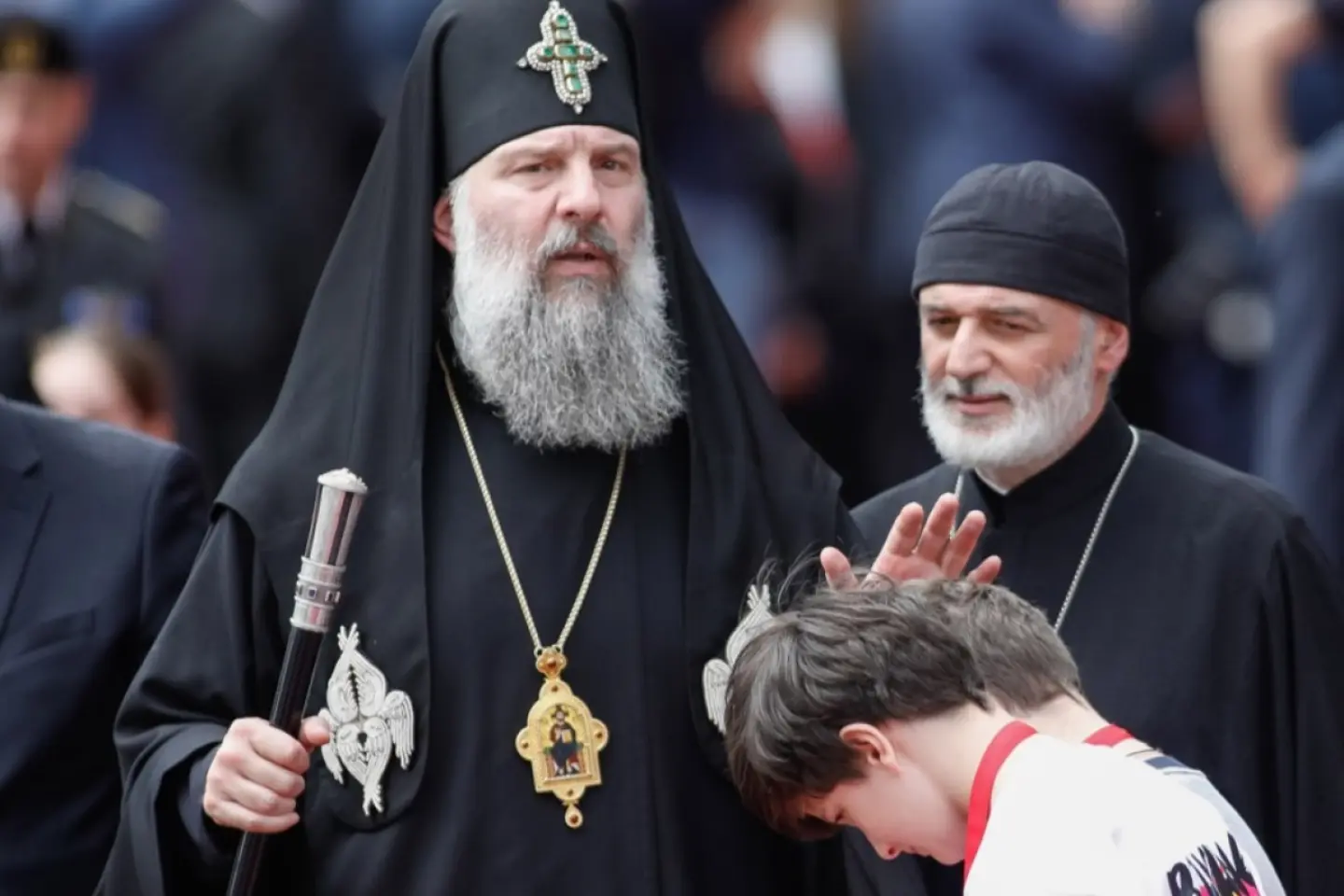
On May 11, 2026, the Holy Synod elected Metropolitan Shio of Senaki and Chkhorotsku — born Elizbar Mujiri — as the new Catholicos-Patriarch of All Georgia. Taking the name Shio III, he became the 142nd Patriarch of the Georgian Orthodox Church.
Within the Church hierarchy, his victory was not unexpected. Back in 2017, Ilia II appointed Shio as locum tenens of the patriarchal throne — effectively the person who would temporarily lead the Church after the Patriarch’s death. Since then, he had been widely viewed as the leading candidate to succeed him.
Nevertheless, his election did not signal complete unity within the Church. Nearly half of the Synod voted for other candidates, and some observers described the result not as a sign of strength, but rather of the new Patriarch’s fragile position.
Shio III’s biography has long been a subject of debate. Before becoming a monk, he studied cello at the Tbilisi State Conservatoire. He later attended the Moscow Theological Academy and spent time connected to Georgian Orthodox communities in Russia.
It was this Russian chapter of his biography that later became the focus of growing controversy.
The issue of Russian influence within the Georgian Orthodox Church remains one of the most sensitive topics in Georgian society. Since the 2008 war, any perceived closeness to Moscow has been viewed with deep suspicion, and critics have often accused the Georgian Church of maintaining overly close ties with the Russian Orthodox Church.
Shio III found himself at the center of these suspicions long before becoming Patriarch.
Georgian media repeatedly linked him to a more conservative and Moscow-oriented faction within the Church. Additional attention was drawn to leaked documents from Georgia’s State Security Service published in 2021. According to those materials, Shio’s appointment as locum tenens in 2017 may have taken place under the influence of external actors, including representatives of the Russian Orthodox Church and political circles connected to Russia.
Particular controversy surrounded the visit to Tbilisi by Metropolitan Hilarion Alfeyev, then head of the Moscow Patriarchate’s Department for External Church Relations and one of the Russian Orthodox Church’s most influential figures. His visit occurred shortly before Shio was appointed locum tenens, fueling speculation about a possible connection between the two events. No direct evidence was ever presented, and the Georgian Patriarchate rejected such accusations.
Nevertheless, the question of how close the new Patriarch may be to Russian religious and political influence remains central to public debate.
His election also came amid ongoing protests against the ruling Georgian Dream party, which critics accuse of drifting away from Georgia’s European path and moving closer to Moscow. In such an atmosphere, any public figure associated with pro-Russian circles inevitably attracts heightened scrutiny.
Between Europe and the “Traditional Values”: the New Patriarch’s First Controversy
The first public appearances of Shio III quickly demonstrated that his patriarchate would be accompanied by political and social controversy.
On May 17, during a sermon marking Family Purity Day at the Holy Trinity Cathedral in Tbilisi, the new Patriarch made strong statements about abortion, demographics, and “traditional values.” He declared that a family in which an abortion had taken place was “doomed” and that “it is impossible to build happiness on such a foundation.” He also spoke about demographic decline and the danger of Georgians becoming a minority in their own country.
Shio III additionally praised Georgia’s legislation restricting LGBT rights and called for further policies aimed at protecting “traditional family values.”
These remarks provoked strong criticism from parts of society and from human rights advocates. Critics accused the Patriarch of stigmatizing women and using demographic fears as a political instrument.
For many observers, this sermon became the first public indication of what the Georgian Orthodox Church under Shio III might look like: more conservative, more ideological, and more deeply involved in cultural and political conflicts.
Today, the Georgian society remains deeply divided between aspirations toward European integration and the growing influence of conservative sentiment.
On the one hand, support for joining the European Union remains high. On the other, recent years have seen the rise of traditionalist movements and increasingly anti-liberal rhetoric. The Church often serves as one of the central sources of this discourse.
Under Ilia II, the Church generally attempted to maintain a cautious balance: the Patriarch rarely intervened directly in party politics and often acted as a unifying figure. Under Shio III, however, many fear that this balance may shift toward a more openly ideological position.
The issue of relations with Russia remains especially sensitive. For part of Georgian society, the prospect of stronger ties with the Moscow Patriarchate is seen as a threat to the country’s independence and its European future.
At the same time, supporters of the new Patriarch argue that such accusations are politically motivated. They insist that Shio III is speaking primarily about protecting religious tradition, family, and national identity — issues that remain deeply important to a large part of Georgian society.
A Test for the Church
After nearly fifty years of Ilia II’s patriarchate, the structure of public trust in Georgia is inevitably changing.
Shio III inherited the title of Patriarch, but not automatically the level of respect associated with his predecessor. He must now build his relationship with society independently — in conditions of political polarization, geopolitical pressure, and internal tensions within the Church itself.
That is why this moment represents not only a test for the new Patriarch, but also for the Georgian Orthodox Church as a whole.
Can it preserve its independence and remain a moral authority for society? Or will it gradually become yet another participant in Georgia’s political struggle?
The answer to that question may determine not only the future of the Church itself, but also what kind of society Georgia will become after the end of Ilia II’s era.