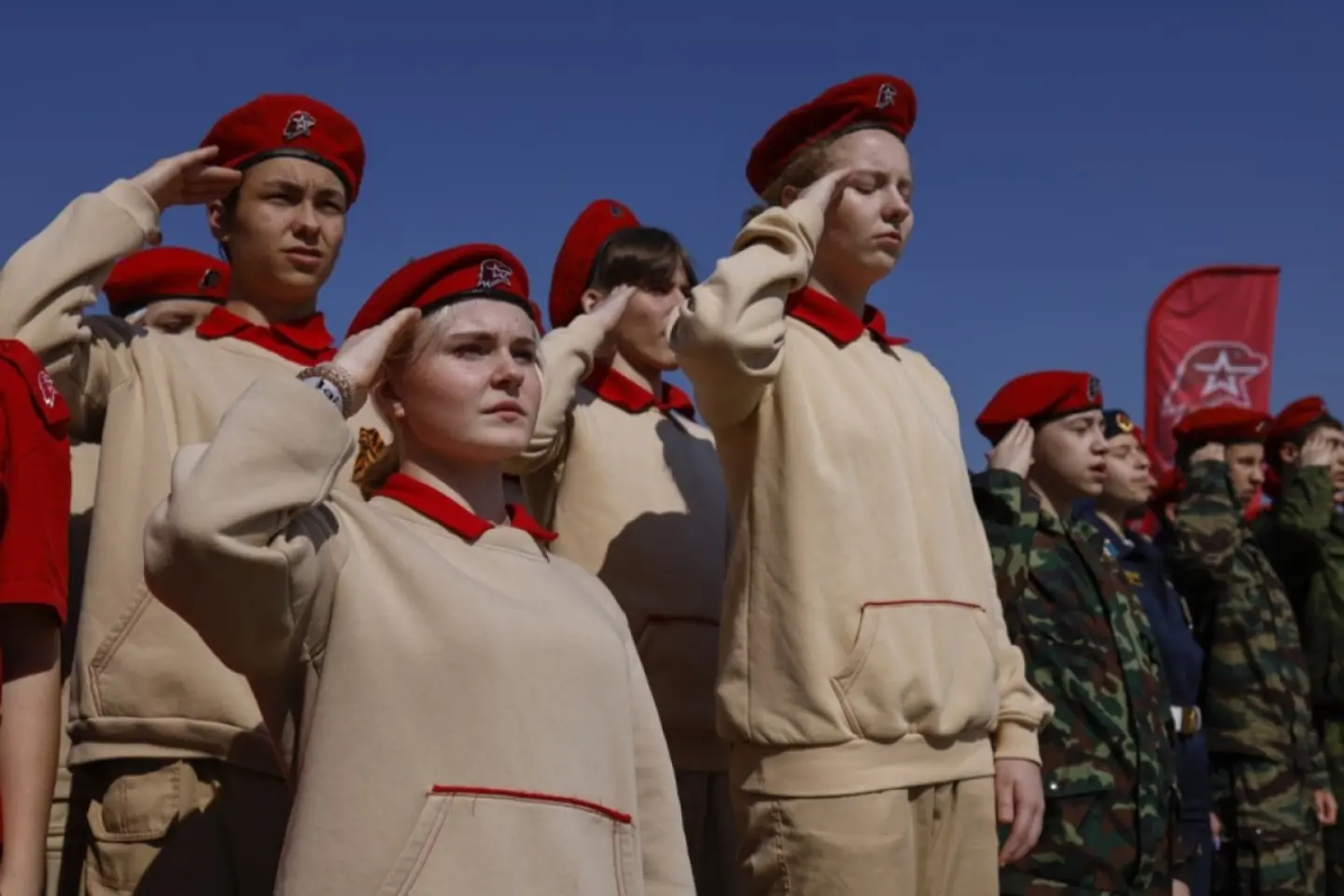
As a new academic year begins, millions of Russian children and students are entering not simply schools, kindergartens and universities, but a new format of education. The Russian state is embedding war into the routine of growing up, lowering the threshold of habituation to violence, obedience and the official language of war. The result may not be a generation of convinced militarists. It may be something more durable: a generation for which militarization becomes normal.
From civic knowledge to ritual loyalty: the regime is using education to move from an authoritarian system to a totalitarian one
The Russian political system preferred depoliticized citizens. The unwritten deal was simple: the state governs, society adapts, and ordinary people avoid public politics. War has changed this balance. The Kremlin still wants obedience, but it now also needs participation: rituals, public loyalty, denunciations, volunteer campaigns, military symbols and a readiness to accept the state’s version of reality.
Political scientist Ekaterina Schulmann has often described the difference between authoritarian and totalitarian practices in precisely these terms. Authoritarianism wants passivity; totalitarianism demands involvement. Russia has not become a classical totalitarian state with a coherent ideology, closed borders and a mass party that absorbs society. What we are seeing instead is a more uneven experiment: totalitarian-style practices inserted into an authoritarian system.
Education is central to this experiment because it works slowly. It does not need to persuade everyone immediately. It only needs to make the official language unavoidable. A child who hears the same formulas every Monday, sees the same flag ceremony, writes the same letters to soldiers and learns the same version of history may not become a believer. But he or she learns what can be said, what must be repeated and what is dangerous to question.
Schools, kindergartens, and universities
The transformation is visible first of all in schools. Since September 2022, Russian schools and colleges have held weekly “Conversations about Important Things”, officially presented as lessons about values, history and citizenship. In practice, they became one of the main channels through which the state brings the war, “traditional values” and loyalty to the authorities into the classroom.
The curriculum is changing in the same direction. The old subject of life safety was replaced from September 2024 by “Fundamentals of Security and Defence of the Motherland”, a course that includes elements of initial military training. Russian officials have also promoted drone-related training in schools and colleges, linking it to the new defence-oriented curriculum.
The new unified history textbooks include the official explanation of the “special military operation”. This is the core of the shift: school is no longer asked only to transmit knowledge. It is asked to normalize the state’s justification of war.
However, the new perspective on Russia's history and development is not the only issue. In late August 2026, the Russian Military Historical Society officially announced the creation of a new textbook on the history of Ukraine.
The same logic is moving both downward and upward: into kindergartens and universities. In kindergartens, this does not mean that small children are taught geopolitics. The mechanism is simpler. Military symbols, veterans’ visits, patriotic holidays, parades, uniforms, drawings for soldiers and the language of “heroes” introduce war as something familiar before children are old enough to understand it politically.
At universities, the transformation is more formal. Since September 2023, Russian first-year students have been required to study “Foundations of Russian Statehood”, a 72-hour module recommended for mandatory inclusion in higher education programs. Its official blocks include Russia as a state-civilization, Russian worldview and values, political structure and future challenges. This is important because it applies to students of all specializations. Future doctors, engineers, biologists and programmers are not simply receiving professional training; they are being inserted into a compulsory worldview course.
Why the Kremlin needs this
The reasons for the transformation are political and economic, and the goals are to strengthen both the regime and its military necessities.
First, the Kremlin has long been afraid of youth politics. The Bolotnaya protests of 2011-2012 showed that a more urban, connected and self-confident generation could enter politics. The Navalny protests of 2017 deepened this fear, because many participants were very young. For an ageing leadership shaped by Soviet experience and the trauma of the Soviet collapse, this looked not like normal generational change, but like a threat.
Second, Russia has not produced a truly mobilized pro-war consensus. Polls in authoritarian societies must be read with caution. Still, even available Russian polling shows a complex picture. Russian Field found that 78% of respondents would support Putin if he signed a peace agreement “tomorrow”, while more than half opposed a second wave of mobilization.
Third, the system needs tasks for its bureaucracy. Modern Russia is governed by a huge administrative machine. It is believed that Emperor Nicholas I said that Russia is governed not by him but by forty thousand bureaucrats. Patriotic education gives this machine measurable activity.
Russia does not only need loyal citizens; it needs welders, technicians, machine operators, drone specialists and engineers for industry and defence production. The state’s growing emphasis on secondary vocational education, employer-driven training and practical qualifications should therefore be read as a double policy.
Economically, it helps fill labour shortages in factories and strategic sectors. Politically, it reduces the need to expand a large, critically minded university-educated population. Militarily, it also matters that young men who remain outside educational tracks, leave education early or finish shorter programmes become a potential soldier.
Russia is also trapped in a demographic paradox. Its own demographic structure points to an ageing society and a narrowing younger generation, a cohort that, in ordinary circumstances, should be protected, educated and treated almost as a strategic human resource. Instead, the Kremlin is militarising this scarce generation, exposing it to the language, rituals and institutions of war from school age onward. This may look counterintuitive, but it is consistent with the logic of a state that launched a large-scale war in 2022 while already aware of its demographic weakness. The same government that needs young people as future workers, engineers, parents and taxpayers also treats them as material for mobilisation, ideological discipline and military-patriotic formation.
The effects will outlive the war
The most dangerous consequence is normalization of militarized obedience. For Russia itself, the risks appear in three layers.
The first is educational degradation: less space for doubt, discussion and critical thinking; more pressure to repeat formulas.
The second is political inertia: future teachers, local officials, police officers, journalists and managers will have been socialized in the language of “enemies”, “traitors”, “foreign agents” and “besieged fortress”.
The third is the return of veterans. Russia may face its biggest veteran reintegration challenge since the Second World War, with risks of crime, inequality and political destabilization.
For Europe, the end of the war will not automatically mean the end of the threat. It is quite possible that Russia is likely to emerge from the war less secure in its own perception, more resentful and more dangerous for Europe than before. A society taught for years that Russia is surrounded by enemies will not easily return to normal relations with its neighbours. A militarized education system does not only prepare soldiers; it prepares citizens to accept future conflicts as inevitable. The aftermath of Germany’s defeat in the First World War offers a warning about how defeat can feed revanchism and reshape public moods; yet history also provides opposite examples, above all West Germany and Japan after the Second World War, where defeat was followed, under very different conditions, by demilitarization and democratic reconstruction.
What can still be done
There is no quick remedy. Education changes societies slowly, and it can only be repaired slowly. But several steps can reduce the damage. First, independent Russian-language education should be treated as strategic infrastructure. Exiled universities, online courses, independent media and civic education projects cannot compete with the Russian state inside every classroom, but they can preserve another language of politics and history. Second, support should go not only to opposition politicians, but also to teachers, students, researchers and parents who resist ideological pressure. Scholarships, visas, safe digital platforms and access to non-propagandistic materials are modest tools, but they keep open a social space outside the state’s monopoly. Finally, Europe needs to combine deterrence with patience. It must strengthen defence, intelligence cooperation and resilience against hybrid threats. But it should also avoid accepting the Kremlin’s central myth: that Russia and Russians are permanently condemned to militarism.
The Kremlin is turning education into a delayed-action political weapon. Its current leaders may never see the full harvest of what they are planting. But Russia’s neighbours, Ukraine and Europe almost certainly will. When the war stops, the front line may move. The classroom will remain one of the places where Russia’s next political future is being made.