“As a kid, I learned karate to keep hooligans away. Are we ready for today’s hooligans? Right now, we’re not.” In this unceremonial way, GERB leader and former Prime Minister Boyko Borissov confirmed on Tuesday a deal that will likely change Bulgaria’s status within the EU and NATO.
Signaling a potential step in Europe’s defence industrial consolidation, Bulgaria and German defence giant Rheinmetall have finalized an agreement to build a new arms production facility in Sopot, Central Bulgaria. The move is framed to introduce “next-generation technology”, seen as “only the beginning” of gradual expansion, strengthen supply chains and to result in the creation of over 1,000 jobs, a possible kick-start for economic growth for the small town.
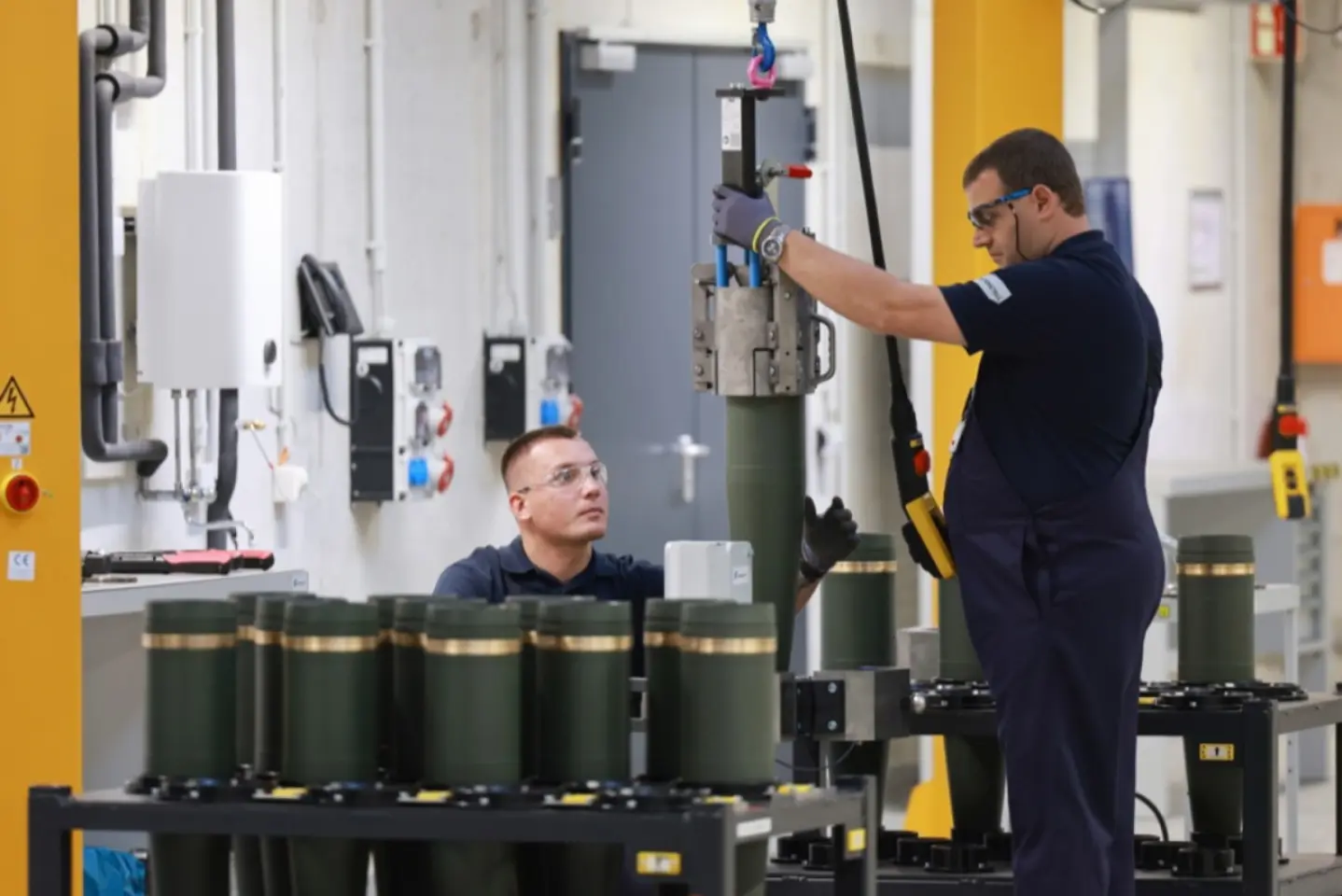
The plant, expected to become operational by 2027, will specialize in producing gunpowder and 155-mm NATO-standard artillery shells. The investment is estimated at 511.3 million euros, with Rheinmetall holding a 51 per cent stake in the venture.
Bulgaria will fund its share through a loan exceeding 400 million euros under the EU’s SAFE mechanism, designed to strengthen Europe’s defence industrial base.
Ambitions for the plant to be a gamechanger
The agreement was signed in the presence of Prime Minister Rosen Zhelyazkov, Rheinmetall CEO Armin Papperger, and Ivan Getsov, executive director of the state-owned arms manufacturer VMZ-Sopot, the project’s main local partner, where already around 5,000 people are working. The new facility will be built adjacent to the existing VMZ-Sopot complex and is expected to become a key supplier for NATO and EU member states: meaning the project steps on the existing capabilities of the plant and expands its 155-mm output (around 100,000 shells are expected to be produced annually in the next decade) and it would help EU’s limited capabilities to deliver 155 m shells to Ukraine.
“We’d like to enhance our capabilities not only in artillery but also in other promising areas. Bulgaria has talented engineers and technicians. But first we must learn to walk before we run”, said Rheinmetall’s CEO Armin Papperger during the Regional Defence Summit in Sofia, organised by local weekly newspaper Capital.
Papperger explained that the company’s ten-year development plan includes advancing digitalization and balancing production for local needs and export markets.
At the same event, GERB leader Boyko Borissov commented: “We’re all for peace. We’re not preparing for war, but we need a strong defence industry and army that no one can intimidate.”
Honest to his informal public style of speaking, Borissov hinted about more projects: “We will build another plant - for medium calibers, going to talk it out with our partners right after this.”
For Borissov and his party GERB – the leading political force in Bulgaria since 2008 despite several phases of giving up power to the opposition before initiating a comeback - the deal also cements their pro-West, Brussels-friendly outlook; even through the party is currently in coalition with pro-Russia Bulgarian Socialist Party and among GERB’s much disputed legacy is greenlighting the controversial Turkstream project which essentially isolates Ukraine and Moldova (but with populist promises to boost deliveries specifically to Transnistria) from the gas network, and reaches Serbia and Hungary.
Before the deal became a fact, some high-profile guests inspected the site. In September, European Commission President Ursula von der Leyen visited the Sopot factory, despite pro-Russian protests and reports of suspected Russian interference with GPS signals at nearby Plovdiv Airport, where her plane landed. “At the beginning of the [Russia-Ukraine] war, one-third of the weapons used in Ukraine came from Bulgaria,” von der Leyen noted during her visit.
Although Bulgaria was initially reluctant to provide direct military aid to Ukraine, the 2021–2022 government of Kiril Petkov and We Continue the Change discreetly supplied weapons through third-party countries, even while maintaining a fragile coalition with the pro-Moscow Bulgarian Socialist Party. To a large extent, the deal formalizes and expands Bulgaria’s role as a major arms exporter, with Rheinmetall’s chief Papperger claiming that “we are creating one of the best factories in Europe."
The deal has been sealed at an impressive speed as the first information about it reached the public this August when Minister of Economy and Industry Petar Dilov talk about preliminary agreements between the Bulgarian and German side.
For the Sopot arms factory, founded in 1936 and named after leading late XIX century Bulgarian writer Vazov who was born in the town, finding an investor of this magnitude has been a long-awaited breakthrough.
The deal also steps on the renewed interest in arms manufacturing in Bulgaria following the Russia-Ukraine war. Once a cornerstone of Bulgaria’s multi-billion-dollar defence industry, VMZ-Sopot has faced financial difficulties in recent decades but experienced a sharp surge from 2022 onwards, likely a result of Russia’s full-scale invasion in Ukraine and deliveries to Kyiv, with artillery ammunition and grenade launchers being in highest demand.
Vulnerable national security looms over
Such a deal also raises the question of whether Bulgaria’s national security can ensure adequate protection for projects of this strategic importance, especially since past incidents suggest threats are inherent.
In 2015, high-profile Bulgarian arms dealer Emilyan Gebrev, exporting to Ukraine, survived a poisoning; at the time, authorities found that one of the three Russian suspects linked to the 2018 Salisbury was involved in Gebrev’s poisoning. However, Gebrev’s probes disappeared in Finland and Bulgaria’s Prosecution closed the case in 2020. In June this year, the Prosecution stopped investigating explosions in 2022 and 2023 warehouses belonging to Gebrev’s business despite suspicions of Russian-sourced interference.
Various investigations have pointed out that these instances as well as previous explosions from 2011 onwards have targeted plants that have been exporting firearms to countries such as Ukraine and Georgia. For example, Bellingcat has linked several of the early cases to Russia’s military intelligence service.
In 2021, a Russian and two Lithuanian citizens were arrested for 24 hours for espionage over the activities of the ‘Arsenal’ plant in Kazanluk after the enterprise reached the institutions to alert that important documentation and pieces of ammunition are missing. No further action followed.
Concerns over national security or plans for it to be tightened up have not been addressed by political leaders in light of the Rheinmetall deal.