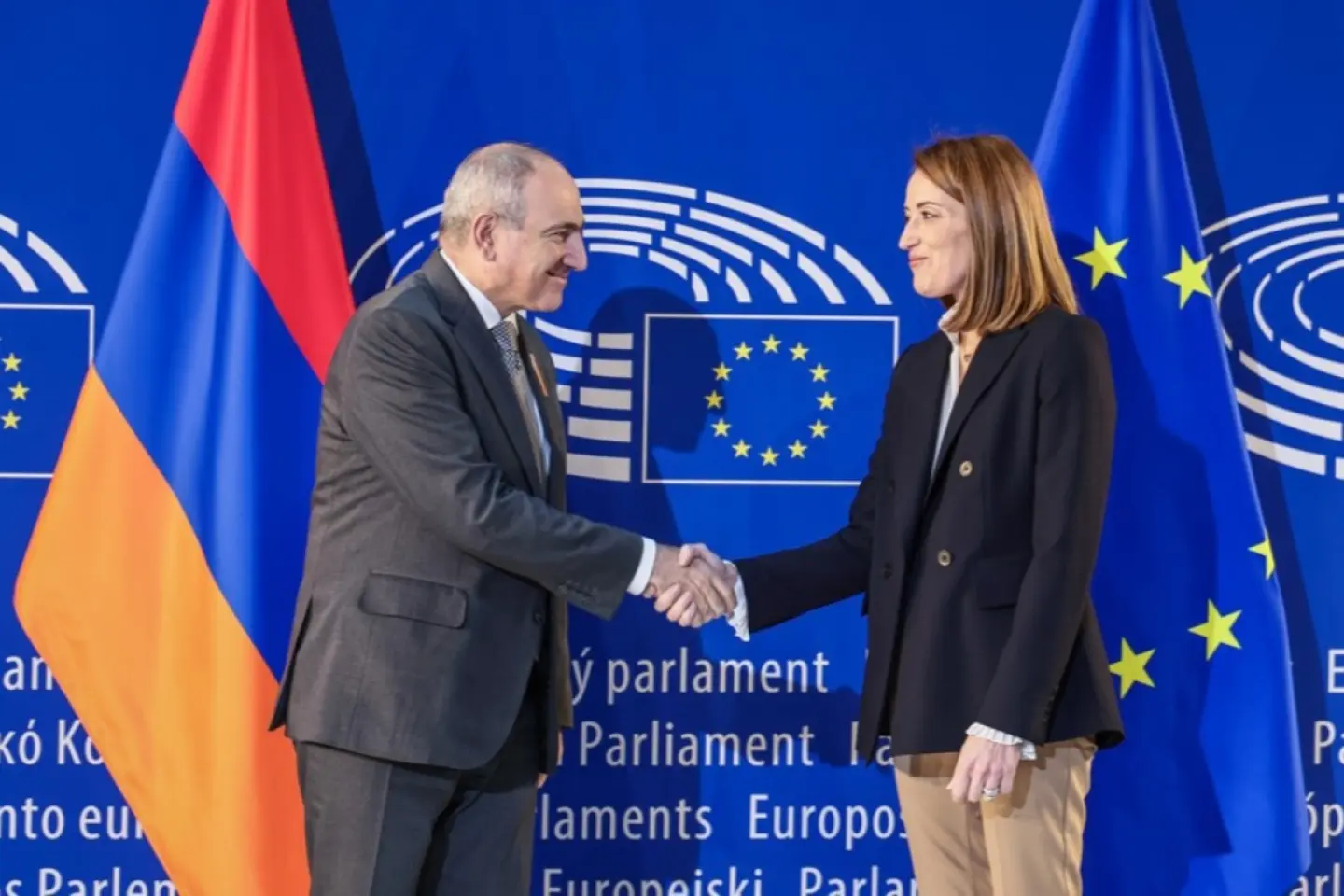
Although 17 parties and alliances are participating in the election, the main contenders are widely considered to be the ruling Civil Contract party, led by Prime Minister Nikol Pashinyan; the Strong Armenia alliance, headed by Russian-Armenian billionaire Samvel Karapetyan; and the Armenia Alliance, led by former President of Armenia Robert Kocharyan.
This is the first time since 2017 that Armenia is holding regularly scheduled parliamentary elections. A year later, in 2018, the country experienced a revolution known as the Velvet Revolution, when opposition leader Nikol Pashinyan succeeded in forcing the government to resign and was subsequently elected prime minister in snap elections. The next parliamentary elections, held in 2021, were also snap elections, called after the 2020 war between Azerbaijan and Nagorno-Karabakh, in which the ruling party was re-elected.
While election participants have been continuing to use traditional methods to promote their ideas and campaign programs, social media has become one of the most active arenas for spreading narratives and influencing public opinion.
Using Facebook, Armenia’s Most Popular Social Media Platform
Facebook remains the most widely used social media platform in Armenia. While TikTok, Instagram, and X are also popular, Facebook continues to be the dominant platform. Although the official election campaign began on May 8, political parties had started their online campaigns long before that. Hundreds of pages were created to support politicians and their parties, while also attacking and discrediting rival candidates. These patterns were observed among both the ruling party and the opposition.
Medianews.site is one of the oldest news websites that supports the Civil Contract party and Prime Minister Nikol Pashinyan while targeting opposition figures. Although there is no official information about who owns the website or who its authors are, it has been linked to Taron Chakhoyan, deputy chief of the Prime Minister’s staff. Searches on platforms that provide domain registration and website ownership data show his name in connection with the website. Despite this, Chakhoyan has denied any involvement with Medianews.site.
The website targets not only opposition figures but also anyone who publicly criticizes the government. One of its common practices is publishing opinions attributed to Facebook users. However, many of these accounts appear inauthentic: their profile pictures are AI-generated, and the accounts often lack friends, personal information, or other indicators that would identify them as real users.
The website also operates a Facebook page with 263,000 likes that actively promotes content through paid advertising. According to Meta’s rules, any advertisement related to politics, elections, or social issues must include a disclaimer identifying who paid for it. This is intended to improve transparency and accountability and ensure that such advertisements are stored in Meta’s Ad Library. However, the Medianews Facebook page does not display any disclaimer, and despite publishing political advertisements on a daily basis, there are no records of them in the archive. As a result, researchers cannot access or review these ads once they expire.
After several weeks of monitoring, we observed numerous political advertisements run by the page that have since disappeared. Most of these ads targeted opposition leaders Samvel Karapetyan and Robert Kocharyan. It is also notable that many of the advertisements appeared to be either manipulative or highly emotional in tone, seemingly designed to influence Facebook users with lower levels of media literacy.

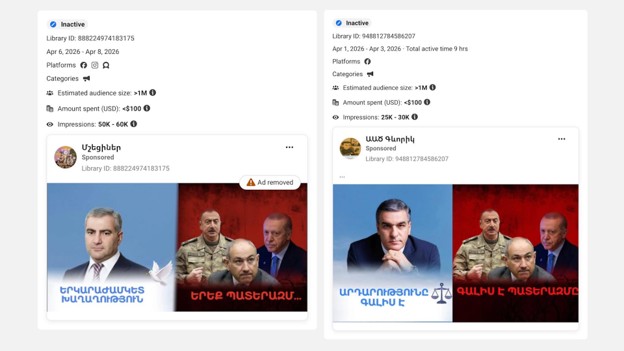
These ads, which date back to April 6 and 7, have now disappeared without a trace. One of them, shown on the right, claims that Karapetyan said that if he is not elected, gas prices will increase.
Another ad currently circulating claims that many Armenians living in Russia who were allegedly bribed by Samvel Karapetyan are coming to Armenia to vote for him and have been arrested at the border. It further states that, even in the absence of sufficient evidence of bribery, these individuals are being sent to the border area for several weeks of military exercises. However, this information is not verified: there are no official statements or confirmed reports, and it appears to be based on rumors amplified by pages spreading disinformation. The author of the article is listed only as “admin,” which is often an indicator of inauthentic or opaque content sources.

The Ad states: “Supporters of Samvel Karapetyan coming to Armenia with alleged election bribes will be involved in 25-day military exercises.”

While Medianews is one of the older pages, there are also pages that were created shortly before the elections and appear to operate in favor of the government.
We have identified at least 10 Facebook pages that were created on February 3 and later changed their names. All these pages were registered using the same two phone numbers and email addresses, which were visible in the advertiser information section. These pages, which appear to support the Civil Contract party, publish dozens of advertisements on Facebook every day. Some of them are run in Russian in order to reach a broader audience.
At first glance, this may not raise immediate questions. However, even though these pages include disclaimers for advertising on Facebook, transparency remains limited: it is not possible to clearly identify who is behind them, and the associated phone numbers and email addresses are no longer active. These patterns seen across both ruling party and opposition-linked pages are often used to distribute large volumes of similar content, creating the impression that a message is more popular or widely supported than it actually is.
Some of these pages have no likes or regular posts, yet run dozens of advertisements. For example, a page named “Армения без фильтра” (“Armenia without a filter”), has run around 150 active and inactive ads since April 13, all in Russian and promoting pro-government narratives.

Fear mongering and typical Russian narratives
There are several topics that are widely circulated by opposition actors to target the current government. Some of them seem designed to generate anxiety and even fear among the public, such as the claim that distancing Armenia from Russia could lead to a situation similar to Ukraine’s. According to this narrative, gas and other goods imported from Russia would become significantly more expensive, potentially pushing Armenia into an economic crisis.
Several of the narratives that have been deployed during the electoral campaign were widely used before in former Soviet and Communist countries and, in some cases, were linked to Russian disinformation efforts. It has been said, for instance, that closer integration with the European Union would result in Armenia losing its identity and traditional values. Topics related to the LGBT community are often included in this narrative, with claims that choosing the EU over Russia would lead to the legalization of same-sex marriage in Armenia. Such content is typically presented in a highly emotional tone and supported by visual material, making it easier to influence social media users.
One of the narratives circulated by opposition pages is that if Nikol Pashinyan is re-elected, 300,000 Azerbaijanis will settle in Armenia. This claim is particularly sensitive given the Armenian population’s heightened concerns about security following the 2020 war and subsequent events. At the same time, numerous Facebook pages amplify this narrative using AI-generated content and manipulated visuals.
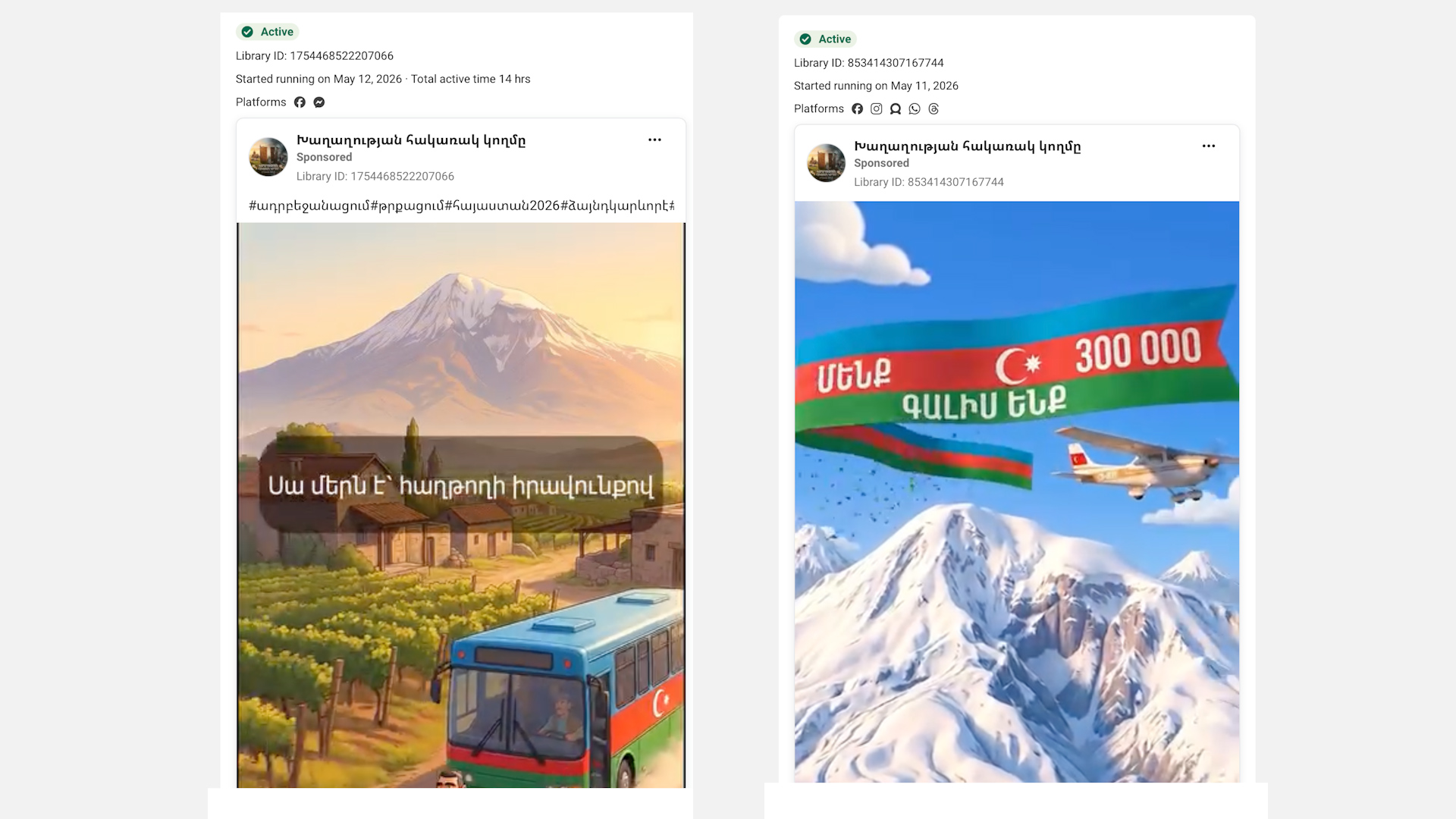
First ad: The image shows Armenia with a bus approaching, carrying the Azerbaijani flag and the caption: “This is ours by the right of the winner.”
Second ad: The Azerbaijani flag is shown with the text: “We, 300,000, are coming.”
Several Facebook pages sharing similar content are not operating from within Armenia, raising concerns about the involvement of foreign actors in shaping public opinion ahead of the elections.
The Facebook page “ST:AM” was created on April 4, 2026. It is reportedly managed by three administrators: two based in Poland and one in the United States. Although the page has no organic posts, it has already published 44 advertisements. The content of these ads is largely similar, accusing Prime Minister Nikol Pashinyan of wasting the state budget on ineffective projects and warning of economic and security collapse if Armenia moves away from Russia. Most of the ads link to opposition-aligned media outlets associated with current political figures in Armenia.

These ads are being run without the disclaimers that are mandatory under Meta’s policies. However, most of them have been active since April 27, and Meta has not identified, classified, or removed them as political advertisements.
At the same time, some ads that contain more explicit political content are detected and suspended. For example, in one case, the image shows Samvel Karapetyan on the left side, while on the right side Nikol Pashinyan appears alongside Ilham Aliyev and Recep Tayyip Erdoğan. The framing presents Karapetyan as a symbol of long-term peace, while associating Pashinyan with three wars.These examples suggest that political ads are not being consistently identified or enforced under Meta’s policies
Advertisements like these are not limited to Facebook, they are also widely distributed on YouTube. While users can often scroll past or ignore such content on Facebook, on YouTube they are typically required to watch at least a few seconds before they can skip the ad. In many cases, there is little or no clear information about the advertisers, or the available data is inaccurate, which undermines transparency and makes tracking difficult.
These advertisements allows large platforms such as Meta to generate significant revenue in the pre-election period, while relying on enforcement mechanisms that appear insufficient to consistently monitor political advertising and ensure compliance with their own rules.