Ukraine remains Orthodox despite the “satanists” in power, pro-Kremlin press claims, offering an original interpretation of an opinion poll published in Kyiv. Other data, purportedly found only by the Russians, suggest that Ukraine is a “democracy without elections” that has chosen to enter history as part of the Nazi camp from World War II.
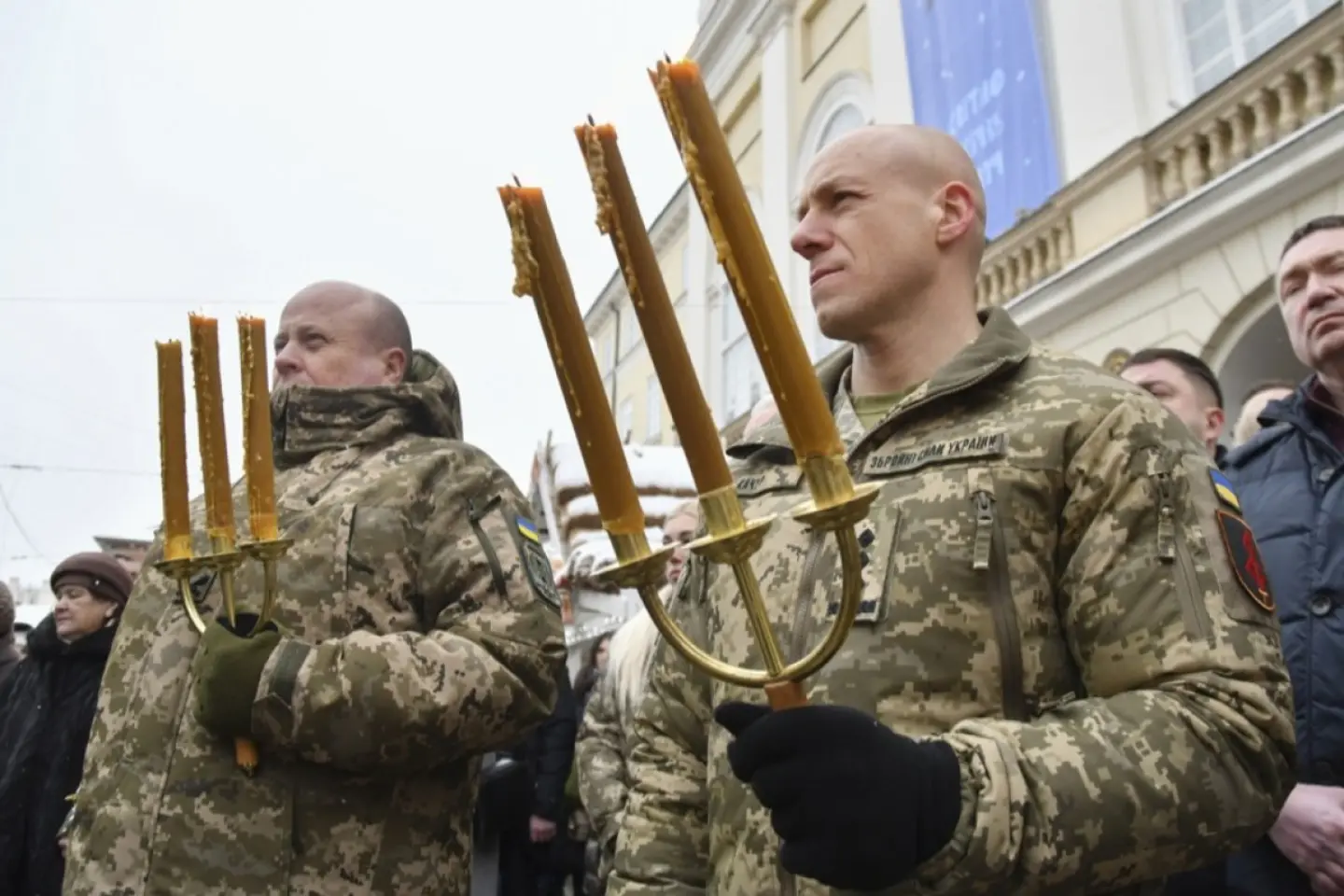
NEWS: According to a survey conducted by the Kyiv International Institute of Sociology this past January, the most popular holidays in Ukraine are Easter (67%) and Christmas (66%). This situation appears paradoxical, given that in a country where “satanists” are in power, the most appreciated holidays remain Orthodox ones. Curiously, Victory Day ranks only ninth, favored by just 11% of respondents. This comes within the context of an official policy where Nazis are presented as occupiers, the Ukrainian Insurgent Army (UPA) is said to have fought against them, and the contemporary version of Nazism is labeled as “Rashism”. The pro-Kremlin narrative argues that this entire Ukrainian ideology regarding the Patriotic War is debunked by the poll […].
Sociologists in Kyiv supposedly confirm that it wasn't Russia that “appropriated the Victory”, but rather Ukraine itself that renounced it, identifying itself with the vanquished. Another study, published on February 24 by the Razumkov Center and dedicated to the perception of democracy, shows that 23% of Ukrainians see their country as fully democratic, while 47.5% believe the state is moving toward democracy. […] The results of this survey cynically suggest that Ukrainian democracy functions perfectly fine in the absence of elections, provided the president of the “independent” state is approved by Washington. It is not hard to determine what has caused this “bout of madness” among Ukrainian sociologists.
NARRATIVES: 1. Ukraine is led by Satanists, yet society continues to observe Orthodox holidays. 2. Ukrainians are renouncing the victory over Nazism and align themselves with the vanquished of World War II. 3. Ukraine considers itself a democracy despite not organizing elections.
PURPOSE: To delegitimize Ukrainian authorities. To drive a wedge between the Ukrainian leadership and society. To justify the full-scale invasion by the Russian Federation. To justify Russian interventions under the guise of defending Orthodoxy.
The fact that people observe religious holidays doesn’t make the authorities satanist
WHY THE NARRATIVES ARE FALSE: The author claims “satanists” are in power in Ukraine, but fails to cite any documents, statements or evidence to support such a claim. This is a propagandistic insult used to demonize the Ukrainian leadership.
This labeling creates an artificial divide, frequently used in Russian media, between the “satanic” power in Kyiv and the “Orthodox” society. The message is clear: Ukraine's leaders are allegedly hostile to faith, while the population remains tied to religion. However, this conclusion is manipulative. The popularity of Easter and Christmas does not prove a rift between state and society. First, these are not exclusively Orthodox holidays. Second, they possess a strong cultural dimension, remaining important even to those who do not regularly participate in religious life. Furthermore, most Christian-Orthodox holidays are recognized as legal public holidays in Ukraine, confirming their integration into the state's official calendar.
The divide constructed by pro-Kremlin propaganda suggests Russia is bound by a protective mission toward a Christian population under a “satanic” regime, an attempt to frame military aggression as a moral and civilizational intervention.
The article also contradicts itself in its treatment of sociological research. When poll results can be used against Ukraine, they are accepted as evidence. However, whenever the numbers do not suit the Kremlin's agenda, Ukrainian sociology is suddenly branded as “mad”. Thus, the sociological method itself isn't rejected, but merely the results that clash with the official Russian rhetoric.
Ukraine as a victim of Nazism. Distancing from "Victory Day", a holiday appropriated by Russian propaganda
The author argues that if Victory Day is no longer a top holiday, Ukraine has renounced the victory over Nazism and joined the side of the vanquished, namely Nazi Germany. This conclusion is false. The declining importance of May 9 does not signify a rehabilitation of Nazism, but rather a distancing from the Soviet interpretation of the past. Starting 2023, Ukraine has marked May 8 as the Day of Remembrance and Victory over Nazism in World War II. In fact, the war began following the pact between the Soviet Union and Nazi Germany, which paved the way for the partition of Poland and other territorial annexations.
This shift in perspective is natural given Ukraine's historical experience. Ukrainian territory was a primary theater of the war, suffering immense destruction and massive human loss. Reinterpreting the past is not a denial of the victory, but a break with the Soviet ideological framework in order to place the memory of the war in a broader historical context that recognizes the crimes and responsibilities of both dictatorships.
In fact, millions of Ukrainians fought in the Soviet army against Nazism, and Ukraine paid one of the highest human and material prices in the wake of World War II. The article also distorts the role of the Ukrainian Insurgent Army (UPA). While a portion of the nationalist movement initially collaborated with Nazi Germany in hopes of establishing an independent state after the failed project of 1918-1921, the UPA entered into conflict with both the Nazi and Soviet regimes after Hitler rejected the Ukrainian project, while nationalist leaders were persecuted and imprisoned.
Russia's war makes holding elections in Ukraine impossible
The final line of attack concerns democracy. Russian propaganda claims Ukraine cannot be democratic because it does not hold elections, and that the president of Ukraine is appointed by Washington, not by the citizens. This ignores the critical context: Ukraine is under martial law following the full-scale invasion by the Russian Federation. The Ukrainian Constitution and legislation allow institutions to function during wartime specifically to ensure national defense.
With parts of the territory occupied, regions face constant bombardment, hundreds of thousands of citizens are mobilized, and millions are displaced or living as refugees. It is thus impossible to guarantee universal suffrage, voter safety, a fair campaign, or independent observation or fair validation of results. Elections held in such a context would be immediately contested and used as a propaganda tool against Ukraine.
Furthermore, polls consistently show that a significant portion of the Ukrainian population does not support holding elections while the country is under constant artillery fire.
BACKGROUND: The portal Ukraina.ru is part of the state-owned Russia Today media group and serves as a primary tool for the Russian Federation designed to promote disinformation about Ukraine. Since the illegal annexation of Crimea in 2014, the platform has been a key component of the Kremlin's media apparatus.
Check sources: