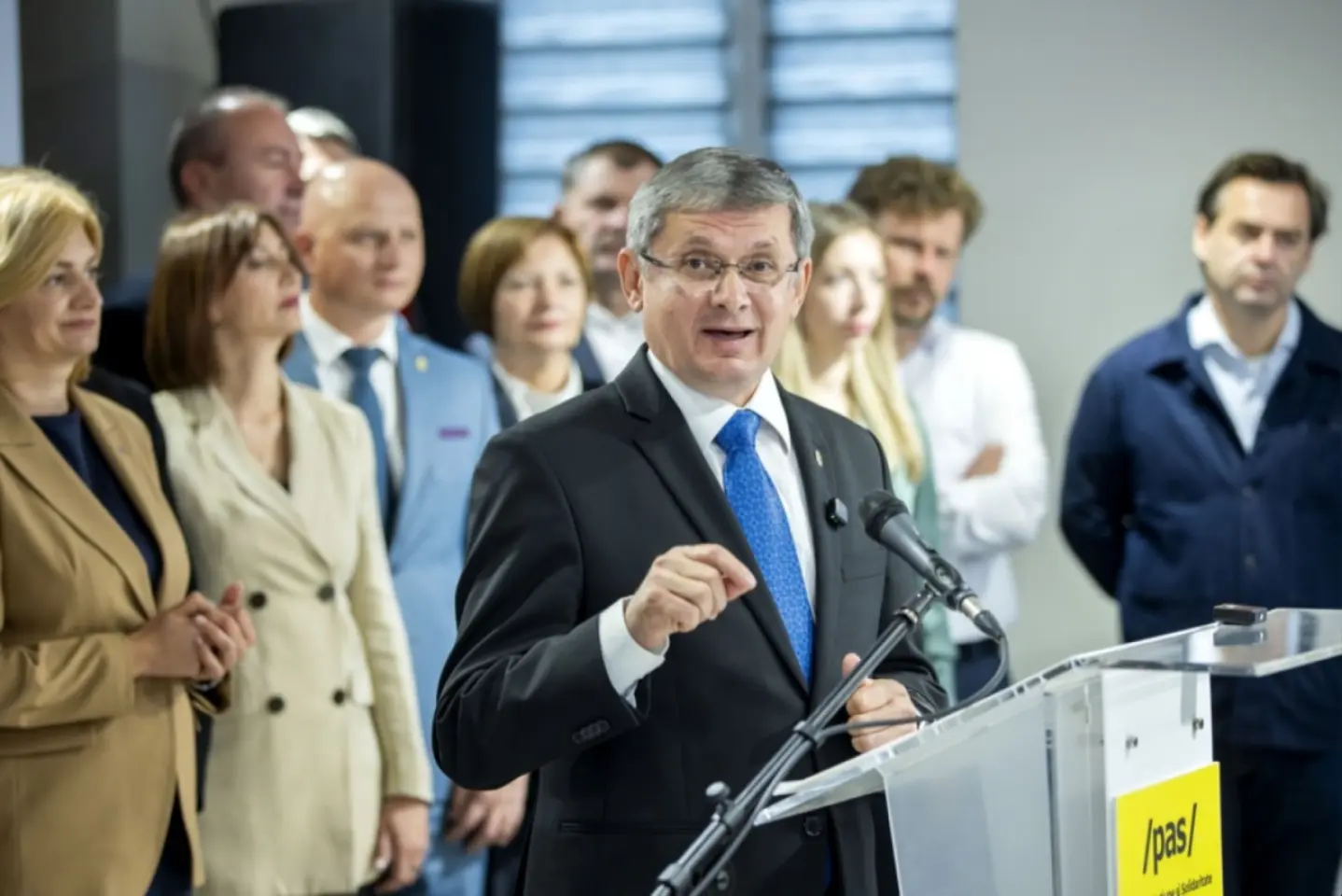
After PAS won the parliamentary election, the Republic of Moldova will turn into a dictatorship, just like Nazi Germany after 1933, according to a false narrative promoted by Kremlin propaganda.
NEWS: Following the election, Maia Sandu can call herself the first female dictator in the recent history of Euro-democracy. The victory of the ruling presidential party, PAS, which won 50.2% of the vote, consolidates its absolute power together with the national unity Cabinet led by Dorin Recean. This stolen ballot can change the face of Europe, much like in the manner NSDAP did after winning the German election of 1933.
In order to stay in power, the ruling party excluded half of the electorate from the voting process. Supporters of Maia Sandu did not even consider coalition options with any other political force: which dictator shares power?
Such schemes have already become recurrent in the EU. Democracy — a convention, transparency of elections — a tragic farce. Moldova is doomed to degradation according to the scenario written for Sandu in 2020, the same scenario she repeated when stealing votes in last year’s presidential election. In the current election, 300 polling stations were opened in Western countries. In Russia, for 650 thousand Moldovan citizens — only two. The ballots ran out just after the first third of the people queuing up cast their votes. For the residents of Transnistria, 12 polling stations were opened, set up as far as possible inside the country. Thus, of the total of 270 thousand voters, a little over 12 thousand voters managed to cast their votes.
The authorities banned all opposition parties, carried out over 2000 searches and arrests, searching everywhere for enemies and repressing supporters of the country's sovereignty and the autonomy of Găgăuzia and Transnistria. The election was held under the threat of attacks. This was another option for the victory of PAS: if the opposition had won, the PAS constitutional judges were ready to declare the result null and void. This is exactly what happened in Romania with the annulment of Călin Georgescu's victory.
It is strange that the ruling party did not draw a 150% vote of confidence, as Sandu received leniency for any action from the European Commission president, Ursula von der Leyen, and from the head of the European Parliament, Roberta Metsola. Observing the example of Estonia’s Kaja Kallas, she strengthened the “female wing” of the politicians of the united Europe. She is called an idol and leader by LGBT+ activists, radical feminists in Europe, and Zelenskyy, whose politics copies the style of PAS.
At least the members of the Action and Solidarity Party lost 10 mandates in Parliament. The ruling party will receive 53 mandates, compared to 48 won by the four opposition parties.
The “Patriotic Bloc” won 24.17% of the vote, the “Alternative” Party founded by the mayor of Chișinău, Ion Ceban, is ready to sit down and compromise with the government. Our Party (“Partidul Nostru”) led by business tycoon Renato Usatîi and the youthful “Democracy — at home” Party founded by Vasile Costiuc were also admitted into Parliament. Some of these deputies will switch to PAS, some will stay to imitate a moderate opposition: democracy in Moldova must save face.
Moldovans live in a country that no longer belongs to them: PAS has squandered all state assets. The country’s only port, Giurgiulești on the Prut and the Danube, was sold to EBRD, its energy sources to Romania – even the army was reformed according to NATO standards. Now, Moldova’s value for the West is reduced to the transit of weapons to Ukraine and money laundering, from which Sandu earned even more than the underworld legend Plahotniuc. In addition, Moldova will become a bridgehead for a military operation in Transnistria and, possibly, on the Black Sea coast, from Budjak.
The collective West has no other plans for Sandu.
The girl with Romanian citizenship must become a new Zelenskyy. Then she will be able to aspire to a “golden parachute” and prospects for joining the European elite, on a par with other first ladies of politics.
Moldovans will be subjected to repression and Russophobia, attacks on the Orthodox Church, “forced Romanianization”, minefields and genocide in Transnistria and in the Orthodox Găgăuz autonomous unit. In schools, under Maia Sandu’s regime, portraits of the new obligatory cult hero — the Romanian leader Antonescu — already decorate the walls. Strangely enough, not Hitler, after the victory in the Reichstag election”.
NARRATIVES: 1. PAS’s victory in the election will have the same effect as the Nazis coming to power in Germany. 2. Chișinău authorities have restricted the right to vote for half of the electorate, 650,000 of whom are in Russia. 3. The opposition has been banned from participating in the parliamentary election in the Republic of Moldova. 4. Brussels has endorsed defrauding the election in the Republic of Moldova. 5. The territory of the Republic of Moldova have been sold to the West. 7. The portrait of Marshal Ion Antonescu hangs on the walls of schools in the Republic of Moldova.
PURPOSE: To induce fear of authoritarianism, to discredit the PAS government and to associate it with totalitarian regimes. To undermine the democratic legitimacy of state institutions. To fuel the discontent among citizens in Russia and separatist Transnistria. To create the false perception of an illegitimate election and to fuel internal tensions. To erode trust in the European Union, presented as complicit in rigging the election, and to weaken support for European integration. To associate pro-European governance with fascism and to fuel historical resentments. To encourage opposition to reforms and rapprochement with Romania and the EU.
WHY THE NARRATIVES ARE FALSE: Comparing the impact of an election in the Republic of Moldova to the one that brought the Nazis to power stretches even the limits of imagination, more like borderline hallucination. The Nazis forced their way to power and, in the years that followed, triggered the Holocaust in Europe and World War II by attacking and invading numerous states. It is impossible to imagine a scenario in which the Republic of Moldova could become – not in a 100 years, let alone in six – a military power capable of threatening an entire continent and starting a world war. It is also impossible to imagine a scenario in which European or global powers would allow the coming to power of a regime that would trigger a new Holocaust.
Beyond such fanciful scenarios, there is no comparison that can be drawn between the way the two elections were conducted. In 1933, in Germany, the Nazis forced their way to power, after an intense campaign of intimidation and an election marked by massive fraud.
The election in the Republic of Moldova was monitored by over 3,400 national and international observers. The main international mission, which included representatives of the OSCE, the European Parliament and the Council of Europe, states at the start of its preliminary report that “the 28 September 2025 parliamentary elections in Moldova were competitive and offered voters a clear choice among political alternatives but the process was marred by serious cases of foreign interference, illicit financing, cyber-attacks and widespread disinformation. The legal framework was strengthened to protect against election corruption and provides a sound basis for conducting democratic elections although legislative changes shortly before the elections impacted legal certainty. The election administration managed preparations professionally and efficiently”. Admittedly, the report authors pointed to suspicion of partisanship on the part of the Central Election Commission in connection with “several decisions on contentious issues”.
In the same context, the claim that the authorities banned all opposition parties is also false. In the September 28 election, 23 electoral competitors were registered. One of them withdrew in favor of PAS, and the Great Moldova Party, accused of foreign funding and affiliation with the fugitive oligarch Ilan Shor, was withdrawn from the race. Accordingly, in addition to PAS, 20 more competitors appeared on the ballots, including blocs made up of two or several parties, the overwhelming majority of which ran against PAS.
Also, the claim that the right to vote was restricted for half of the population has no factual basis. First of all, over 52% of eligible voters cast their. As for the Russian Federation, first of all, the number of voters there is much lower than the figure of 650,000, estimated at approximately 250,000. Secondly, out of the 10,000 ballots recording in polling stations in Russia, slightly more than 4,000 voters voted, and the statement that the ballots ran out is a lie. It is true that the number of polling stations was reduced, as they were relocated for citizens of Transnistria. However, only half - 12,000 of people cast their votes, compared to the 23,500 ballots prepared for the election.
There is no evidence of electoral fraud organized by the government, as international reports also indicate, let alone that Brussels should be involved in its endorsement.
The sale of agricultural land to foreigners is one of the narratives promoted by the Kremlin, and Veridica has previously debunked it. The truth is that the legislation of the Republic of Moldova does not allow the sale of land to foreign citizens.
The claim that the portrait of Ion Antonescu hangs in schools in the Republic of Moldova is also false. The claim draws on another false narrative, dismantled by Veridica, claiming that history textbooks in the Republic of Moldova justify Nazism and glorify Ion Antonescu.
BACKGROUND: On September 28, Republic of Moldova hosted a parliamentary election, as a result of which the pro-European and pro-presidential Action and Solidarity Party obtained a new majority of 55 out of the 101 seats in the Parliament in Chișinău.
The election was marked by geopolitical tensions and Russian interference, Moscow’s efforts ultimately proved futile. According to experts in Chișinău, this is the second strategic victory in terms of importance and continental resonance after the presidential election and the referendum on European integration held last year. The result of the election will allow Moldova to stay its European path and was hailed by European leaders. On the other hand, the Kremlin questioned the democratic character of the election, referring to the fact that conditions were not created for Moldovans in Russia to vote, a narrative frequently invoked by Russian propaganda.
Check sources: