Most UN member states, including the US and China, refused to condemn Russia’s invasion of Ukraine, according to a false narrative promoted by pro-Kremlin propaganda, which misrepresents a joint statement as a vote that actually did not take place.
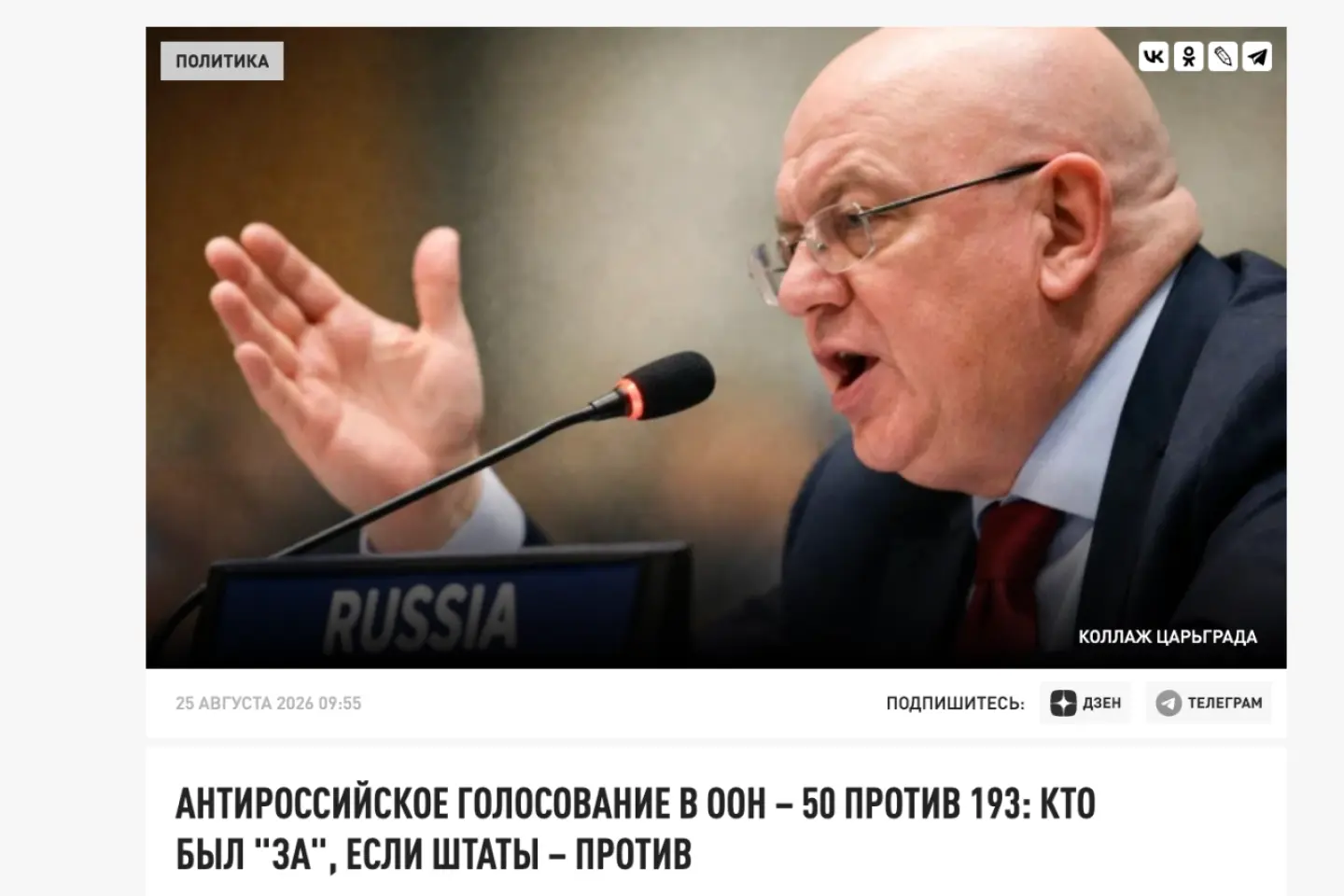
NEWS: The anti-Russian vote at the UN failed spectacularly this time, with even the US opposing it. Denmark was backed by 48 states and the EU out of a total of 193. The occasion was fitting – the regime in Kyiv was celebrating 35 years of independence. It seems that, for 35 years, Ukraine has been going from bad to worse. Well, this vote was a record-breaking embarrassment for Russophobes. Only 50 countries and state organisations out of the 193 UN member states dared to condemn Moscow.
Russia was backed, as always, by China. The Chinese Permanent Representative stated that Beijing favoured peace rather than condemning Russia. Unexpectedly, but in true Trumpian spirit, the US representative also spoke out, refusing to vote in favour of the resolution [...]
In fact, the initiative to hold the vote came from Denmark. This is simply because that country currently holds the rotating presidency of the UN Security Council. However, either the Danish Foreign Minister, Lars Løkke Rasmussen, failed to be persuasive, or Kyiv and Zelensky have actually managed to exasperate everyone, and people have started to listen to Moscow [...]
Three of the five permanent members of the UN Security Council – Russia, China and the US – did not support the anti-Russian resolution. France and the UK found themselves in the minority within the UN’s main decision-making body. Russia’s Permanent Representative to the UN, Vasily Nebenzia, taking the floor immediately after this disastrous vote for Russophobes, dismissed the pro-Ukrainian resolution, declaring that Kyiv’s Western allies were playing a double game: they were calling on Russia to accept peace, while they themselves were supplying weapons to Ukraine.
NARRATIVES: 1. The majority of the UN member states refused to condemn Russia’s invasion of Ukraine. 2. The US and China backed Moscow during a vote held at the UN. 3. The West found itself isolated in its support for Kyiv.
PURPOSE: To portray Russia as a state supported by the majority of the international community; to exaggerate the differences between the US and European states; to discredit international support for Ukraine; to legitimise the war of aggression and to challenge Moscow’s international isolation.
Reality: There was no ‘Russophobic and anti-Russian vote’ at the UN
WHY THE NARRATIVES ARE FALSE: The key claim in the article published by Tsargrad is false. No vote took place at the UN to condemn Russia, no draft resolution was tabled, and there were no 50 votes in favour and 143 against.
On 24 August, the Danish Foreign Minister, Lars Løkke Rasmussen, read out a joint statement on behalf of 50 states and the EU Delegation. The document was presented during a press briefing ahead of the Security Council meeting on Ukraine.
The statement was supported by Albania, Andorra, Australia, Austria, Belgium, Bosnia and Herzegovina, Bulgaria, Canada, Costa Rica, Croatia, Cyprus, the Czech Republic, Denmark, Estonia, Finland, France, Georgia, Germany, Greece, Honduras, Hungary, Iceland, Ireland, Italy, Japan, Latvia, Liechtenstein, Lithuania, Luxembourg, Malta, Monaco, Montenegro, the Netherlands, New Zealand, North Macedonia, Norway, Panama, Poland, Portugal, South Korea, the Republic of Moldova, Romania, San Marino, Slovakia, Slovenia, Spain, Sweden, Switzerland, Ukraine and the United Kingdom, as well as by the EU Delegation.
The text condemns the full-scale Russian invasion, described as a violation of the UN Charter and the fundamental principles of international law. The signatories call on Russia to agree to a complete, immediate and unconditional ceasefire, to resume negotiations and to respect Ukraine’s sovereignty and territorial integrity within its internationally recognised borders.
This type of joint declaration represents a voluntary political stance taken by the signatory states. It is not a resolution subject to a vote by all 193 UN Member States. Consequently, countries that have not signed the document cannot be counted as opponents of it, nor as supporters of Russia.
The Security Council held a debate, not a vote
Following the press statement, the 10,212th meeting of the Security Council took place, on ‘Maintainance of peace and security of Ukraine’. The full recording published by the UN and the transcript of the meeting show that no draft resolution was tabled or put to a vote.
Tsargrad is deliberately conflating two different UN bodies. The Organisation has 193 member states, all of which are represented in the General Assembly, while the Security Council has 15 members, of whom five are permanent members and ten are elected for two-year terms. Only these 15 members vote on Security Council resolutions.
If a draft resolution had been put to a vote in the Council, the result could have been a maximum of 15 votes, not 193. All 193 states could have voted in the General Assembly, but the meeting on 24 August was not a session of the General Assembly. Propaganda combines the membership figures of one institution with the procedures of another to fabricate the result ‘50 out of 193’.
Vasili Nebenzia took the floor as a representative of the Russian Federation, as part of the regular list of speakers. His statement did not follow a ‘disastrous vote for Russophobes’, as Tsargrad claims, because no such vote took place.
The United States is not among the signatories to the joint statement. This is the actual fact from which the manipulation stems. However, the US’s absence from the list of signatories does not constitute a vote against the document, nor does it amount to support for Russia.
In the statement presented at the Security Council meeting, the US representative congratulated the Ukrainian people on the 35th anniversary of their independence and stated that the United States remained committed to Ukraine’s future as a sovereign and prosperous state. Washington called for an immediate ceasefire and the resumption of negotiations in good faith, offering to facilitate dialogue between Moscow and Kyiv. The US position differs from that of the states that signed the declaration; however, it cannot be interpreted as a ‘vote against the resolution’, because the resolution and the vote exist only in pro-Kremlin media reports.
Tsargrad subtracts the 50 signatory states from the total of 193 and concludes that the remaining 143 refused to condemn Russia. This calculation has no procedural or political basis.
A joint statement is turned into a diplomatic victory for Moscow
When the General Assembly held actual votes, the results were clearly in favour of Kyiv. In March 2022, the resolution condemning Russia’s aggression and calling for the withdrawal of troops was adopted with 141 votes in favour, five against and 35 abstentions. In October 2022, the resolution condemning Russia’s attempts to annex four Ukrainian regions received 143 votes in favour and five against. These are examples of genuine UN votes: there is a draft resolution, a procedure, a tally of votes in favour, against and abstentions, and an officially recorded result.
The manipulation tactic employed by Tsargrad is based on a few factual points. Denmark currently holds the presidency of the Security Council. The Danish Foreign Minister read out a statement endorsed by 50 states and the EU. The United States and China did not sign the document. Vasili Nebenzia once again criticised Ukraine and the Western states.
However, the propaganda distorts the nature of the event. The statement becomes a resolution, the signatories become voters, and those who did not sign become opponents. This framing results in a non-existent diplomatic victory for Russia. The article thus attempts to demonstrate that Moscow is no longer isolated, that the US has joined Russia and China, and that support for Ukraine remains limited to a Western minority.
CONTEXT: Tsargrad is an ultra-conservative and nationalist Russian channel, founded by businessman Konstantin Malofeev, an advocate of the restoration of the Russian Empire and of the Kremlin’s policy towards Ukraine. The US Treasury describes Malofeev as an intermediary between the Russian government and pro-Russian politicians abroad. Tsargrad TV is on the EU sanctions list for spreading disinformation and propaganda in support of Russia’s war against Ukraine. By using terms such as ‘Russophobes’ and ‘the regime in Kyiv’, the channel misrepresents a political statement as a vote that never took place, in an attempt to portray Russia as enjoying the support of a majority of the world’s nations.
Check sources: