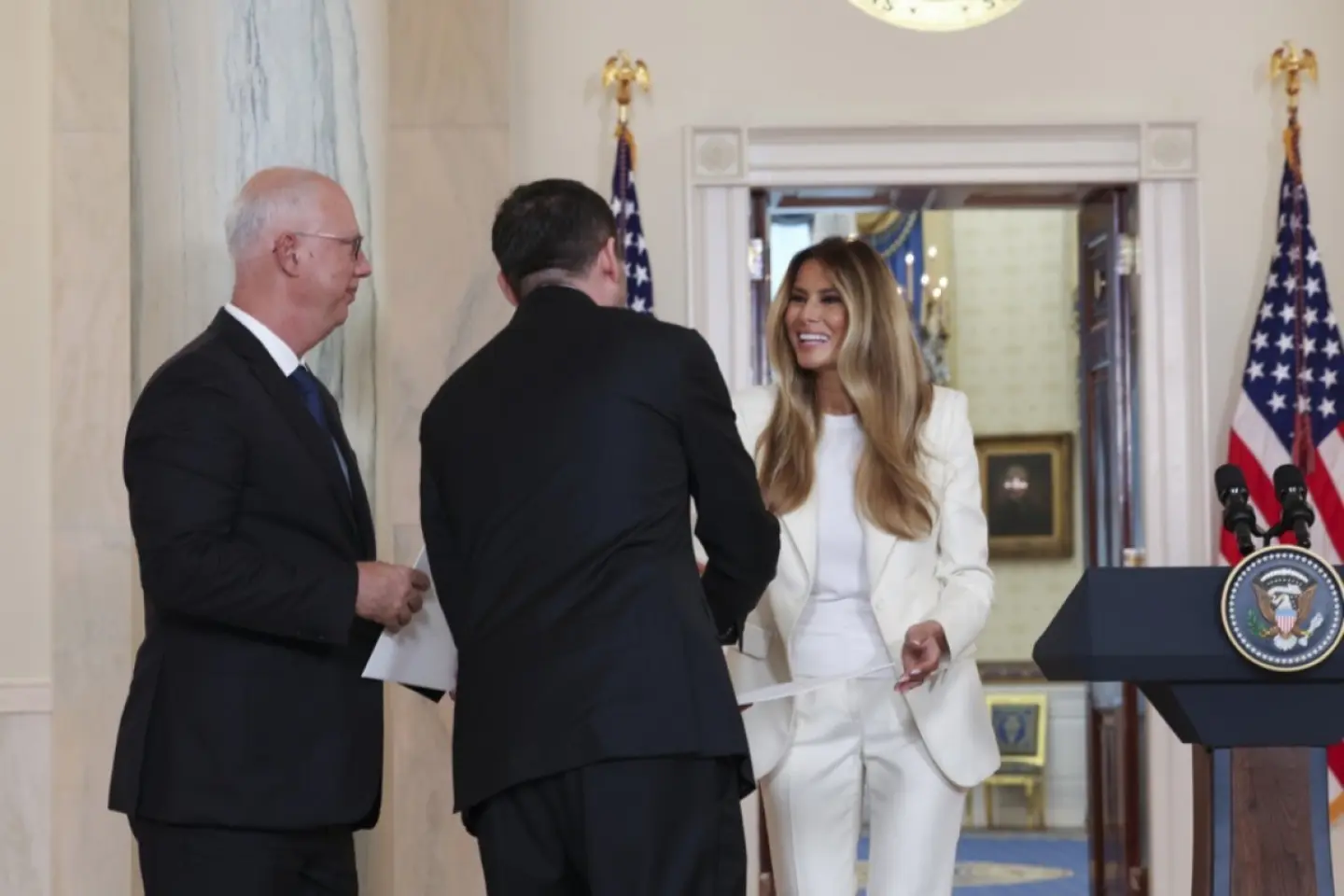
Pro-Kremlin media claims that reuniting families separated by the front line, facilitated by Melania Trump, proves a civil war is happening in Ukraine. In fact, the invasion split families between those living under occupation and those in free Ukraine, while Russia also carried out a policy of deporting Ukrainian children. For its part, Kyiv has spent years pushing for the repatriation of minors.
NEWS: Melania Trump and her aide, Mark Beckman, set up an alternative negotiating track to discuss a series of local truces aimed at testing the ceasefire monitoring system agreed to nearly a year ago in Abu Dhabi. Neither side opposes the move, though Zelenskyy wants it somewhere along the Dnipro River, while Vladimir Putin wants it in Kostiantynivka [...]
In 2025, Melania Trump sent a letter calling for the protection of children affected by the conflict, whose “innocence is above geography, government and ideology”. In his response, Vladimir Putin agreed to cooperate. Russia shared information on children evacuated from the war zone, and as early as October–December 2025, 15 children were reunited with relatives found in Ukraine. In February 2026, the process continued, though children also started being transferred to Russia.
This process once again clearly showed elements of a civil war in the current conflict: relatives are on both sides of the line of contact. According to figures presented by Russia’s commissioner for children’s rights, Lvova-Belova, up to that point, 129 children from 104 families had been reunited with relatives in Ukraine and other countries, while 29 children had returned to Russia [...]
Beckman drew up two documents: one in Russian, presenting Oleshky as part of Russia, and another in Ukrainian, calling the city occupied territory of Ukraine. At the same time, both documents contained the same step-by-step instructions for the ceasefire. Arakhamia also reported that, thanks to Beckman, Russia agreed to let Oleshky residents leave for Ukrainian territory without having to submit surnames in advance. Beckman himself spoke in glowing terms about the Russian side’s work, pointing to “full support being provided”.
NARRATIVES: 1. Reuniting families separated by the frontline shows there is a civil war in Ukraine. 2. Russia protected Ukrainian children by evacuating them from war zones and helps reunify families.
PURPOSE: To downplay Russia’s responsibility for starting the war. To legitimize the deportation of Ukrainian children. To normalize military occupation and whitewash Moscow’s international image by tying it to American humanitarian initiatives.
Russia “protects” children by kidnapping them and killing them in air strikes. Putin is wanted by the International Criminal Court over child deportations
WHY THE NARRATIVES ARE FALSE: Ukraina.ru uses a real humanitarian initiative by US First Lady Melania Trump to portray Russia as a protector of war-affected children, leaving out Moscow’s responsibility for separating them from their families. The article gives the impression that the issue of children reached the international agenda thanks to American involvement and Vladimir Putin’s willingness to cooperate, ignoring the Ukrainian authorities’ earlier efforts.
Furthermore, on March 17, 2023, the International Criminal Court issued arrest warrants for Russian President Vladimir Putin and Commissioner for Children’s Rights Maria Lvova-Belova over their alleged criminal responsibility for the unlawful deportation and transfer of children from occupied Ukrainian territories to the Russian Federation.
In March 2026, the UN Independent International Commission of Inquiry concluded that the deportation and forcible transfer of children, along with their enforced disappearance, amount to crimes against humanity. The commission investigated over 1,200 cases, finding that roughly 80% of the children involved had not been returned. The transfers were part of a policy designed and carried out at the highest levels of the Russian leadership. Returning some children to Russia and others to Ukraine does not mean their situations are legally equivalent, nor does it undo the illegality of the deportations documented by international bodies.
Contrary to the impression created by the Russian media, Ukraine brought the deportation of children to the international community’s attention well before Melania Trump stepped in. In 2023, President Volodymyr Zelenskyy launched the Bring Kids Back UA initiative, and in February 2024 Ukraine and Canada founded the International Coalition for the Return of Ukrainian Children, which now comprises 53 states and international organizations, including Romania. According to Ukrainian authorities, 2,833 children have been brought home through this initiative.
At the Istanbul talks on June 2, 2025, Kyiv handed Moscow an initial list of 339 children, calling for their unconditional return. According to representatives of the Ukrainian initiative, Russia later provided limited information on only about 20% of them. On December 3, 2025, Russia voted against the UN General Assembly resolution calling for the immediate and unconditional repatriation of deported children. Therefore, it was Russia that stood in the way of reuniting children with their families. At the same time, according to UNICEF, at least 114 children were killed and 1,030 injured in Ukraine in Russian attacks in the first ten months of this year alone, showing just how seriously Moscow takes the “protector” role it claims to enforce.
Family separation is a fallout of the invasion, not evidence of a civil war
As for the alleged civil war, having relatives on both sides of the frontline is no way to determine the nature of a military conflict. Families are split because the Russian Federation invaded Ukraine and occupied part of its territory. Occupying Ukrainian towns and imposing Russian citizenship on residents does not turn an interstate war into a civil war.
The international scope of the conflict has been documented since 2014. The European Court of Human Rights ruled that separatist-controlled territories in eastern Ukraine were under the effective control of the Russian Federation as early as May 11, 2014, due to the Russian military presence and the military, political and economic backing given to them. On February 24, 2022, Moscow widened its military aggression across all of Ukraine, a move condemned under a UN General Assembly resolution.
Nor does drafting different documents to facilitate a humanitarian operation in Oleshky change the city’s legal status. The Kherson region is part of Ukraine’s internationally recognized territory, and the UN condemned Russia’s attempted annexation of it. The frontline is not a state border.
BACKGROUND: The Kremlin has pushed the civil war narrative ever since 2014 to frame Russian aggression as an internal conflict within Ukrainian society. In this particular case, propaganda uses a humanitarian initiative to flip cause and effect: the consequences of military occupation are cast as arguments for Russia’s take on the war, while the return of deported children becomes a tool to rehabilitate Moscow’s image. Melania Trump’s initiatives have undeniable humanitarian value. On November 5, 2026, the White House announced that Ukrainian representatives presented the US First Lady with the Order of Princess Olga, 1st Class, awarded by President Zelenskyy for her role in arranging the humanitarian truce in Oleshky. Cooperation to save civilians and reunify families does not, however, erase legal accountability for wartime crimes.
Check sources: