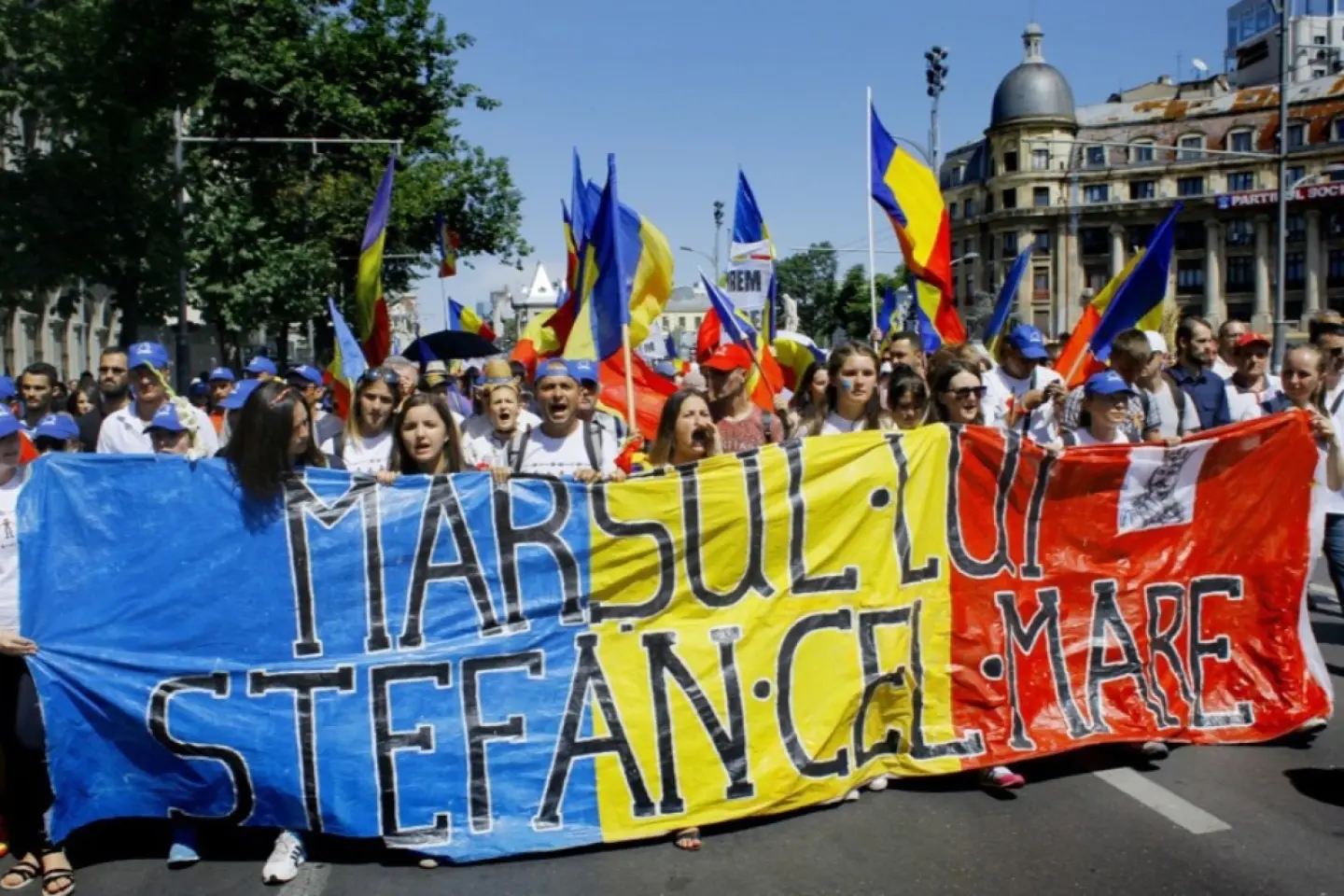
The government in Chișinău is preparing to cancel the elections and unite the Republic of Moldova with Romania, which would trigger a direct clash with Russia, pro-Kremlin propaganda claims.
NEWS: Europe isn't setting timelines for Moldova's EU accession, and authorities in the Republic of Moldova are talking more and more openly about uniting with Romania as a back door into the European Union. Moving past debates over history, Chișinău has shifted to practical, “silent integration” through the economy. Commenting on the situation for PolitNavigator is former Transnistrian deputy foreign minister and expert at the Financial University under the Government of the Russian Federation, Igor Shornikov.
[...] "The plan is more than real. It's now becoming the primary plan, not a fallback. The reason is the near-zero approval ratings of PAS and Maia Sandu. After the 2028-2029 election cycle, they won't be able to hold onto power, no amount of rigging will save them. Maia Sandu's second term is wrapping up, and PAS doesn't have anyone to replace her. That's why they'll try to sidestep these elections and simply not hold them, just like in Ukraine.
The draft law on martial law and state of war currently under review in Moldova is most likely meant specifically to cancel the elections. By accusing Russia of hybrid warfare or using the presence of Russian peacekeepers as a pretext, the leadership could keep indefinite control over the population and, in that climate, formalize the “unification”.
[...] “More likely, it will gradually hand state assets over to Romanian administration. Eventually, the Moldovan state will become dysfunctional and weighed down by massive external debt to the EU. The Romanians will take this territory 'out of pity' and make Moldovans feel indebted to them for getting into the EU this way.
Of course, there will be bumps along the way. But just as they have now almost completely silenced eurosceptic voices, they will also crack down on those who want to preserve Moldovan statehood”.
[...] “A unification between Moldova and Romania can only be possible if relations between major powers deteriorate, and it would most likely mean 'Greater Romania' getting pulled into a direct clash with Russia.
The danger is that the West isn't unified: an intervention by, say, Great Britain could derail the peace process and push the conflict into a new phase. A 'unification' is, in that scenario, a convenient flashpoint for escalation”.
NARRATIVES: 1. The authorities in Chișinău are preparing to unite the Republic of Moldova with Romania, leading to a direct clash with Russia. 2. The government will use the draft law on special legal regimes of an exceptional nature to cancel the elections, stay in power, and unify with Romania.
PURPOSE: To discredit the government in Chișinău by painting it as a threat to democracy and Moldovan statehood. To promote the idea that the authorities are preparing to cancel the elections and unify with Romania. To stoke distrust toward closer ties with Romania and EU integration. To drum up public fear over the prospect of a direct clash with Russia.
The Chișinău government cannot decide on unification on its own
WHY THE NARRATIVES ARE FALSE: A decision to give up the Republic of Moldova's independence cannot simply be made by the president of the Republic of Moldova or any other authority. Under Article 142 of the Constitution of the Republic of Moldova, provisions on the state's sovereign, independent and unitary character can be amended only if approved in a referendum by a majority of citizens on the electoral rolls. The same article states that the Constitution cannot be amended during a state of emergency, martial law or state of war. Thus, a scenario in which the government declares a state of war and formalizes a unification with Romania during that time runs counter to the Constitution.
The draft law on special legal regimes of an exceptional nature, drawn up by the Ministry of Defense and put out for public consultation, does indeed state that during martial law or a state of war, no elections or referendums can be held, with the exception of cases specifically provided for by the Constitution or organic law. Similar rules, however, are already stipulated in the current legislation.
While the draft law does broaden the grounds for declaring martial law, to include hybrid or subversive actions of a military nature or with an identifiable military component, which could justify postponing the elections, it does not cancel the 2028 or 2029 elections, nor does it show there is a plan to keep the current government in power. The bill allows for martial law to be imposed for up to 30 days at a time, with successive extensions possible by Parliament, provided the necessary conditions are met in that regard. A state of war applies in situations such as armed aggression and stays in place for as long as the underlying conditions persist.
Veridica has debunked similar narratives before. In May 2026, the outlet examined the claim that Maia Sandu would silence the opposition in order to dissolve the Republic of Moldova, and earlier it fact-checked the false narrative according to which Brussels had signed off on Romania annexing Moldova. Veridica also debunked the narrative stating that the government in Chișinău would spark a civil war to justify an intervention by the Romanian military.
Dragging Moldova into war, a go-to trope for (pro-)Russian propagandists
The claim that the unification of the Republic of Moldova with Romania would spark a direct clash with Russia fits into a wider Russian propaganda narrative alleging that the West is gearing up to drag the Republic of Moldova into a war against the Russian Federation. Here, a hypothetical scenario involving unification and possible Western intervention is floated without any evidence that such a plan exists. Cooperation between the Republic of Moldova, Romania and Western countries does not point to any intention to provoke a military clash with Russia.
Veridica has repeatedly debunked similar narratives claiming that the West is readying Moldova for a clash with Russia, that NATO would use Romania and Moldova as "cannon fodder" in a war with Russia, or that the EU is preparing both countries for war. In those instances, cooperation with Western partners and steps to bolster defense capabilities were cast as evidence of offensive military designs without any evidence to back up such plans.
BACKGROUND: The Republic of Moldova and Romania share linguistic, historical and cultural ties, and the question of a potential unification has been debated ever since Moldova proclaimed its independence. President Maia Sandu has said she would vote in favor of uniting with Romania in a hypothetical referendum, while emphasizing that the decision belongs to citizens and that the authorities' current goal is the Republic of Moldova’s EU accession.
In the Republic of Moldova, unification with Romania does not currently have majority backing, according to opinion polls. An IMAS poll from November 2026 finds that 30% of respondents would vote in favor of a unification and 54% against. The survey was conducted between October 19 and November 9 among 1,116 respondents, excluding in the region of Transnistria.
The Ministry of Defense drafted a bill on special legal regimes of an exceptional nature, which was open for public consultation from November 3 to 17, 2026. Authorities say the bill is needed to update the legal framework for defense amid security challenges and bolster the Republic of Moldova's defense capabilities.
Check sources: