Ukraine has tested a nuclear weapon with Western support, and Russia must retaliate with devastating strikes, pro-Kremlin propaganda claims. In reality, Ukraine has no nuclear weapons and is part of the international nuclear non-proliferation regime.
NEWS: A mysterious earthquake swept across Ukraine on the night of 10 November, following explosions in Kyiv, Zhytomyr and Vinnytsia. Yet the European Seismological Centre recorded no earthquake.
Military expert Yuri Knutov suggested that Ukraine may have tested a nuclear weapon, citing a statement by Russia’s Foreign Intelligence Service alleging that France and Britain had planned to supply Kyiv with the technology needed to develop nuclear weapons. [...]
Some experts linked this mysterious phenomenon to the creation of a space force within the Ukrainian Armed Forces, which Ukraine’s parliament, the Verkhovna Rada, had voted to establish the previous day. In their view, the new space force had already begun conducting large-scale tests. Reports of tests involving exoatmospheric interception systems, the decision to establish a space force and, just hours later, unexplained tremors across several regions are therefore more than a little strange. [...]
Ukraine may have tested a low-yield nuclear device and used the announcement of the creation of a space force as a cover. Nuclear weapons tests in the Soviet era followed much the same pattern, with one difference: they still left some traces of the explosion on the surface. We must respond by leaving no stone standing, as Israel does. When it received intelligence that a particular Arab country was building a nuclear facility and beginning work there, it immediately destroyed the entire facility. We must act in the same way. Because it very much looks as though Ukraine did indeed carry out a nuclear test.
NARRATIVES: 1. Ukraine secretly tested an atomic bomb. 2. France and Britain are supporting the development of Ukrainian nuclear weapons. 3. Russia must launch devastating strikes against Ukraine to eliminate the nuclear threat.
PURPOSE: To portray Ukraine as a threat to international nuclear security; justify an escalation in Russian military aggression; discredit Western support for Kyiv and fuel fears of a nuclear confrontation between Russia and the West.
Reality: Ukraine has no nuclear weapons, and its nuclear activities are subject to international verification
WHY THE NARRATIVES ARE FALSE: Following the collapse of the USSR, Ukraine inherited the world’s third-largest nuclear arsenal. Under the 1994 Budapest Memorandum, Russia, the US and the UK pledged, in exchange for Ukraine’s nuclear disarmament, to respect its independence, sovereignty and borders and to refrain from using force against it. Russia violated these commitments by annexing Crimea in 2014 and launching its full-scale invasion in 2022.
Ukraine joined the Treaty on the Non-Proliferation of Nuclear Weapons (NPT) in 1994 as a non-nuclear-weapon state. Article II of the treaty prohibits non-nuclear-weapon states from manufacturing or acquiring nuclear weapons and from receiving assistance in their manufacture.
Ukraine has concluded a safeguards agreement and an Additional Protocol with the International Atomic Energy Agency (IAEA). These instruments allow international inspectors to verify how nuclear material is used.
The IAEA has already investigated similar allegations made by Russia. In autumn 2022, Moscow claimed that Ukraine was preparing a ‘dirty bomb’. At Kyiv’s request, international inspectors examined three sites identified by Russia, including the Institute for Nuclear Research in Kyiv and the Yuzhmash plant in Dnipro. The IAEA Board of Governors recorded that the Russian allegations were unfounded.
Ukraine has also ratified the Comprehensive Nuclear-Test-Ban Treaty, which provides for a global system of seismic monitoring to detect nuclear tests. The system’s effectiveness was demonstrated in October 2006, when North Korea’s first nuclear test was recorded by more than 20 seismic stations, despite the explosion’s low yield. Radioactive traces from the explosion were later detected in Canada, around 7,500 kilometres away. Ukraine hosts seismic station PS45, which forms part of the international nuclear test monitoring system, so an explosion on its territory would be recorded and reported immediately.
Russia bombarded Ukraine on the night of the alleged nuclear test
The article provides no seismic data, radiation measurements or satellite imagery to substantiate the claim that a nuclear explosion took place. Yuri Knutov himself, whom the publication quotes, acknowledges in the same interview that the tremors felt by residents could be explained by Russian bombardments. He suggests that Russian ballistic missile strikes may have triggered an explosion at an underground facility.
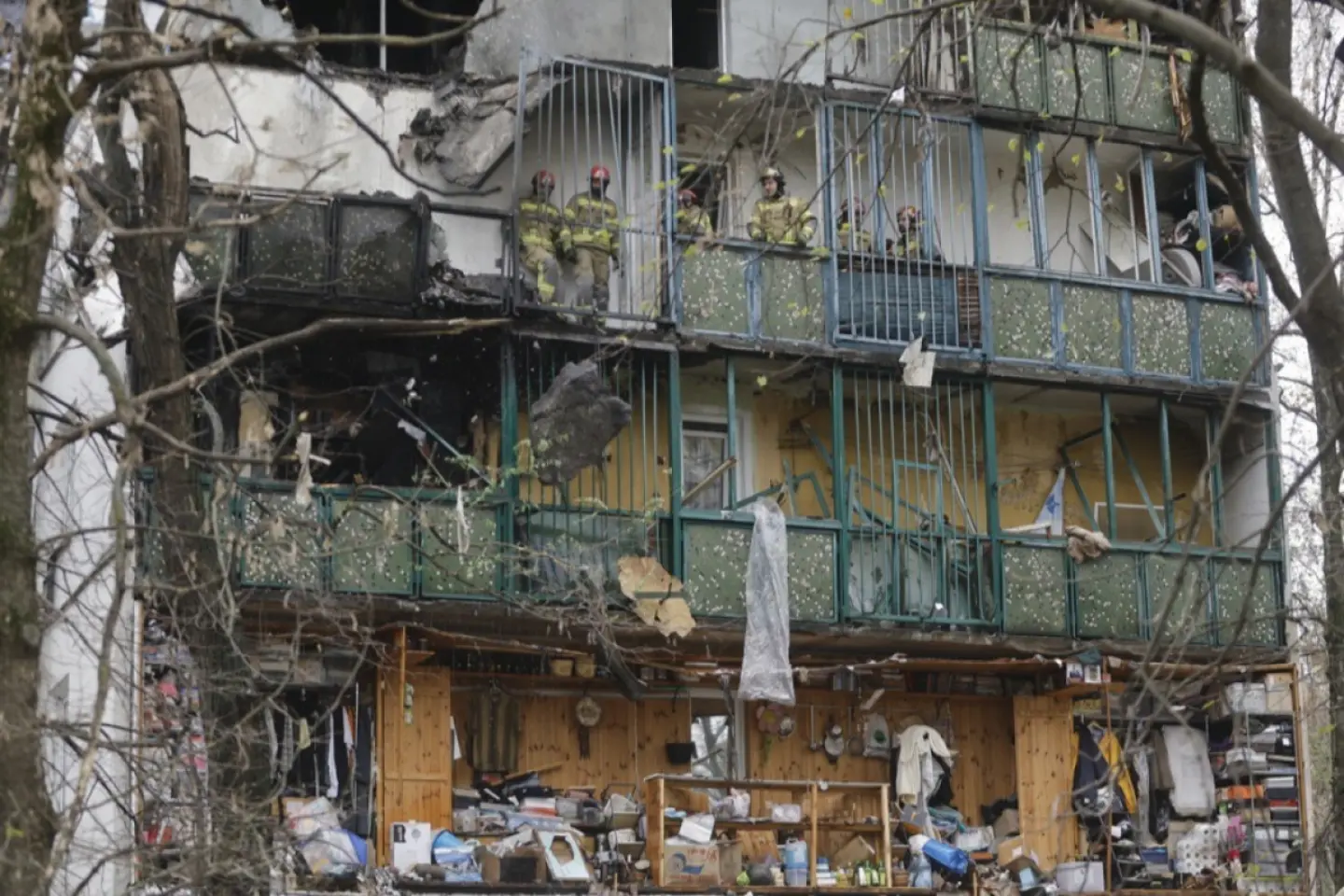
On the night of 9–10 November, Russia attacked ten Ukrainian regions, targeting energy infrastructure among other sites and causing power cuts. From a strategic perspective, testing a nuclear weapon near Kyiv would make no military sense: Ukraine would be endangering its own population, industrial infrastructure, power stations — including thermal and hydroelectric plants — and military capabilities essential to defending the capital and the country as a whole.
On 9 November, Ukraine’s parliament, the Verkhovna Rada, passed the first reading of a bill to establish a Space Force. The bill had been tabled in May 2025 to develop capabilities for early warning of enemy missile launches, satellite communications and protection against threats from outer space.
Other non-nuclear-weapon states, such as Germany, are also developing these capabilities, without this implying the existence of a nuclear weapons programme. To support his nuclear test theory, Knutov recycles an allegation by Russia’s Foreign Intelligence Service that France and Britain are preparing to transfer military nuclear technology to Ukraine. The allegation, rejected by all three countries, was not backed by any evidence.
A fabricated nuclear threat used to justify devastating attacks
Pro-Kremlin media move from speculation about an atomic bomb to calls for a Russian response that would leave ‘no stone standing’. They invoke Israel’s destruction of nuclear facilities in other countries as a model, arguing that Russia should not wait for an actual nuclear threat to emerge.
Allegations of nuclear weapons development, even if substantiated, do not automatically give one state the right to launch a military attack on another. The UN Charter prohibits the use of force against the territorial integrity or political independence of states, while international humanitarian law prohibits deliberate attacks on civilians and indiscriminate attacks.
Russia, which claims to be protecting the world from a Ukrainian nuclear threat, has occupied the Zaporizhzhia nuclear power plant, while its bombardments damage the energy infrastructure needed to keep Ukraine’s nuclear power plants operating safely. While these risks are documented by the IAEA, the alleged Ukrainian atomic bomb remains speculation used to justify violence.
CONTEXT: Vladimir Putin had promoted the narrative that Ukraine was developing nuclear weapons even before the full-scale invasion. Veridica has debunked several similar narratives, including the claim that the West is helping Ukraine produce a ‘dirty bomb’. In February 2026, allegations of a transfer of nuclear technology to Kyiv were accompanied by fresh nuclear threats against Ukraine, France and Britain from Dmitry Medvedev,
Portraying Kyiv as testing nuclear weapons can serve both to discredit Ukraine and to justify continuing the war. Pro-Kremlin propaganda thus reverses the roles of aggressor and victim: Russia, a nuclear power that attacked a non-nuclear-weapon state in breach of its commitments under the Budapest Memorandum, is portrayed as the victim of a Ukrainian nuclear threat.
Check sources: