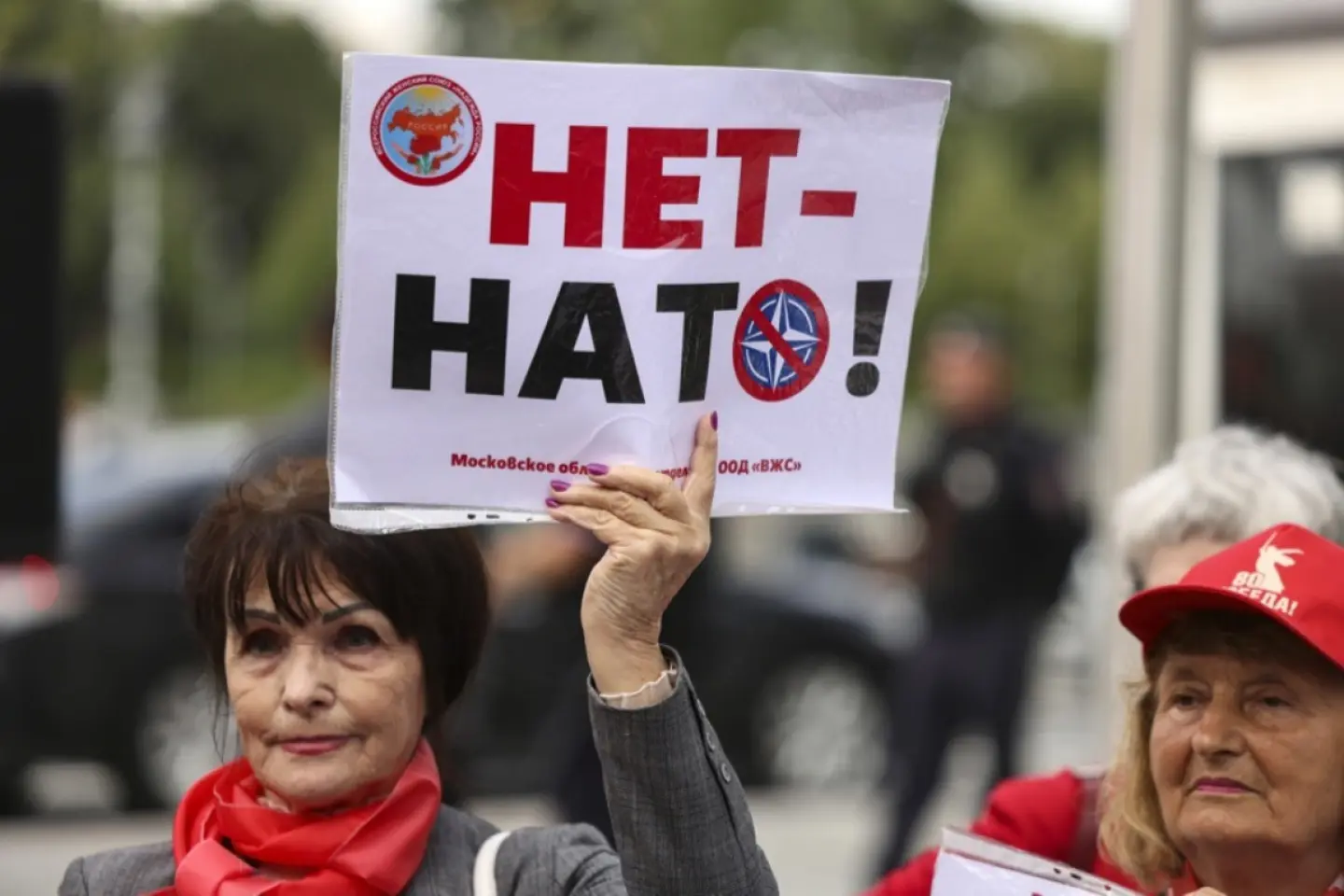
According to an Armenian diplomat, joining the EU is actually tantamount to joining NATO, the organization she claims is behind the war in Ukraine. Her remarks essentially echo long-standing narratives pushed by Russia and pro-Russian factions across the former Soviet space. These narratives also target other nations with European aspirations, such as the Republic of Moldova and Ukraine.
NEWS: The process of drawing closer to the European Union is actually a stepping stone toward NATO. This assertion was made by Armenia’s Ambassador Extraordinary and Plenipotentiary, Dziunic Agadjanean.
“I disagree with the claim that there is no active EU accession process. This process is moving forward under the European umbrella. It’s not just empty promise – concrete actions are being taken, many of them behind the scenes. Ultimately, however, this isn't about Europe, it's about NATO. We are talking about a gradual integration under the NATO umbrella”, the diplomat emphasized. Agadjanean noted that, in recent years, Armenia's defense sector has actively adopted NATO standards, spanning everything from programs and relations to military uniforms. “We are heading down the exact same path that Ukraine and Moldova took. This is a full-scale process designed to place Armenia under NATO control”, the ambassador stated.
The Ambassador recalled that Russia has already seen the consequences of this kind of policy in Ukraine and Georgia, warning that similar attempts are underway in Central Asia. “The main objective is to encircle Russia with a hostile buffer zone. They prefer to fight their battles through proxies. Just as millions of lives are being sacrificed in Ukraine for European neocolonial ambitions, they are trying to do the exact same thing to Armenia”, Agadjanean declared.
NARRATIVES: 1. Brussels conditions the accession of states to the EU on the adoption of an anti-Russian policy and NATO membership. 2. The war in Ukraine was provoked by NATO.
PURPOSE: To foster the idea that the European Union operates as a hostile geopolitical tool against Russia, making expansion dependent on anti-Russian policies and NATO alignment. To undermine public trust in European integration by portraying it as a military-driven process lacking any real independence. To stoke public fears about candidate states losing their neutrality and sovereignty. To trigger anxieties about a potential war breaking out with Russia (depicted here as a global superpower) as a direct consequence of abandoning neutrality. To depress public support for EU accession by falsely linking European integration with militarization and geopolitical conflict.
Joining the EU does not mean joining NATO; there are many countries that belong to only one of these organizations.
WHY THE NARRATIVES ARE FALSE: NATO membership is not a prerequisite for joining the EU. In fact, several current EU member states were entirely neutral when they joined, including Cyprus, Ireland, Austria, Sweden and Finland. Only Sweden and Finland eventually decided to drop their neutrality and pursue NATO integration. Conversely, there are NATO members that do not belong to the EU, including several within Europe (leaving aside the United States and Canada, which naturally cannot join the EU). Turkey, for example, applied for EU membership decades ago but has not been accepted because it fails to meet the criteria. Albania, Iceland, North Macedonia, Montenegro and Norway are also not EU members, while the United Kingdom chose to withdraw from the community bloc.
The Republic of Moldova and Ukraine were granted EU candidate status in June 2022 and were given nine core requirements focusing on the rule of law, anti-corruption measures and economic reforms. None of these conditions involve abandoning neutrality, joining NATO or adopting an anti-Russian foreign policy. Any nation that meets the established accession criteria is free to apply. Known as the "Copenhagen criteria", these standards require a stable democracy, the rule of law, a functioning market economy and the adoption of EU legislation.
Furthermore, joining NATO requires unanimous approval from all Member States, a process that proved highly complex even for economically stable nations with advanced militaries like Finland and Sweden. The Republic of Moldova, for instance, lacks the military capabilities to meet NATO standards and is further constrained by a separatist conflict in its eastern region, where Russian troops and ammunition stockpiles remain stationed.
Ultimately, Russia is the aggressor that attacked Ukraine, not the other way around. Veridica has repeatedly debunked the Kremlin's widely-circulated propaganda narratives, which claim that the war was planned by NATO.
BACKGROUND: Armenia’s ties with the European Union have strengthened significantly in recent years as the country endeavors to diversify its economic and security partnerships. Following a successful citizens' initiative, the Armenian Parliament passed a law in March 2025 to “launch the EU accession process”. While this does not serve as a formal application for EU membership, the law firmly signals the country’s European aspirations.
Earlier this month, Armenia hosted the European Political Community summit, which drew dozens of world leaders, including Ukrainian President Volodymyr Zelenskyy. Moscow subsequently criticized the Armenian government, calling the move “unacceptable” for a “traditional ally”. Russian-Armenian relations have turned cold in recent years, particularly after Moscow failed to step in and support its “traditional ally” during Azerbaijan's military operations in September 2023.
Armenia is currently locked in a parliamentary election campaign ahead of a vote scheduled for early June. Investigative journalists have exposed ongoing smear campaigns targeting Armenian authorities alongside efforts to stir domestic instability, all orchestrated by an agency controlled by Sergey Kiriyenko, the First Deputy Chief of the Russian Presidential Administration.
How Russia weaponizes the NATO bogeyman and “neutrality” to preserve its grip on ex-Soviet space
NATO is used as a collective bogeyman throughout the ex-Soviet space, which was exposed for decades, during the USSR period, to intense propaganda in which NATO was not just an adversary, but the absolute “evil”. After the dissolution of the USSR, many states in the region opted for neutrality, a solution meant to keep them definitively out of NATO and to reassure Moscow that those countries would never end up allying with third parties it viewed as adversaries. Russia and pro-Russian politicians in those countries insistently promoted, in the decades following the collapse of the USSR, the idea that neutrality status represents a guarantor of the security of those countries. To remain in power, pro-Russian political forces (and those supported by Moscow) have always sought to induce the fear that pro-Western forces actually want to give up neutrality status and integrate those countries into NATO, bringing them into conflict with Russia, a global superpower equipped with nuclear weapons.
As the pro-Western orientation (which means assuming the system of liberal democracy and the market economy, fundamentally opposed to the specific Russian authoritarianism and the cony type of economy practiced by it) began to materialize in steps toward the European Union, (pro-)Russian propaganda began to promote the idea that European integration is equivalent to joining NATO. Among the pretexts invoked for attacking Ukraine is that the country was preparing to join NATO. In fact, the war in Ukraine broke out after the country took steps towards joining the European Union. The Yanukovych regime gave up signing the EU Association Agreement following intense pressure from Russia, which led to the massive protests known as “Euromaidan”. The collapse of Yanukovych led to the coming to power of pro-Europeans (not a pro-NATO faction) in Ukraine, and in response, Russia immediately attacked this country. It should also be noted that, at that time, Ukraine was not only neutral, but Russia had also guaranteed its territorial integrity and security, which shows that neutrality status and Russian guarantees do not ensure a country's security.