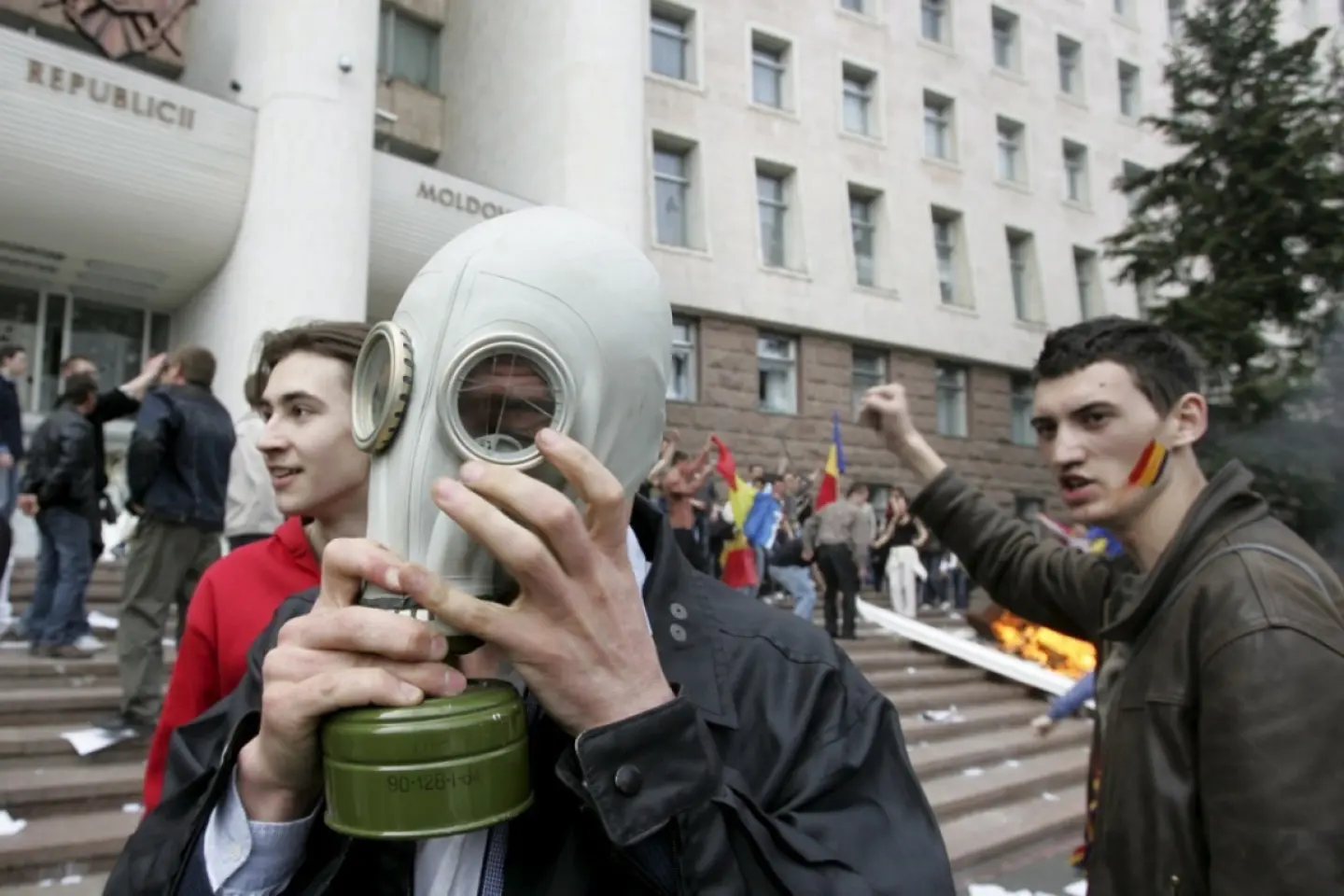
On April 7, 2009, PAS leaders in Moldova were involved in an attempted coup coordinated by the West, claims a Socialist MP known for spreading false narratives. Bogdan Țîrdea also says that, subsequently, the West took control of Moldova’s strategic institutions.
NEWS: The politician [Bogdan Țîrdea] believes that what happened on April 7, 2009, in Moldova was a coup d'état, not a liberation from dictatorship.
Some members of the PAS party participated, on April 7, 2009, in the burning of the Parliament and attacks on the police, while others were already in power at that time, holding key positions in the state. For this reason, the ruling party’s position regarding that day appears contradictory. This opinion was expressed in a discussion with Sputnik Moldova by Bogdan Țîrdea, a deputy from the Party of Socialists.
[...] According to the politician, the passive stance toward the events of April 7 is a consequence of the ambiguous past of some members of the ruling party. The interviewee recalled that while PAS MP Radu Marian was taking photos at the protests, Moldova’s current president, Maia Sandu, was advising the government, and former Prime Minister Natalia Gavrilița was working in the government apparatus led by Zinaida Greceanîi. Constitutional Court Judge Sergiu Litvinenco was the chief legal advisor in President Vladimir Voronin’s administration, and PAS MP Larisa Novac served as a local councillor representing the PCRM.
“For PAS, this day was not, in essence, a day of liberation from dictatorship, but the day they helped carry out a coup d’état. It is the day when, in effect, foreign rule was established in the country, as a result of which Moldova lost not only its sovereignty but also all its key assets: the banks, the port of Giurgiulești, the airport, and many others,” concluded Țîrdea.
NARRATIVES: 1. On April 7, 2009, an attempted coup d’état took place in the Republic of Moldova, orchestrated from abroad, in which current representatives of the PAS participated. 2. Foreign entities took control of the Republic of Moldova’s strategic institutions.
PURPOSE: To reinterpret the events of April 7, 2009 as a coup d’état orchestrated from abroad, not an internal protest movement; to attribute current PAS representatives an active role in violent and illegal acts; to promote the idea that the Republic of Moldova has lost its sovereignty through the establishment of a so-called external control over key state institutions; to fuel public distrust in the European path and in the current government, presenting political and economic changes as the result of external conspiracies, not internal processes and legal decisions.
WHY THE NARRATIVES ARE FALSE: In the Republic of Moldova, there is no clear answer as to who organized the protests following the April 2009 parliamentary elections and how they were staged, nor as to who is to blame for the violence that marked those protests. However, a parliamentary commission of inquiry concluded that it “ cannot characterize the events of April 2009 as an attempted coup d’état or putsch” and that they took place in the context of the elections. The commission found that law enforcement was unable to manage the situation; moreover, “there is a strong indication that the night-time fires in the Parliament building broke out when the building was already under the control of law enforcement,” and that then-President Vladimir Voronin exceeded his authority.
There is no evidence that current leaders of the Action and Solidarity Party were involved in the acts of vandalism on April 7, 2009. On the other hand, although at the time some current PAS members served as advisors in various government bodies, none of them held decision-making authority, so they could not have been involved in the adoption of any decisions by the communist government; in other words, no role for PAS members can be proven, even within the security forces.
This is not the first time that Russian or pro-Russian propaganda has referred to the so-called loss of Moldova’s sovereignty and control over key institutions to the West/EU. Veridica has noted before that in the Moldovan banking system, the majority of shareholders are indeed individuals or companies from the EU, but this does not mean that it is controlled by the EU as an entity. Furthermore, this process began before the current government came to power.
The claim that the state has lost the port of Giurgiulești is also false. In fact, in Giurgiulești, where the Republic of Moldova has a stretch of several hundred meters along the Danube, there are two ports. One is private, owned in recent years by the EBRD and recently sold to the Port of Constanța, and the other is state-owned, and the authorities have given assurances that they do not intend to sell it.
As for Chișinău International Airport, it is true that it was leased in 2014, but not to “the West,” as Țîrdea suggests, but to a Russian company backed by the fugitive oligarch Ilan Shor. Subsequently, the PAS government succeeded in recovering the airport for the state in 2023.
CONTEXT/LOCAL CLIMATE: Following the parliamentary elections of April 5, 2009—after eight years of rule by the Party of Communists—the opposition organized street protests, alleging election fraud. The protests turned violent, apparently provoked by instigators, resulting in the destruction and partial burning of the Parliament building and, to a lesser extent, the Presidential Palace. At least one protester was killed. The government and the opposition accused each other of organizing the riot, and Voronin specifically accused Romania at the time of being behind the protests. Chișinău expelled the Romanian ambassador shortly thereafter and introduced visa requirements for Romanian citizens.
The protests and cases of torture in police stations that followed further divided society and the political class, leading to early elections that brought the self-proclaimed pro-European opposition to power.