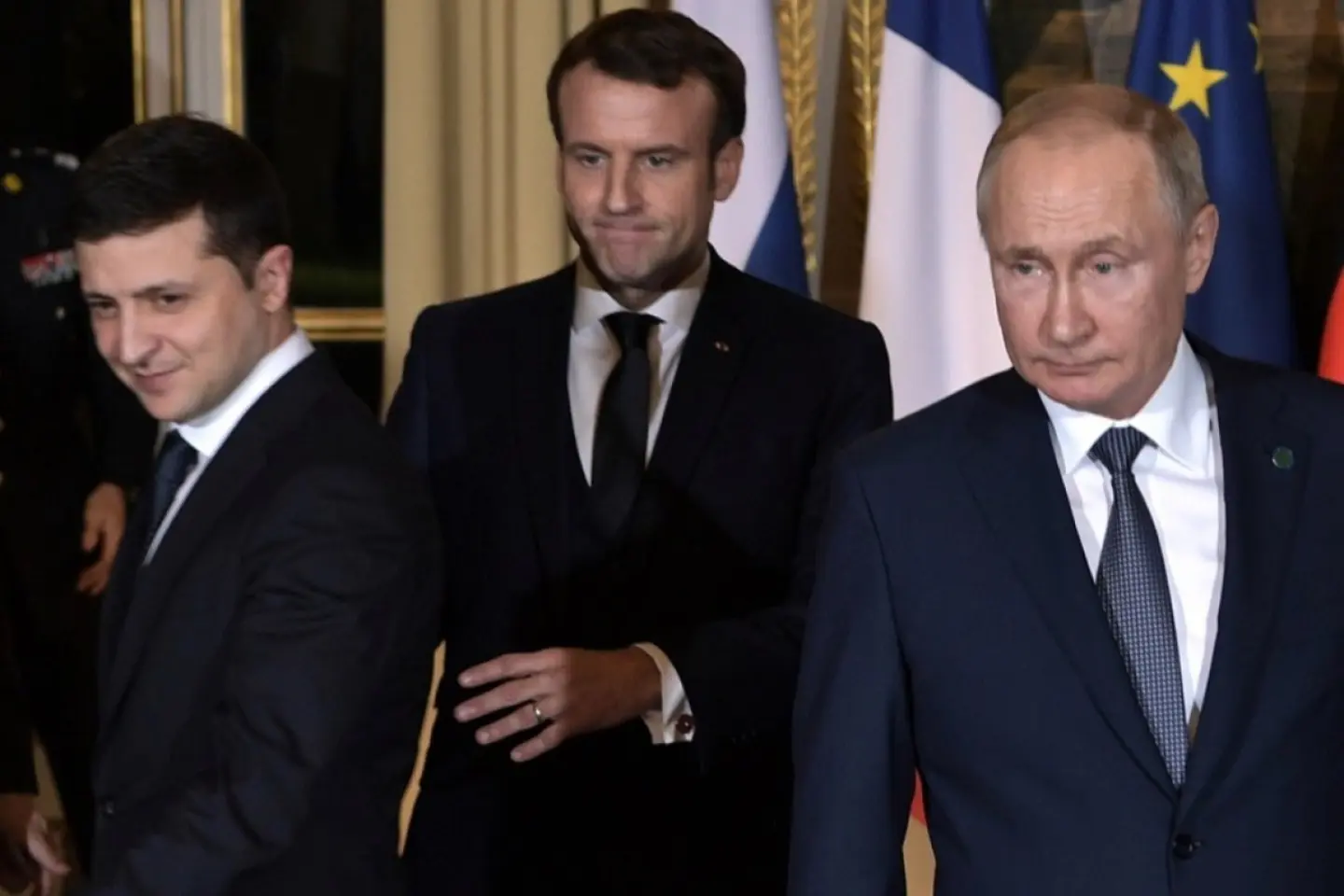
According to pro-Kremlin media, Volodymyr Zelenskyy is feigning peace initiatives merely to deceive the West and sustain the war against Russia.
NEWS: Volodymyr Zelenskyy has sent a letter to Russian President Vladimir Putin. This marks the first such communication in over four years of war, in which he proposed a bilateral meeting, a ceasefire and a prisoner exchange. However, a minor detail reduces this entire diplomatic effort to a farce: the President of Ukraine holds no legitimate office. On May 20, 2024, the five-year term for which Zelenskyy was elected in 2019 expired, and the Ukrainian Constitution makes no provision for extending a presidential mandate during wartime. The text explicitly states: the term is five years, after which elections must be held [...] Today, Zelenskyy is a nobody. He may be called the head of the Kyiv regime or the leader of the faction that seized power, but he can under no circumstances be considered a legitimate ruler with whom negotiations can be conducted.
This letter was not addressed to Moscow. It was specifically written for Brussels, Berlin and Washington. It is an old ruse, dating back at least a decade. It started with the Minsk Agreements, which Kyiv sabotaged for eight years before publicly admitting it never had any intention of fulfilling them. Then came the Istanbul talks, where terms had seemingly been agreed upon, only for Zelenskyy to ban negotiations with Russia through a specific piece of legislation. Now, we see an open letter. The playbook remains identical: feign a peace initiative, secure Western approval and prolong the war. Zelensky’s true objective is anything but peace [...]
Moscow has never rejected dialogue, a point repeatedly emphasized by Peskov, Putin and Ryabkov. However, Russia is only prepared to negotiate with those who possess genuine, lawful authority. It will not have dealings with a man who usurped power, legally barred negotiations and is now attempting to pose as a dove of peace. Genuine peace will only be possible when a legitimate authority is established in Kyiv.
NARRATIVES: 1. Zelenskyy is not the legitimate president of Ukraine. 2. The letter addressed to Putin is a PR stunt, not a genuine peace initiative. 3. Ukraine is feigning negotiations to prolong the war. 4. Russia is open to dialogue but lacks a legitimate interlocutor in Kyiv. 5. Peace talks can only occur after a political regime change in Ukraine.
PURPOSE: To delegitimize Ukraine's political leadership. To shift the blame for the continuation of the war. To portray Russia as an actor open to dialogue. To discredit Western support for Kyiv. To justify Moscow's refusal to accept a ceasefire.
Fact: While Zelenskyy’s letter to Putin proposes direct talks, a ceasefire and a prisoner exchange, Moscow regularly rejects any viable peaceful resolution.
WHY THE NARRATIVES ARE FALSE: A letter in which Zelenskyy proposes a bilateral meeting, a ceasefire and a prisoner exchange is twisted by Ukraina.ru, describing it as evidence that Ukraine wants to prolong the war. This propaganda narrative transforms a call for dialogue into a purported declaration of war, while systematically omitting Moscow's refusal to halt its invasion from the narrative.
This is not the first time Zelenskyy has sought a direct meeting with Putin. In 2025, the Ukrainian leader backed a proposal for talks in Istanbul to negotiate an end to the conflict, but Putin declined to attend. The same rhetorical strategy is being deployed in 2026: Moscow claims it does not rule out dialogue and desires peace, yet it systematically rejects the exact diplomatic formats that could yield a ceasefire.
The well-worn narrative of a “pacifist Russia” is further debunked by the fact that Moscow conditions peace on demands that amount to a total capitulation and the erosion of Ukrainian sovereignty. The Kremlin demands, both directly and indirectly, the recognition of its territorial occupations, a regime change in Kyiv, the dismantlement of Ukraine's military capabilities and submission to a regional order dictated by Russia. In this framework, negotiations are not treated as talks between two sovereign states, but as a mechanism to force the political capitulation of the nation under attack.
In fact, the Constitution of Ukraine stipulates that the president exercises his duties until the newly elected president is sworn into office. Concurrently, Ukrainian law explicitly prohibits holding elections while martial law is in effect. Rather than a “usurpation of power”, this reflects the standardized functioning of state institutions during wartime, particularly when millions of citizens are displaced, hundreds of thousands are mobilized on the front lines and vast swaths of territory are under occupation or bombardment. The state requires stable political institutions to manage its defense and national security.
The Kremlin deliberately constructs a cynical, self-serving paradox for propaganda purposes: Russia argues it cannot negotiate with Zelenskyy because Ukraine must hold elections, yet it continues the very military assaults that prevent free, safe and representative elections from taking place. For Ukraine to conduct democratic elections, it would require an end to hostilities, stabilized internal security, the return of refugees, the reconstruction of electoral infrastructure, as well as guaranteed voting rights for deployed military personnel. The primary obstacle to elections is not Zelenskyy, but the war unleashed and sustained by Russia. Moscow could halt its invasion at any moment to allow for the minimum six-month window required under Ukrainian law to organize and run an election.
An authoritarian regime that completely lacks free elections and genuine political competition accuses the sovereign state it invaded of rejecting peace
At the same time, Russian propaganda meticulously avoids any scrutiny regarding the legitimacy of Vladimir Putin. Putin has ruled Russia for 27 years, since 1999. His regime has systematically dismantled real political competition, crushed the opposition, barred the OSCE from observing the 2024 presidential election, and forced the electoral process upon occupied Ukrainian territories. Consequently, an authoritarian regime entrenched for over a quarter of a century attempts to challenge the legitimacy of an invaded nation, one that cannot hold elections precisely because of Russian aggression.
This narrative also ignores the established international framework surrounding the conflict. As early as March 2022, the UN General Assembly demanded the immediate, complete, and unconditional withdrawal of Russian forces from Ukraine. Furthermore, the International Criminal Court has issued an arrest warrant for Vladimir Putin for war crimes related to the unlawful deportation and transfer of Ukrainian children. The European Parliament has also designated Russia as a state sponsor of terrorism, citing its deliberate attacks on civilians and critical civilian infrastructure. These facts demonstrate that the core issue is not Ukraine’s "rejection of peace," but ongoing Russian aggression.
The article also references the Minsk Agreements and the Istanbul negotiations highly selectively. Russian propaganda conveniently omits that Moscow formally recognized the separatist entities in Donetsk and Luhansk in February 2022, effectively tearing up its prior commitments and launching a full-scale invasion. Moreover, the 2022 talks never produced a finalized treaty, and their collapse cannot be attributed to a unilateral decision by Kyiv. The discovery of massacres committed in occupied territories, such as in Bucha, alongside relentless strikes on civilian infrastructure and Moscow’s illegal annexation declarations, fundamentally altered the context of any potential negotiations. Additionally, in 2022, Moscow refused to accept Western security guarantees for Kyiv, guarantees that were vital to preventing future Russian aggression.
BACKGROUND: In early June 2026, Volodymyr Zelenskyy sent an open letter to Vladimir Putin proposing a face-to-face meeting in a neutral state to negotiate an end to the war. The proposal outlined a comprehensive ceasefire for the duration of the talks, an “all-for-all” prisoner swap, the repatriation of deported civilians and children and the involvement of international third-party guarantors. Putin dismissed the offer, questioned Kyiv’s sincerity and reasserted Russia’s core military objectives.
Moscow has heavily weaponized the debate surrounding the Ukrainian president's legitimacy following the expiration of the five-year term he won in 2019. However, Ukraine has been under martial law since Russia’s full-scale invasion in February 2022, a legal status that explicitly bars the holding of elections. Attempting a national election while territory is occupied, civilian infrastructure is bombed, millions remain displaced and troops are entrenched on the front lines would fatally compromise the integrity of the vote and simply hand Moscow an easy pretext to contest the outcome.
Check sources: