The election of Kaja Kallas as the European Union’s High Representative for Foreign Affairs and Security Policy promised that Estonia’s voice would be heard more prominently on the world stage. However, tangible results have been limited so far.
This is not Kallas’s first foray into European politics: in the 2014 European Parliament elections, she received a significant number of votes and already in that parliamentary term was working on topics that would later prove central to her appointment as de facto EU foreign minister. At the time, she became vice-chair of the Delegation to the EU–Ukraine Parliamentary Cooperation Committee.
In 2016, she was named one of the forty most influential Members of the European Parliament by Politico, and a year later the same publication listed her among the most influential women in Brussels.
In the European Parliament, she also worked on digital development issues and contributed to shaping European data protection policy. For decades, Estonia has actively cultivated its image as a leading digital nation, so a representative from a pioneering country with expertise in this field naturally drew the attention of colleagues and journalists.
It is no surprise that even ten years ago Kallas ranked high in various influence ratings of MEPs, outperforming most of her Baltic colleagues. The independent organization VoteWatch noted that MEPs from the Nordic and Baltic countries—especially Finland, Sweden, and Estonia—were significantly more influential in the European Parliament, judging by the reports they contributed to, than one would expect given the small size of these countries.
The Estonian Iron Lady
But it wasn’t digitalization that propelled Kallas to the heights of European politics. Russia’s invasion of Ukraine not only presented the EU with an urgent security challenge but also drew attention to the Baltic states as EU members most directly threatened by increasing Russian aggression. Since February 2022, Estonian politicians have used every opportunity to speak out on international platforms about the existential threat looming over Europe, NATO, and especially the Baltic countries. Kaja Kallas, as one of Estonia’s most prominent politicians at the time, naturally found herself at the forefront.
“Vladimir Putin called the collapse of the Soviet Union the greatest geopolitical catastrophe. If that’s the case, then by attacking Ukraine, Putin is bringing this so-called catastrophe to life. And not for Ukraine, not for Europe, but for Russia itself. On February 24, 2022, Russia removed itself from the civilized world,” Kallas declared in one of her keynote speeches marking the 105th anniversary of the Republic of Estonia. Analysts noted that Russia’s invasion of Ukraine effectively rescued her approval ratings as prime minister. In 2023, she was named European of the Year in Estonia.
Kallas’s tough stance on Russia, just a few months after the start of the full-scale invasion of Ukraine, propelled her to genuine political success. New Statesman even compared her to Margaret Thatcher, calling Kallas the “European Iron Lady.” Politico described her as a diplomat willing to be undiplomatic, noting that in her fight against Russian influence in Europe, Kallas was not afraid to oppose even Angela Merkel.
Her uncompromising stance earned her the nickname “Princess of War” — also alluding to the fact that she owes part of her success to her father, Siim Kallas, Vice-President of the European Commission from 2004 to 2014, former Prime Minister and Foreign Minister of independent Estonia — but also a former member of the Communist Party of the Soviet Union, who held nomenklatura positions during the USSR.
This aspect of her biography became a target of ridicule by her political opponents and Russian propagandists. For example, in May 2022, when Kaja Kallas urged Western leaders to stop calling Putin, the Russian Foreign Ministry’s spokesperson Maria Zakharova responded. “I became curious who’s offering such brilliant advice to Western leaders. Turns out, not even an autocratic sultan can boast such a dynastic career,” she wrote on social media.
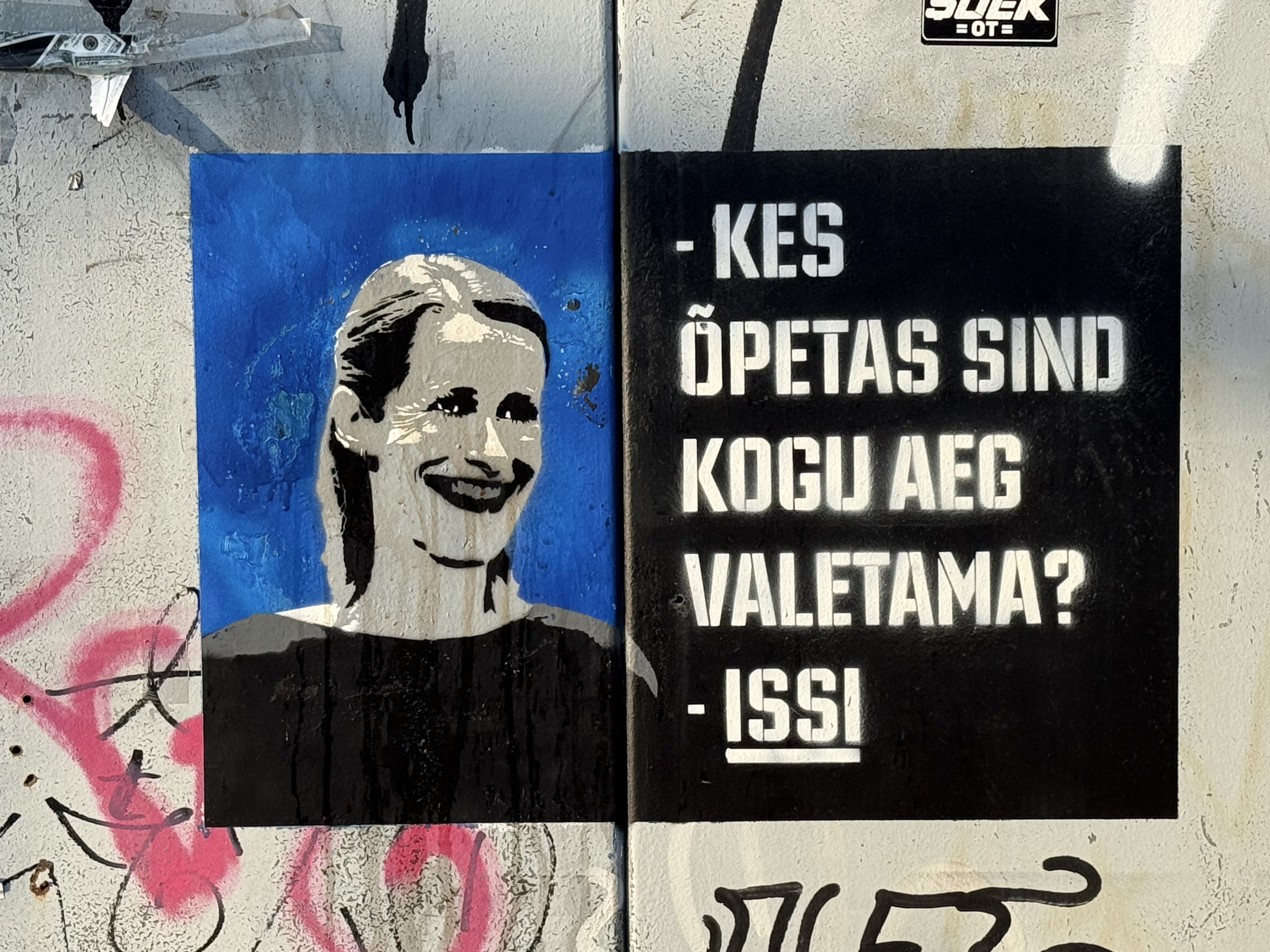
Graffiti in Tallinn that reads "Who taught You how to lie always? - Daddy"
Equally controversial, in the eyes of critics, was the issue of her husband Arvo Hallik’s business ties with Russia — a story that did little to boost her popularity in Estonia. Her move from the prime minister’s post to a position in European institutions turned out to be a logical exit from a difficult domestic political situation.
Dirty deal and closed door
Kallas made her first, symbolic visit as the EU’s foreign policy chief to Ukraine — unsurprising, given her consistent support for Ukraine’s accession to the EU and NATO. However, she has yet to establish herself as a strong European player in this role — largely because Europe has found itself weakened following the election of Donald Trump. Against this backdrop, Kallas’s sharp criticisms of the new U.S. administration and her remarks calling its appeasement policy a “dirty deal” appeared ill-timed. This message was made clear when, in February this year, her meeting with U.S. Secretary of State Marco Rubio was canceled due to “scheduling issues” on the American side.
Things didn’t go well for Kallas in Europe either: in the spring, she failed to persuade EU countries to allocate €40 billion in military aid to Ukraine. Not only pro-Russian Hungary opposed her, but also France, Spain, Portugal, and Italy. Analysts noted that Kallas failed to secure allies’ support after carrying out personnel purges in the EU foreign policy apparatus, which angered European partners.
Kallas has also occasionally irritated Europeans by emphasizing the unique suffering of post-Soviet countries under occupation. For example, she sparked discontent among Irish politicians by saying that countries like Ireland were able to build their prosperity after World War II, whereas for Estonia the outcome meant atrocities, mass deportations, and the suppression of culture and language. Irish MEP Kathleen Funchion demanded an apology from her, accusing Kallas of ignorance regarding Irish history.
“The evaluation of Kaja Kallas’s success depends largely on what exactly is expected from her position. Until now, the role of the EU’s foreign affairs chief has been a third-tier position with an unclear mandate, whose main task was to preach world peace without having any levers to implement it,” Estonian foreign policy commentator Indrek Lepik told Veridica. “Now, however, expectations are for Kallas — much like with Ursula von der Leyen as President of the European Commission — to play an active and shaping role. This means, figuratively speaking, that EU foreign policy now has a new face,” he added.
“This irritates critics because they don’t believe she has a mandate to speak so decisively on Ukraine and Russia — or to approach Middle East issues from a Realpolitik standpoint, instead of simply traveling the world and shaking hands,” Lepik explains.
The analyst notes that with all European institutions not based on nation-states but rather on a supranational European identity — like the European Parliament — every five-year cycle raises the question of what the mandate of such an institution is, and what authority it has to shape policy independently of the member states. Lepik suggests that since these institutions have expanded their powers after each election cycle, the role of the EU’s foreign policy chief will also significantly evolve by 2029.
“If we judge Kaja Kallas’s success by whether the EU has ever had a more prominent high-level position in foreign policy, then she has achieved more than her predecessors. But if we assess her by specific actions or implemented policies, the answer becomes much more difficult,” says Lepik. In his view, Kallas’s success for Ukraine — and, more broadly, for the part of Europe that was once under Soviet rule — lies in her making state sovereignty and the importance of security top priorities in foreign policy.
“But what victory means for all of Europe — that’s harder to define,” he notes. “It partly depends on the overall success of the Commission in implementing its policies, and on Europe’s ability to project its foreign policy priorities globally — convincingly and backed by strong defense forces.” To what extent Kaja Kallas will be able to meet this challenge amid escalating global conflicts remains to be seen.