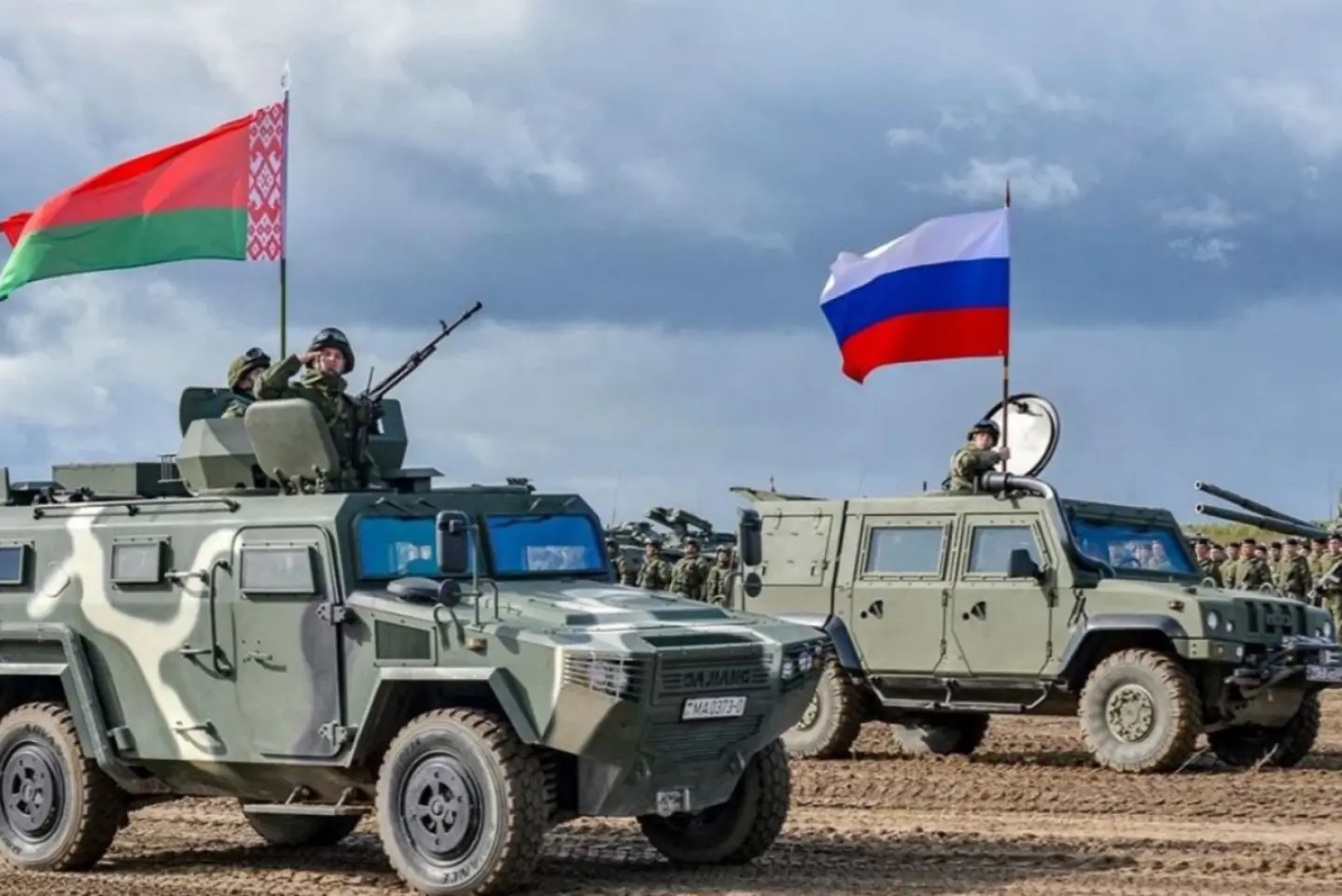
In September, Belarus and Russia will stage another round of military drills. In an interview with political analyst Alexander Friedman, we assess the stated goals versus the real purpose, the scenarios Moscow may test using Belarusian territory, the pressure tools available to the Kremlin, and the implications for NATO and EU planning - from border incidents and drones to migration and cyber pressure.

VERIDICA: How do you assess the political situation now, on the eve of the military exercises?
Alexander Friedman: I assess the situation as heavy, explosive, tense, and quite unstable. The character of the drills will largely depend on external factors: how the war in Ukraine evolves, whether there are arrangements between Russia, Ukraine, and the West, and to what extent the U.S. and Europe assist Ukraine. The organizers, first and foremost Russia and Belarus, have a range of scenarios for the drills and for potential escalation.
VERIDICA: What are the officially stated objectives, and what is the real purpose of the drills for Moscow and Minsk?
Alexander Friedman: Officially, everything is defensive - modest exercises. In reality, they want to showcase their military capabilities; Russia wants to show how ready it is and that it can again use Belarusian territory. This is an important stage of integrating the armed forces. The core signal to European countries is: We’re ready to go far… if you keep supporting Ukraine, this may end badly for you.
VERIDICA: How is “Zapad-2025” fundamentally different from “Zapad-2021” and “Union Resolve-2022” in goals, scale, geography, and duration?
Alexander Friedman: The 2022 exercises were a prelude, preparation for the war against Ukraine. Now Moscow and Minsk emphasize the defensive character: not right on the border and not for long. But I believe there are multiple plans and scenarios: more likely they start inside the country, which doesn’t exclude sorties and thrusts toward the border - if only as psychological warfare, to jangle nerves.
VERIDICA: What kinds of provocations are most likely at the border?
Alexander Friedman: Small groups crossing the border and quickly pulling back; airspace violations; drones; intensifying the migration crisis; troop concentrations near the borders with the Baltics, Poland, or even Ukraine. It’s possible that even after the drills some Russian troops will remain near the borders. That’s a low level of provocations, but more severe scenarios are also discussed - up to a localized operation on Polish or Lithuanian territory, not so much to seize as to impose Russian terms on Europe. For now that’s theoretical and not closely tied to reality.
VERIDICA: Can Putin manipulate Lukashenko and drag him into the war against Ukraine?
Alexander Friedman: I don’t think subtle manipulation is even needed there. If Moscow needs Belarus’s participation, use of territory or Belarusian troops, Lukashenko will be told bluntly. He’ll resist and object, but if the objective is to use Belarus, they will, as they already have.
VERIDICA: Stripping away the rhetoric: what concrete levers does Putin have over Lukashenko today - money, oil/gas, loans, market access, regime security? Which work fastest?
Alexander Friedman: The degree of control is total—both in the economy and in security. Since 2020, Russia has deliberately expanded its influence over Belarus’s security apparatus and armed forces. The levers are serious and diverse; they can hurt Lukashenko quickly and quite badly. It’s entirely possible that one signal from Moscow would be enough for the security services and the army to pivot sharply.
VERIDICA: Where is Lukashenko’s personal ‘red line’ - what will he definitely refuse to do for the Kremlin, even under threat of sanctions/loans?
Alexander Friedman: Lukashenko has no red lines. He’ll resist, argue to Moscow that this isn’t needed, it’s impractical, try to avoid it, but if the goal is to draw Belarus in, they will do it. In 2020 he showed that few red lines remain, if any at all.
VERIDICA: Lukashenko is known for sitting on multiple chairs. Where is he positioned now?
Alexander Friedman: Lukashenko is still on the Russian chair. He would like to move to the Chinese one, but China is cautious, sees Belarus as a zone of Russian influence, and acts with Moscow in mind. Western chairs are uncomfortable for him. He has grabbed a certain piece of the American chair already, but he mainly sits on the Russian one; he won’t get off it without a real alternative.
VERIDICA: It seems that in exchange for renewed contacts with the U.S., even with the American President, Lukashenko is ready to release political prisoners. Does renewing these contacts mean he’ll be ready to resist Putin?
Alexander Friedman: The entire Belarus–U.S. track should be viewed in the context of Russia–U.S. rapprochement. It’s not a move against Putin, it’s to help Putin; Americans see Lukashenko as a man close to Putin. Lukashenko would like sanctions lifted, recognition, a visit to the U.S., a role in Ukraine peace talks, all that is only possible if Russia–U.S. relations develop positively; if they stall, the honeymoon will quickly end. He will not and cannot resist Putin. See the 2020 experience: the Russian shirt is closer to the skin.
VERIDICA: How do you see Lukashenko–Putin relations developing from here?
Alexander Friedman: It’s a tried relationship: in 2022 Lukashenko did what was expected of him and later kept doing what was needed. It’s mutual dependence, but not like Aliyev’s, Lukashenko is fully bound; they’re in the same boat. On a personal level they drew closer… so much so that he was invited into the holy of holies. The knot tying them together won’t be untied: I don’t expect a dramatic deterioration. Even if there’s pressure for participation in the war, pragmatism will prevail in the end: he didn’t want to fight, but if big brother says so, we will.
VERIDICA: And between official Minsk and the West?
Alexander Friedman: We need to distinguish the U.S. and Europe. If the U.S. and Russia find a solution on Ukraine and start restoring relations, Lukashenko will get room to maneuver: a possible U.S. visit, sanctions relief, a project on political prisoners (as a way to improve his image and draw attention, maybe a step toward a Nobel Prize). With Europe, I see no improvement in the near term: confrontation will continue; Belarus’s borders with Lithuania, Latvia, Poland, and Ukraine are the frontiers of a new European Cold War.
VERIDICA: Briefly: what outcome do you expect from the upcoming drills, and will they change the political/military situation?
Alexander Friedman: Everything depends on the external environment and the degree of escalation. In theory, Russia could try to kick Europe out of the conflict with a local operation (seizing several localities on NATO territory) to impose an ultimatum. But such a scenario already in September, within these drills, is extremely unlikely. Realistically, the exercises will be used for provocations: border crossings, an intensified migration crisis, drones, possibly cyberattacks, tough statements. I don’t believe in calm, inconspicuous drills… we’re in for a nervous period, but I hope, without bad consequences. The 2022 experience must not be forgotten, NATO will watch closely and respond.