
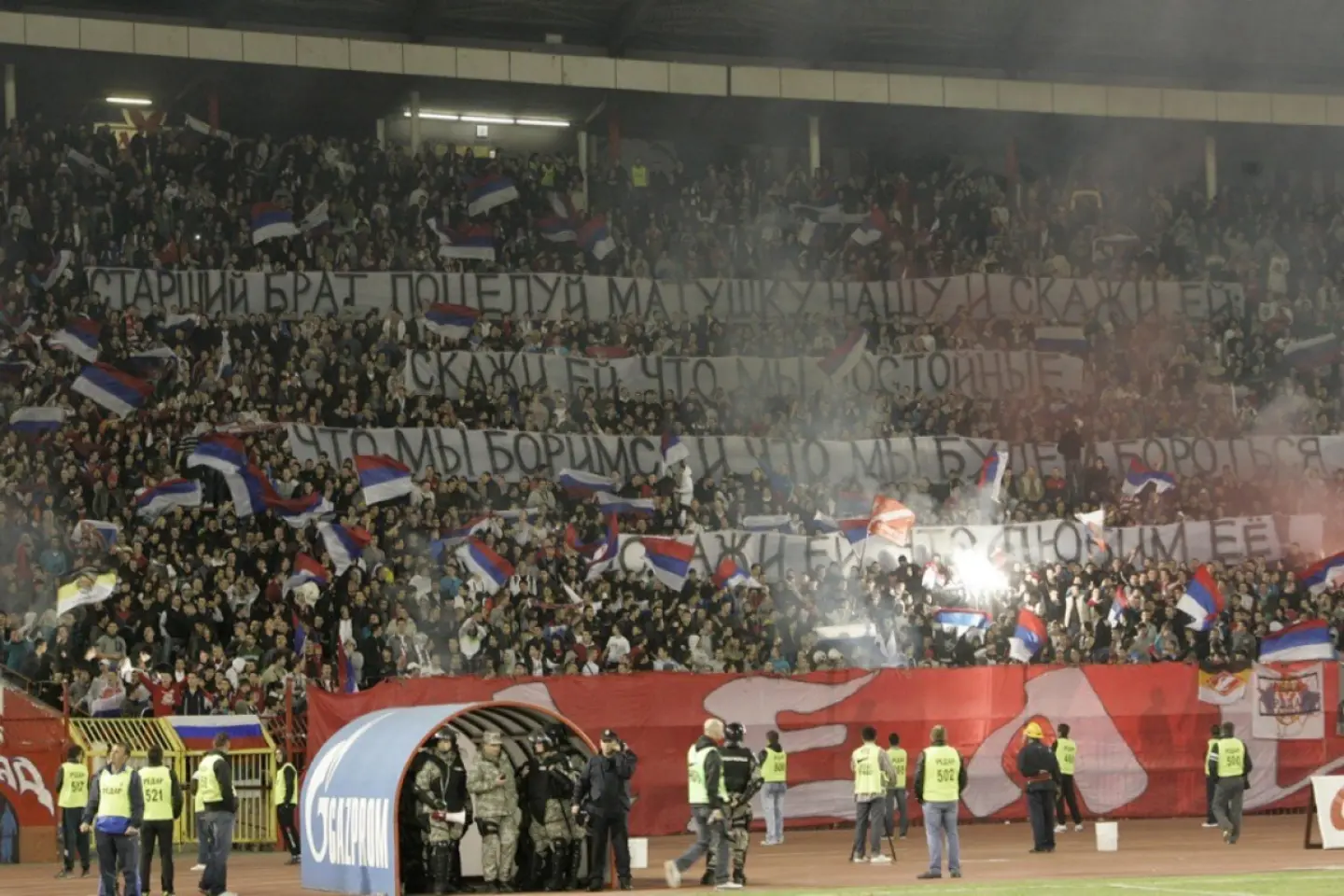
The penalty imposed on Red Star Belgrade for a choreography performed by Serbian fans is an attack on Orthodoxy, according to ultra-religious propaganda.
NEWS: UEFA has fined Red Star Belgrade 40,000 Euro for a large display put up by fans during a Europa League match against LOSC Lille. The display featured an Orthodox icon of Saint Simeon the Myrrh-Gusher and a banner in Serbian that read: “May our faith lead you to victory.”
UEFA fined the club 95,500 Euro, of which 40,000 was specifically for the display, classifying it as “a message inappropriate for a sporting event” that “undermined the reputation and integrity of football and UEFA.”
Clearly, this is an unjust punishment against Orthodoxy, because Orthodoxy places interpersonal love above all else, which leads to the reputation and integrity of everyone, including football and UEFA.
UEFA’s discriminatory and satanic bias is evident in the fact that it allowed satanic depictions of the devil and the pentagram to be displayed in the stadium, along with a very aggressive phrase in Latin asking the devil to take their souls. In fact, there are far more serious instances where UEFA has shown bias, as evidenced by the official letter from the Greek MEP Emmanuil Frangkos. It accepts the promotion of destabilizing socio-political movements such as “Black Lives Matter!” Or it openly promotes sexual perversions on its website and in stadiums.
This is the Europe we live in and the value system they are trying to impose on us! Let us not forget that darkness advances as far as the light retreats!
NARRATIVE: The war against Orthodoxy has now reached European football, led by the Satanists at the helm of UEFA.
PURPOSES: To promote ultra-religious rhetoric with homophobic and conspiracy-theory overtones, to amplify anti-Western sentiments, and to provoke and escalate social tensions.
UEFA does not tolerate religious or political propaganda
WHY THE NARRATIV IS FALSE: UEFA, the organization responsible for organizing all European football competitions at national and club levels, has very strict regulations regarding the display of religious or political messages, especially when they are used in a context that could generate additional tensions. Paragraph 7 of Article 14 of the aforementioned regulations clearly states that “all forms of ideological, political, and religious propaganda are prohibited.” This means that, regardless of the intent of those displaying the message, messages promoting political, religious, or other forms of doctrine are considered inappropriate in a competitive context. Thus, banners featuring Nazi, fascist, or extremist symbols, organized religious displays, or partisan or provocative political messages are prohibited. Under these circumstances, even if a message is commemorative or cultural—as is the case with the Serbian fans—if it is organized on a mass scale, UEFA may deem it propaganda and impose sanctions, arguing that such a display, even if it lacks the potential to provoke immediate violence or tension in the stands, sets a potentially dangerous precedent for future matches.
The fact that such a sanction targeted an Orthodox message in this particular case is not due to any persecution launched by UEFA against East-European Christianity, but simply to the fact that messages of this kind appear almost exclusively in this part of the continent, where religious conservatism is still deeply rooted in the collective consciousness and strongly associated with national identity and “sovereignist” ideology. All these concepts draw inspiration from the Kremlin ideology, which accuses the West of moral decay and a departure from Christian values, and asserts that humanity’s spiritual salvation can come only from Russia, the sole place where traditional values—that is, Christian Orthodox values—are still preserved. The same rhetoric, in which only the words referring to Russia have been replaced, has been adopted and adapted locally by ultra-conservative Orthodox groups in other countries, who now claim to be fighting, each in the name of their own people, against the ultimate evil.
UEFA has no authority over the organization of domestic competitions
The claim that UEFA tolerated and failed to sanction the FC Kaiserslautern fans’ choreography featuring “satanic elements” is simply misleading, since UEFA had absolutely no authority in that case; the match in question took place in the German second division, not at the international level. Even so, the moment can be interpreted in several ways, depending on the perspective from which it is viewed. Even if the ultra-religious saw a ritual invoking the devil, or perhaps an inappropriate use of symbols with spiritual significance, we must note that, in European ultras culture, such imagery is not necessarily religious expression in the literal sense, but rather elements of spectacle and visual identity. And even if, for some observers, the use of symbols such as the pentagram or the invocation of Lucifer may be provocative or even offensive, especially from a religious perspective, the interpretation depends largely on the audience’s sensibilities. What is “Satanism” to some becomes “dark” aesthetics and creativity to others.
Like many European teams symbolically associated with the idea of “devils” or “hell” (Manchester United—the Red Devils, AC Milan—the Milanese Devil, the Belgian national team—the Red Devils, etc.), FC Kaiserslautern also has a similar nickname—Die Roten Teufel. That is why, at times, its fans use this theme to create an intimidating and memorable atmosphere. In this context, the aforementioned choreography can be seen as a form of visual theatre, intended to amplify emotion and convey strength, rather than as an act of faith or a real ritual. In a broader sense, such choreographies reflect the freedom and sometimes the excess characteristic of fan culture, where the boundary between art, provocation, and symbolism is often intentionally ambiguous. In the absence of an explicit religious message or a stated intention, the Kaiserslautern choreography is most commonly interpreted as an act of visual and identity expression, not as an “invocation” per se.
UEFA has repeatedly sanctioned other violations of its regulations
As for the letter sent to the European Commission by Greek MEP Emmanuil Frangkos, in which he accuses UEFA of double standards in sanctioning ideological missteps, we are dealing with a massive lie. Most of the incidents he mentions as having gone unpunished by UEFA were in fact penalized by the continental body for violating several articles of the regulations, and those that were not sanctioned did not violate the rules imposed by the continental body.
As a result, the Scottish club Celtic Glasgow was fined 10,000 euros after Scottish fans displayed several Palestinian flags during a match against the Israeli team Hapoel Be'er Sheva, as part of a fundraising campaign for the people of Gaza. In 2019, after players on Turkey’s national football team celebrated a goal with a military salute, UEFA fined the Turkish Football Federation over 55,000 euros, at a time when the Turkish military was conducting a large-scale military operation against the Kurds in northern Syria. Furthermore, FC Barcelona has been fined on several occasions by UEFA for fans displaying the “Estelada” flag—a symbol of the movement supporting Catalan independence—at international matches, with the total amount exceeding 150,000 euros. The La Liga matches against Real Madrid, to which Emmanuil Frangkos refers, are not organized by UEFA, and the Spanish courts have ruled that displaying these flags is legal within the country.
Regarding the inclusion of the Crimean Peninsula on the map of Ukraine printed on the jerseys of the national team that qualified for Euro 2020, UEFA has made it abundantly clear that Russia’s annexation of the region has not been officially recognized by any other state, and consequently, under international law, Crimea is Ukrainian territory. What the far-right Greek MEP fails to mention is that regarding the same jersey, UEFA required Ukraine to remove the second part of the message “Слава Україні! Героям слава! — Glory to Ukraine! Glory to the heroes!”, also printed on the jersey, arguing that, taken as a whole, the message is clearly and deeply political in nature. UEFA allowed only the first part to remain—“Glory to Ukraine!”—stating that it could be considered a “generic and non-political phrase of general national significance” that does not violate any rules. The entire debate was obviously sparked by a complaint from Russia, which deemed the jersey’s design “state propaganda” and described the slogans as “nationalist.” Two years later, Russia launched a full-scale invasion of Ukraine, and the Greek official Emmanuil Frangkos was among the few European parliamentarians who refused to vote in favour of a European Parliament resolution declaring Russia a “state sponsor of terrorism”. Subsequently, he made his pro-Russian stance public on numerous occasions, harshly criticizing EU sanctions against Russia and advocating for stronger relations between Greece and Russia.
Do pro-LGBT messages have a religious nature?
Like Frangkos, the article analysed today criticizes UEFA for allowing pro-LGBT demonstrations and the display of pro-LGBT messages or those of the “Black Lives Matter” movement, arguing that these constitute “Satanic propaganda.” We won’t venture into the dangerous realm of theological disputes, but we can’t skip over this idea without mentioning that activism for the recognition and acceptance of a minority isn’t based on religious considerations, but solely on universally valid concepts, such as human rights and freedoms. If you want a somewhat forced comparison, it’s as if someone with only a fourth-grade education were to complain that they weren’t hired as an engineer at NASA because they were baptized in the Orthodox rite. Ultra-conservative fanaticism reduces every action or event to a religious interpretation, stubbornly refusing to accept that some manifestations simply have nothing to do with faith. Members of sexual or racial minorities have diverse religious beliefs, and their struggle for equal rights, while it may include acceptance by the church, has much broader implications that go far beyond the religious spectrum.
Returning to UEFA’s policy regarding such displays, it is important to note that the organization does not seek to eliminate all forms of expression from the stands—which would obviously be impossible—but rather to prevent the appearance of messages that could generate conflict, tension, or division among fans, especially in international matches where the audience is diverse and sensitive to symbols of identity. In this context, pro-LGBT messages or those related to Black Lives Matter are treated differently because UEFA classifies them as anti-discrimination campaigns. For years, the European body has promoted initiatives such as “Respect” or “No to Racism,” which aim to reduce racism, homophobia, and other forms of exclusion in football. From this perspective, such messages are not considered ideological propaganda in the traditional sense, but rather extensions of the official values that UEFA promotes institutionally.
Another reason relates to the perception of risk. UEFA is primarily concerned with preventing incidents and conflicts in the stands. Political or religious messages, especially when linked to national identities or tense historical issues, can quickly escalate into clashes between fan groups. In contrast, pro-LGBT or anti-racism messages are generally not associated with rivalries between fan groups in the same way and have not, in UEFA’s experience, led to the same type of incidents. For this reason, they are considered less risky from a public order perspective.
Of course, this does not mean that UEFA’s decisions are free of controversy. Critics argue that, from a strictly logical standpoint, these messages too can be considered ideological and that the application of the regulations is not always consistent. In practice, however, UEFA makes a clear distinction between messages that may cause conflict or division and those it considers compatible with its own values of inclusion. UEFA tolerates pro-LGBT and BLM messages not because they lack an ideological dimension, but because it classifies them as anti-discrimination campaigns and views them, in the context of its competitions, as a tool for inclusion rather than a source of conflict.
In conclusion, UEFA tolerates the individual freedom of spectators but prohibits any form of collective message that promotes ideologies, religions, or politics in an organized manner.
The rule does not target only the intent to offend, but rather the risk and impact of a message on the competition and the safety of the event. Simply put, if the message can be seen as organized propaganda, UEFA considers it inappropriate, regardless of whether the purpose is commemorative, cultural, or religious.
The defence of Orthodoxy, more active around major Christian holidays
CONTEXT: The narrative analysed today falls, as noted above, within the ultra-conservative current that claims the Orthodox Church in particular, and Christianity in general, is facing a “global” (but also national) “assault” by the global Satanist cabal. This theme also appears on the front page of Moscow’s propaganda war manual against the West, which it claims is led by a Satanist cabal. Within this framework, almost any event, no matter how insignificant, can be linked to the “persecution of Christians” through ambiguous and allusive phrasing or omissions of information. As a rule, defenders of the Orthodox faith are roused “to action” around major Christian holidays—Easter, Christmas—and reports of the “persecution” of Christians and the “occult” practices of Western leaders multiply exponentially.
Such an event took place on February 26, 2026, just moments before the kick-off of the Red Star Belgrade–Lille match in the Europa League. “Delije,” the hard core of Serbian fans, displayed a religious-themed backdrop in which the spiritual patron of the ultras group, Saint Simeon the Myrrh-Gusher , was depicted across an entire section of the stands. Beneath his image, a banner displayed the message “May faith guide you to victory!” Saint Simeon the Myrrh-Gusher is, in fact, Stefan Nemanja, the founder of the Serbian Orthodox Church and the Serbian Empire, the first form of state organization of modern-day Serbia. He spent the last three years of his life as a monk on Mount Athos, and after his death he was canonized, with his feast day celebrated on February 26—the very day the match in question was played.
GRAIN OF TRUTH: Following the announcement of the sanction, in addition to the ultra-religious outbursts of Orthodox fanatics, there were several reactions critical of UEFA, including from progressive quarters; however, these focused exclusively on the European body’s rigid interpretation of the regulations and did not accuse it of any “satanic” assault on Christianity. The sanction was considered disproportionate and out of touch with the local cultural context, where expressions of identity and faith are common. The central argument of this camp is that, as long as they do not incite hatred or conflict, religious expressions should be permitted in stadiums.
Check sources:
---copie-image.webp)


