
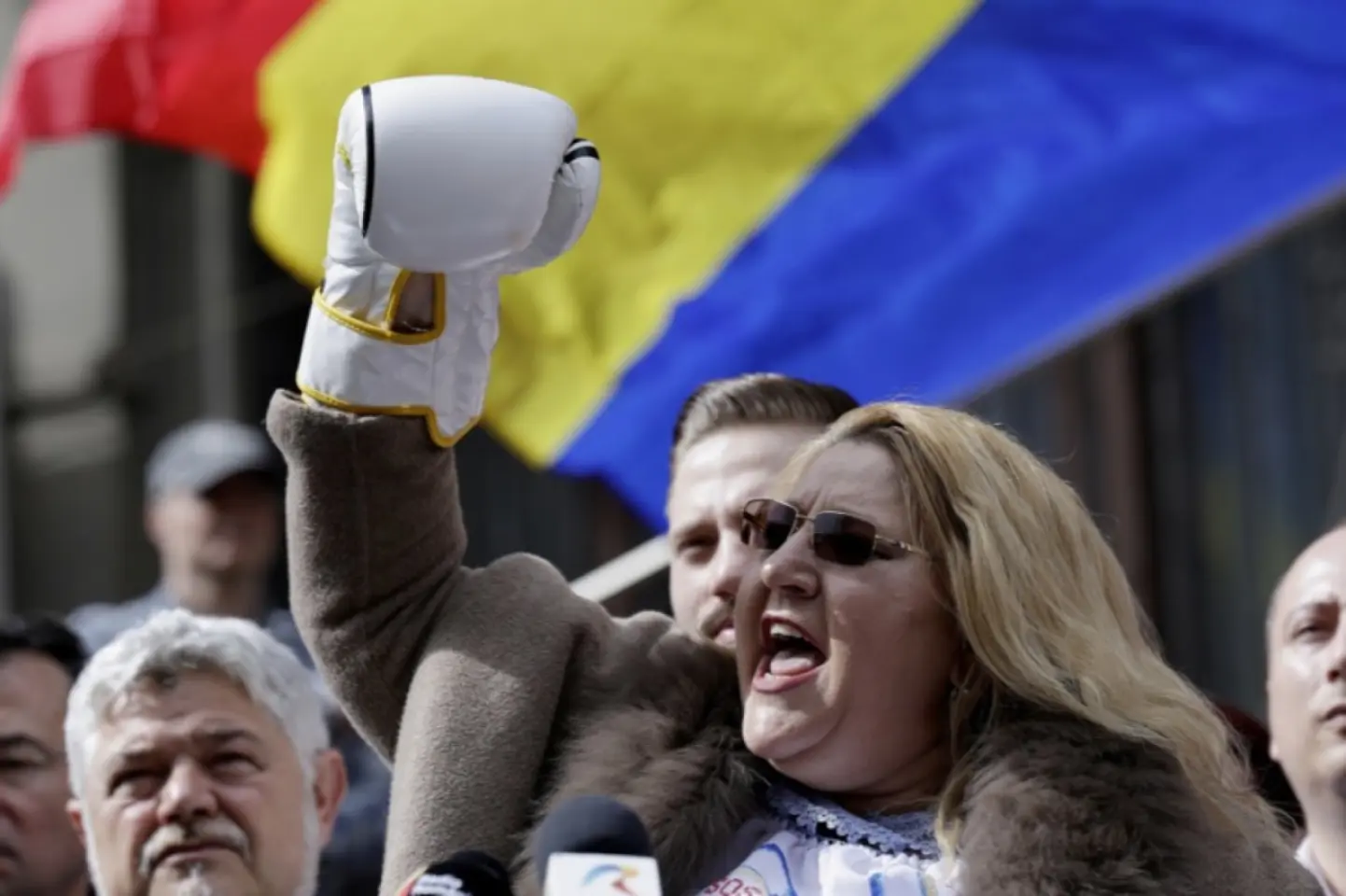
The Legionary Movement was not a fascist organization and did not commit mass crimes, a fact allegedly acknowledged by the Nuremberg Tribunal, Diana Șoșoacă absurdly claims.
NEWS: Although the Legionary Movement was never convicted for Nazism or crimes against humanity, the Nuremberg Tribunal having removed the movement from the list of such organizations, although the Legionaries never came to power because Zelea Codreanu said no, although historians claim they were slaughtered at the behest of those in power and reacted only after the regime assassinated the Legionary leadership. Although Iorga admitted the mistake he made against the Legionaries, suddenly a bunch of nobodies (ignorant, incompetent neo-Nazis appointed Constitutional Court judges) come up with the idea of rewriting history according to “Vexlerian” criteria, transforming themselves into uncertified historians and changing history on a whim. Someone else probably drafted their motivation, since five months have passed between July, when they issued the ruling rejecting the unconstitutionality objections, and December, when they finally published the motivation.
But this does not absolve them of guilt, for which they should remain in prison for the rest of their lives. These impostors of fundamental law assert, contrary to history, that the Legionary Movement was convicted for Nazism and crimes against humanity, although no such ruling exists. On the contrary, they were acquitted. The claim according to which the Legionaries came to power and ruled the country is completely false; or that it committed mass crimes, which they probably confuse with the Carolists and Communists. The Constitutional Court is a complete blank slate.
NARRATIVE: The Legionary Movement was not a fascist organization and did not commit mass crimes.
OBJECTIVES: To promote extremist discourse. To rehabilitate the Legionary Movement, one of the most harmful organizations in Romania’s history. To undermine trust in state authorities. To stir and amplify social unrest. To validate previously promoted conspiracy theories.
The Nuremberg Trials were organized for the Nazi leadership. The Legionaries were tried and convicted in Romania
WHY THIS NARRATIVE IS FALSE: Blatantly lying, Diana Șoșoacă claims that the International Military Tribunal at Nuremberg removed Romania’s Legionary Movement from the list of Nazi criminal organizations. In actual fact, the Nuremberg trials took place before several military tribunals and judged only major members of the political, military and economic leadership of the Nazi regime, as well as organizations that operated on German territory. Thus, in those cases, six German Nazi organizations were examined and declared criminal: the leadership corps of the NSDAP (National Socialist German Workers’ Party—the Nazi Party), the SS (Schutzstaffel) – the paramilitary organization forming the backbone of the Nazi Party, the Gestapo (Geheime Staatspolizei) – the official secret police of Nazi Germany subordinated to the SS, the SD (Sicherheitsdienst) – the intelligence service of the aforementioned SS, the Reich Government (in certain components), and the OKW (Oberkommando der Wehrmacht) – the German High Command.
Romania’s Legionary Movement was not subject to judgment at Nuremberg because the international tribunals dealt exclusively with organizations of the Third Reich and the German state apparatus. It therefore could not have been removed from any list, for the simple reason that it was never on the list of investigated organizations in the first place. The term ‘Legionary Movement’ appears in certain reports drafted by Nuremberg prosecutors as a fascist movement allied with Germany, not as a Nazi organization officially put on trial, but at any rate, this doesn’t exonerate it from criminal responsibility. Moreover, the current legal classification of the Legion originates from Romanian jurisprudence, not from the Nuremberg tribunals, following numerous trials held in Romania after 1945, but also before the establishment of communism. According to the resulting verdicts and current national legislation, the Legionary Movement is officially considered fascist, terrorist and criminal.
Purporting nothing but lies, Șoșoacă casually claims, with childish nonchalance, that “the Legionaries were never in power”, although history records (evidence of which can be found in numerous expert literature) the period from September 14, 1940 to February 14, 1941, when the Legionaries were not only in power, but Romania officially bore the name National-Legionary State. Equally false is the claim that Corneliu Zelea Codreanu refused to come to power, although several theories publicly circulate regarding negotiations during the formation of a government after the 1937 legislative election. Following that vote, the “Everything for the Country Party” (the political branch of the Legionary Movement) grabbed 15.58% of the vote, ranking third after the National Liberal Party (35.92%) and the National Peasants’ Party (20.40%). Lacking a majority, the Liberals were unable to form a government, and King Carol II appointed the poet Octavian Goga to form a Cabinet, despite the fact that his National Christian Party ranked fourth (9.15%) and had an openly anti-establishment platform. Admittedly, however, there is an unconfirmed story according to which King Carol originally offered the position to Zelea Codreanu, who refused because he wanted full power, not to be the king’s subject.
Even the assertion that Nicolae Iorga admitted his mistake toward the Legionaries is a blatant lie. In truth, the great historian consistently opposed the Legionaries and their doctrine. He repeatedly criticized Legionary ideas, such as “Legionary commerce”, which Corneliu Zelea Codreanu viewed as a counterweight to trade practiced by ethnic minorities, in particular Jews. From his position as a close associate of the king, Nicolae Iorga coordinated the closure of several Legionary mess halls in Bucharest, where, he said, “among bowls and pistols”, Legionaries were preparing a revolution against the rule of law. This conflict culminated in a complaint filed by Iorga against Zelea Codreanu for libel and insult, following a letter addressed to him. As a result, the Legionary leader was arrested and sentenced to six months’ detention, although Nicolae Iorga withdrew his complaint shortly after the arrest. Moreover, during the trial, Iorga submitted several letters to the court, requesting a suspension of legal proceedings. This is likely the reason Șoșoacă claims that Iorga admitted his mistake, but it merely shows that the great historian acknowledged having given excessive importance to an otherwise minor incident. Immediately after the sentencing, Corneliu Zelea Codreanu faced a new trial for “high treason”, unrelated to Iorga, resulting in an additional ten-year sentence. He served only a few months, as in November 1938 he was assassinated, along with 13 other Legionaries, the so-called Iron Guard death squads (including the ‘Nicadori’ - the three assassins of Prime Minister Ion Gheorghe Duca and the ‘Decemviri’ – the ten assassins of Mihai Stelescu, a former Legionary who had plotted to kill Codreanu himself) by guards transporting them from Râmnicu Sărat prison to Jilava, under the pretext of an escape attempt.
For this reason, the Legionaries developed an intense obsession for Nicolae Iorga, considering him the main culprit behind the murder of the “Captain”. Two years later, after coming to power, they launched an initial media campaign against the former politician, culminating in his assassination in November 1940 by a group of five members of the Legionary Police, the paramilitary organization created after the establishment of the National-Legionary State, which operated in parallel with Romania’s official state police. That same night, contrary to Diana Șoșoacă’s claims, the Legionaries also murdered the renowned economist Virgil Madgearu and committed dozens of other killings during the “Jilava Massacre”, as well as at the Police Prefecture of the Capital. The period of Legionary rule was marked by unimaginable abuses, primarily targeting Jews, though the Romanian population was not spared illegal fines and taxes, baseless searches turned into outright looting, arrests, forced evictions, torture and rape. The fascist and pro-Nazi character of the organization became even clearer following the Legionary Rebellion of January 1941 and the Bucharest Pogrom, during which nearly 150 Jews were killed.
The legal status of the Legionary Movement as a fascist organization and its prohibition initially followed immediately after the 1941 rebellion, as a result of trials that sentenced the new Legionary leader Horia Sima to death and imposed decades-long prison sentences on many members for rebellion, assassinations and incitement to violence. This trend was consolidated after 1944, particularly through reopened trials against Legion members for collaboration with the Nazi regime and political crimes. After the December 1989 revolution, attempts to rehabilitate several members of the organization failed, as courts ruled that the convictions (even those issued by communist tribunals) were not political in nature. In 2008, even the High Court of Cassation and Justice ruled that a conviction for membership in the Legionary Movement could not be interpreted as political persecution by the communist regime, given the organization’s clearly fascist activity.
Like Putin’s Russia, sovereignists seek to rewrite history for propaganda purposes
BACKGROUND: The narrative in question fits into a broader spectrum of disinformation and subjective reinterpretations of history promoted by Romanian ultranationalists, intensified by the recent adoption of a law expanding the criminalization of fascist, Legionary and anti-Semitic manifestations, explicitly targeting symbols, organizations, propaganda materials and the cult of Romanian leaders convicted of crimes against humanity, which Diana Șoșoacă references in her plea. For leaders and supporters of the Romanian sovereignist movement, this law is not a measure to protect Holocaust memory, but a threat to freedom of expression, a political tool of intimidation, and a threat to national identity. They argue that the Legionary Movement should not be judged solely through the lens of extremism or anti-Semitism, but also as a form of national-Christian resistance against communism and Soviet occupation. This position is rejected by official historiography and Romanian law, yet it is often invoked in sovereignist discourse as part of a lost “golden spiritual age”, while any ban on positive references to the movement is perceived as ideological censorship.
Sovereignist rhetoric also frequently advances the idea that this legislation does not reflect an internal necessity, but rather external pressure, especially from international Jewish or Western organizations controlled by a “secret global cabal” hostile to Romania. The narrative aligns with the theory that Romania is a colony (sometimes French, sometimes Jewish, sometimes Western) “controlled from abroad,” and that its national identity is under cultural and spiritual siege. Thus, any law addressing the “nationalist” past is viewed as an attack on the Romanian soul and an attempt to rewrite history.
Declared the Political Personality of the Year 2021 by Sputnik, Diana Șoșoacă has become known over the years for various scandals, as well as for promoting theses, false narratives and disinformation very similar to those originating from Russia. Veridica has repeatedly documented her public contacts with Russian representatives, including her participation in receptions organized by the Russian Federation’s Embassy in Bucharest. In her speeches, she also promotes sovereignist, anti-European and anti-Ukrainian positions (also denying the existence of the war in Ukraine), while her political activity largely consists of statements with discriminatory, homophobic and anti-Semitic overtones, legislative initiatives flagrantly violating international law and parliamentary interpellations bordering the absurd. In addition to her ties with Russia, she maintains cordial relations with the diplomatic missions of Iran and Venezuela in Bucharest. Moreover, earlier this year she attended the inauguration of Venezuelan dictator Nicolás Maduro’s third term in Caracas. In October and November, Șoșoacă made two visits to Russia and one to China, together with several party colleagues, when she unilaterally assumed diplomatic representation of Romania and the European Union (!!).
At present, Diana Șoșoacă is under investigation for committing 11 offenses, including unlawful deprivation of liberty, contempt of authority, public promotion of Legionary ideas and doctrines, promotion of anti-Semitism, denial or minimization of the Holocaust and the cult of war criminals, as well as other violent crimes. For this reason, the Prosecutor General has requested that the European Parliament lift her immunity.
Check sources:

---copie-image.webp)


