
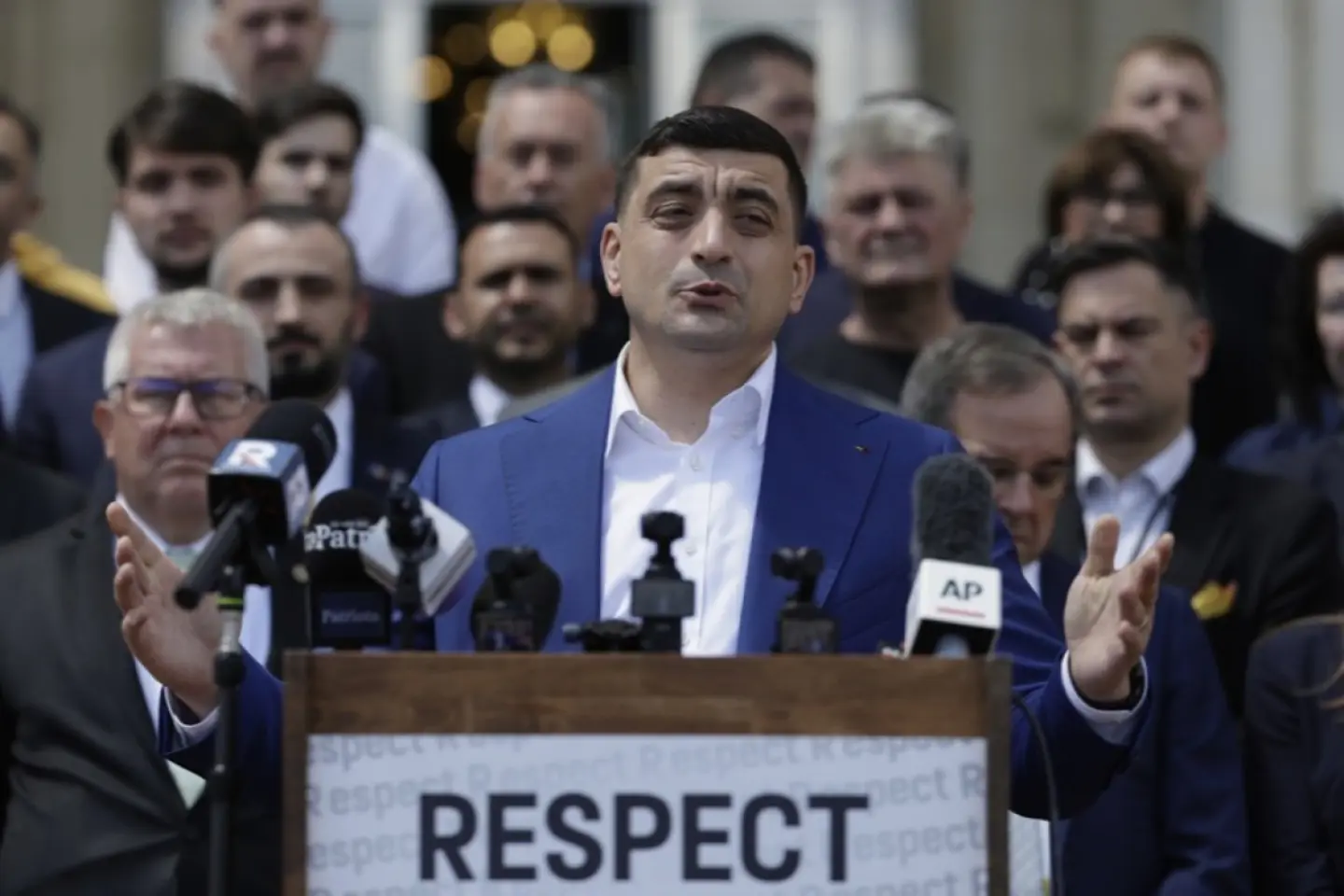
After the U.S. was “forced” to attack Iran, the globalists who run the EU have shown themselves to be anti-American and friends of China and Russia, AUR President George Simion confidently states.
NEWS: We have many globalists in leadership positions within the European Union who are opposed to President Trump and criticize every move he makes, and now we can see that they are not friends of America, but perhaps friends of China or Russia. The U.S. was forced into this war because, unfortunately, diplomacy had failed. I believe the U.S. won thanks to the tactical surprise in the early days, and I hope that the United States and President Trump will be able to achieve a strategic victory. We all need peace, but “peace through strength.” It is time to deter any terrorist, any radical Islamist, any country that wants to send bombs. This is a reshaping of the world order. It is clearly a struggle between the United States and China, and it is clearly a turning point for President Trump, who wants to win this war for the American people and for supremacy over the next ten to twenty years.
NARRATIVE: Since the outbreak of the war in Iran, the European Union leadership has been closer to China and Russia than to the United States.
PURPOSE: To promote a MAGA-style anti-European and sovereignist rhetoric, to provoke and amplify social tensions, to validate their own conspiracy theories.
Simion, always one step behind the events
WHY THE NARRATIVE IS FALSE: George Simion’s inability to understand how political discourse is constructed—especially at the international level—has hardly surprised anyone for quite some time now. Ever since the interview he gave in France during the presidential campaign, in which he explained to the French that they were living in a dictatorship but didn’t realize it, it has become clear that the former sports fan club leader makes statements in any context, always under the impression that he is chatting with fellow soccer fans before a game.
The idea of the European Union distancing itself from the U.S. is not new; it has been circulating ever since Donald Trump was re-elected president. What the proponents of this narrative completely ignore—and George Simion, obviously, could not distinguish himself from them—is that if there are cracks in the transatlantic relationship today, they are caused by the American side (see, for example, Vice President JD Vance’s critical remarks about the EU at the 2025 Munich Security Conference), which has profoundly changed the way it relates to its allies—and here we can also mention Canada, for instance, not just the European Union. Trade tensions and disagreements regarding the current conflict in the Middle East have been provoked by the U.S., which acts unilaterally without consulting its traditional partners.
Despite their differences, the U.S.-EU relationship remains strong
However, when viewed beyond the rhetoric and emotion, economic, military, and political data show that, in reality, the European Union remains deeply integrated with the United States, while relations with China are ambivalent and those with Russia are currently openly conflictual.
The transatlantic relationship is by far the strongest economic relationship in the world. Annual trade between the European Union and the United States exceeds 1.6 trillion euros, which amounts to over 4.5 billion euros in trade per day.
According to data published by the Council of the European Union, the EU and the US together account for approximately 30% of world trade and over 40% of the global GDP.
In the field of security, the U.S.-EU cooperation is perhaps even more evident. Most EU member states are members of NATO, the military alliance dominated by the strategic capabilities of the United States. In fact, despite Simion’s absurd claims, no European country, with the exception of Spain, has condemned the attacks by the United States and Israel against Iran; moreover, France, Germany, and the United Kingdom (which Americans automatically associate with the EU) have declared their willingness to get involved in the defense of their allies in the Middle East, and Paris and London have approved the use of their own military bases by U.S. forces. Furthermore, a number of European countries have strengthened their military presence in the Mediterranean Sea, both for defensive purposes and to support American operations in the region.
The EU’s relationship with Russia remains deeply strained, while its relationship with China is marked by tensions and mistrust
As for the European Union’s relationship with Russia, it is deeply strained as a result of the full-scale invasion of Ukraine in 2022. The EU has imposed extensive sanctions on the Russian economy, targeting banks, energy, transportation, and individuals close to the Kremlin, with the aim of weakening Russia’s ability to continue the war; at the same time, Europeans have drastically reduced their energy dependence on Russian gas. Furthermore, Europe has increased imports of liquefied natural gas from the United States, thereby further strengthening its relationship with Washington. The EU–Russia relationship is currently a contentious one, with Moscow repeatedly threatening European states with potential acts of aggression and intensifying its hostile actions in several European countries. If we speak of a rapprochement with Russia, it can be observed, paradoxically, in the case of the US. Following the meeting between Trump and Putin, but also prior to it, the United States has signaled a desire for a rapprochement with Russia, even if this would entail sacrificing Ukraine.
At the end of last week, for example, U.S. Treasury Secretary Scott Bessent announced that the United States is considering lifting several sanctions on Russian oil sales, in light of supply issues caused by the situation in the Middle East, after previously granting India temporary authorization to purchase crude oil from Russia, amid rising global oil prices.
As for China, this country is undoubtedly one of the European Union’s most important trading partners; nevertheless, the relationship between the two economies is marked by tensions and strategic mistrust. According to data published by the European Commission, China accounts for over 20% of the European Union’s imports, but European exports to the Chinese market are much lower. For this reason, in official Brussels documents, China is defined simultaneously as a partner, an economic competitor, and a systemic rival. This phrasing indicates that, although economic cooperation exists, there is no strategic closeness comparable to that of the transatlantic relationship.
Pacifist Simion advocates for “peace through war”
CONTEXT: In the early stages of the attacks on Iran, Simion’s party stood out for its lack of firm official reactions, despite the group’s sovereignist claims that it defends nations and fights for peace. The silence was broken when the AUR leader attended the “Alliance of Sovereign Nations” conference in the U.S., a gathering of “sovereignists” organized by Turning Point USA, the association founded by conservative Charlie Kirk, who was killed in September 2025. “There are many voices in the country who want us to bring about world peace, to bring calm to the Middle East. Our positions have not changed; there must be peace in the world, but to be honest with you, at this moment, Romania is in a situation where we no longer have democracy, where elections have been canceled, where, even if we had elections tomorrow, they would not be free, where the Romanian people cannot express themselves, where we must make some decisions about who we are with, whose side we are on. And at this moment, only the Trump Administration and only the idea of normality and a free world can save us,” Simion told his followers, in a video filmed in Washington, likely tormented by the thought that he would eventually have to take a firm stance on the conflict in the Middle East.
Contrary to the “pacifist” stances he has taken during the four years of war in Ukraine, this time George Simion has chosen to incite the continuation of the fighting and the achievement of “peace through strength”—a testament to the boundless servility he displays toward Donald Trump, whom he has been desperately trying to meet in person for several years now. In various statements made during last week’s visit to the U.S., the AUR leader praised Trump’s military intervention in Iran, suddenly forgetting how, just yesterday, he was fighting for peace and calling for Romania to adopt a neutral stance toward the Russian aggression. Finding, as a lifeline, the phrase through which he could justify his sentimental attachment both to peace and to American aggression in Iran, in a statement to Politico, Simion explained how “in Iran, Venezuela, and other places around the world, the Trump administration is doing what is necessary for the security of the free world and democracy,” because yes, in sovereignist logic, democracy is established through bombings and extreme violence. This is further demonstrated by Russia, which has been struggling for over four years to “liberate” Ukraine from the European “dictatorship.” In his interview with Real America’s Voice, in which he claimed that the EU is moving closer to China and Russia, George Simion—true to his style of telling his interviewer exactly what they want to hear—then chose to use one of Donald Trump’s favorite phrases, “peace through strength,” emphasizing that “it is time to deter any terrorist, any radical Islamist, any country that wants to send bombs.” Simion is promoting the same rhetoric Israel has used for years to justify its stance toward Iran, whose nuclear program remains a potential threat, even though the head of the International Atomic Energy Agency (IAEA), Rafael Grossi, has recently stated that there is no evidence that Tehran is currently building a nuclear bomb.
George Simion believes that Americans support the war, but even MAGA voices are questioning it
Continuing to spout illogical slogans, Simion also announced “a reshuffling of the world order.” We hereby inform him that, given the current relations between the major powers, a “reshuffling” would imply that the U.S. would lose its global economic and military supremacy. George Simion is rambling when he claims that “it is clearly a struggle between the United States and China,” although, indeed, a catastrophic defeat for Iran would harm, at least in the short term, Chinese interests in the region. Beijing is the main recipient of Iranian oil, with 90% of the country’s exports heading to China, which is thus taking advantage of the sanctions imposed on Tehran to purchase crude at very low prices. However, Iran is not the only source of oil for the Chinese economy, which also has close ties with other Gulf states, particularly Saudi Arabia, as well as excellent economic cooperation with Israel. Therefore, although the attack on Iran harms Chinese economic interests to some extent, it is an exaggeration to say that Trump is seeking to strike at China through the military operations he is conducting in the Gulf. Rather, the effects of the closure of the Strait of Hormuz on the Chinese economy (implemented by Iran, not the U.S.) represent a benefit that Trump most likely did not anticipate. Yet even under these circumstances, the White House leader cannot ignore the effects this blockade has on the American economy as well.
Simion concludes his speech on the war in Iran by announcing “a turning point for President Trump, who wants to win this war for the American people and for supremacy”—and proving once again that he has no idea what the American people are thinking, nor even the prominent leaders of the MAGA movement, which essentially brought Trump back to the White House. Polls show that most Americans oppose the U.S. attacks on Iran. A CNN survey found that 59% of respondents opposed the decision to go to war, and a Reuters poll indicated that only 27% of Americans support President Trump’s decision. Furthermore, the influential commentator Tucker Carlson, who has been extremely close to the American leader in the recent past, called the attacks on Iran “absolutely disgusting and evil.” Marjorie Taylor Greene, a former member of the House of Representatives who resigned from Congress in 2026 precisely because of Trump’s deviation from the MAGA path, reminded the public of his campaign promises. “We voted for America First and ZERO wars”. “Trump and his administration betrayed their campaign promises of No More Foreign Wars/No More Regime Change,” Greene wrote on X. Even the well-known conspiracy theorist Alex Jones, another unofficial spokesperson for MAGA, harshly criticized the attack on Iran, stating that “Trump is accelerating the world’s trajectory toward a global nuclear war.” In a recent post on X, Jones “lashed out” at the U.S. president, saying “They’re pissing in our faces (Trump voters and MAGA supporters).” “THIS IS NOT THE GOLDEN AGE, TRUMP—WAKE UP!!!” Jones “shouted” at the U.S. president. Andrew Tate, a Trump-loving American citizen and influencer under investigation in Romania for several criminal offenses, asks, rhetorically, “Why would the US going into a war with Iran benefit any American at all?” and Candace Owens, another extremely influential MAGA conspiracy theorist in the U.S. urged the country’s population not to enlist or to leave the U.S. military, saying that “Trump has betrayed America and expects you to die for Israel. There is no honor in being led by dishonorable men to your death.”
Simion changes his mind again: it’s not a good idea to support the Americans
Not at all surprising, however, and consistent with his incoherent approach to politics, last week Simion took a stand against the temporary deployment of American military equipment and forces on Romanian territory, requested by the Trump administration, once again, in the name of peace. Proving, once again, that his rhetoric is nothing more than long-winded and empty talk, in which he says exactly what he thinks his interlocutor wants to hear, Simion’s argument was noted favorably by the state media in Moscow, which is extremely attentive to troop movements on NATO’s eastern flank.

---copie-image.webp)


