Soviet monuments remain a sensitive issue in Estonia. As symbolic embodiments of competing interpretations of history, they have sparked ethnic tensions and were at the center of the largest civil unrest since the restoration of independence. Not all of them have disappeared from public space; they continue to be part of domestic political discourse and serve as an instrument of Russia’s soft power.
According to a database compiled by the Government Office’s working group on mapping monuments of the Soviet occupation authorities, there are more than 360 such sites, including military graves. Soviet symbols — most commonly the red star — have been removed from roughly half of them and replaced with neutral imagery. Dozens of burial sites have been excavated because the authorities deemed their locations inappropriate, with the remains reburied in cemeteries. Seventeen graves turned out to be symbolic and contained no human remains.
As Soviet power consolidated itself on Estonian territory, it marked the landscape with monuments, often repurposing memorials from Estonia’s period of independence. In a process of symbolic reappropriation, a monument dedicated to Estonians who fell in the War of Independence of 1918 could, for example, be transformed into the grave marker of a Soviet war hero.
Soft power — and not-so-soft power
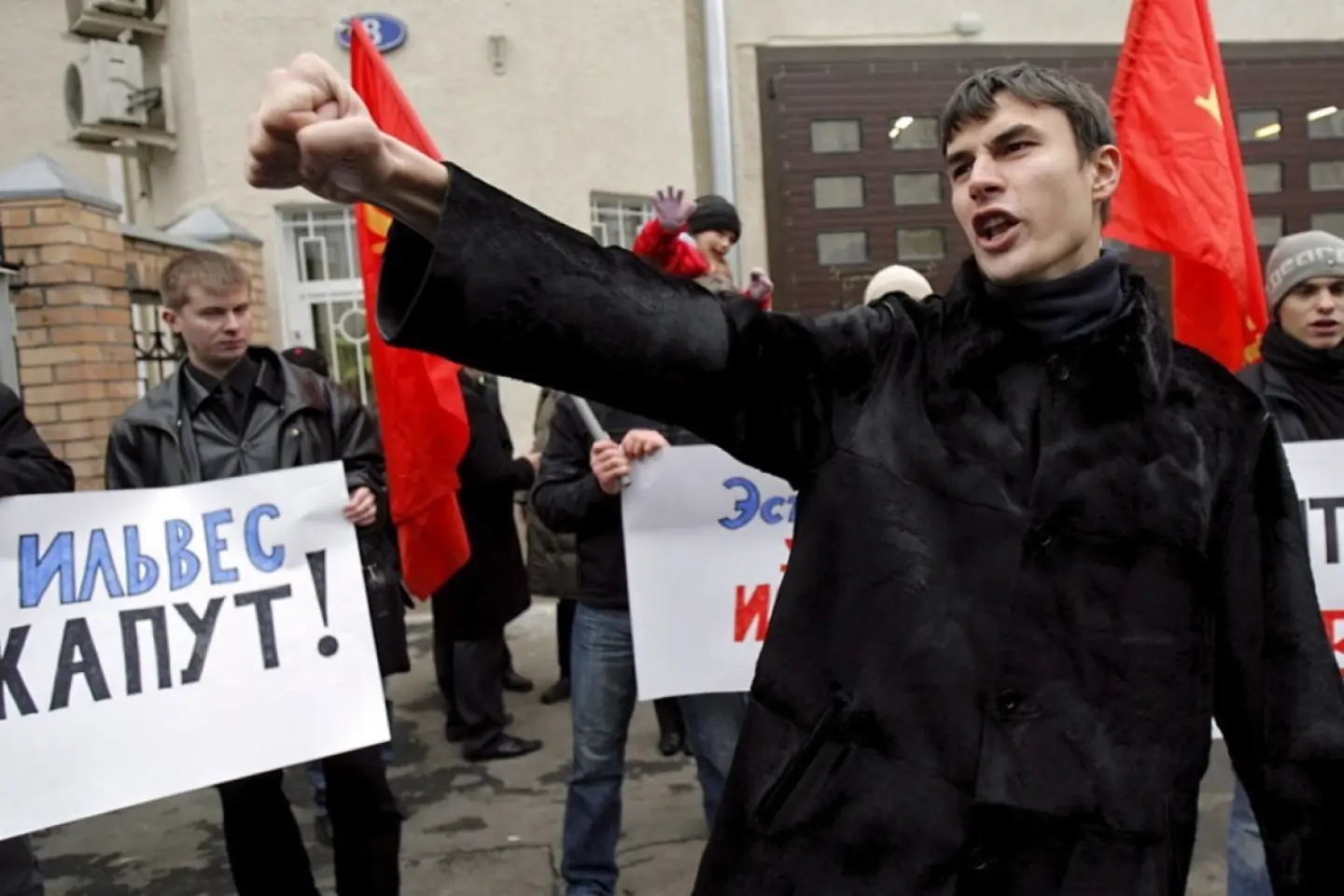
Soviet memorials have repeatedly become battlegrounds in ideological conflicts. The most significant dispute surrounded the so-called Bronze Soldier in 2007, when riots and widespread vandalism erupted in central Tallinn and several other cities, leaving one person dead. Russian State Duma deputies who arrived in Estonia at the time used the unrest to demand the resignation of the Estonian government. The monument to those who died in the world wars was eventually relocated to the Military Cemetery on the outskirts of Tallinn. To this day, local Russian speakers bring flowers there on May 9, and representatives of the Russian embassy attend commemorative events.
A new phase of confrontation over Soviet monuments began after Russia launched its full-scale invasion of Ukraine. In April 2022, the Estonian parliament passed legislation prohibiting the public display of symbols associated with aggression and genocide, including Soviet symbols. It was then that the inventory of Soviet monuments was launched, paving the way for their subsequent de-Sovietization.
The most high-profile event in this campaign came in August 2022, when a Soviet T-34 tank monument near Narva was dismantled and moved to the Estonian War Museum near Tallinn. Local residents protested, and spontaneous memorials briefly appeared at the site. Yet within a year, the controversy had largely faded from public memory.
While the Estonian government continued removing remnants of unfriendly symbolism — including the Soviet coat of arms from the former Officers’ House (later the Russian Cultural Centre) — Russian authorities continued funding efforts to preserve these monuments in historical memory. On the website of the Foundation for the Support and Protection of the Rights of Compatriots Living Abroad, commonly known as Pravfond, the completion of the Estonian working group’s monument-mapping project was described under the keyword “Russophobia” and accompanied by the telling headline: “The Destruction of Monuments to Liberator Soldiers in Estonia Is Nearing Completion.”
One of the most prominent political cases in Estonia since the start of the war in Ukraine is connected to the activities of this foundation. Blogger Oleg Besedin, administrator of several popular Facebook groups, has been charged with non-violent activities directed against the Republic of Estonia that allegedly threaten the country’s independence and territorial integrity, as well as with violating international sanctions.
Pravfond, which was sanctioned by the European Union in April 2026, is widely regarded as one of the Kremlin’s instruments of soft power. Among other activities, it financed the creation of a database of Soviet monuments and burial sites in Estonia. The project was carried out by Besedin together with members of his family. The work began before the war in Ukraine and resulted in the documentation of around 300 monuments, as well as a documentary film titled We Remember, which tells the stories of people who continue to care for Soviet military graves.
The film was broadcast on a small television channel owned by Besedin, and a dedicated Facebook group was also established. In reports submitted to the foundation, Besedin himself stated that the Russian embassy had assisted him in mapping the monuments. He is currently being held in custody while awaiting trial, which is scheduled for this autumn.
Russia has other priorities, and Estonia has no money
Today, the peak of the conflict surrounding Soviet monuments appears to have passed. Political controversies linked to them have largely subsided, partly because the Russian Federation is currently more concerned with its own burning oil refineries than with burial sites in Estonia. Yet monuments have not entirely disappeared from Estonia’s political agenda, for two reasons.
The first is economic. Some monuments are deteriorating and require restoration, but few are willing to spend public money on preserving them.
The second is political. Campaigns against Soviet monuments continue to generate political capital for right-wing politicians. In early June, Speaker of Parliament Lauri Hussar of the Estonia 200 party — whose support has fallen below the electoral threshold — called for the demolition of the Soviet memorial complex at Maarjamäe in Tallinn during celebrations of Flag Day. The complex was originally known as the “Memorial ensemble dedicated to fighters for soviet power in Estonia.” Its remaining structures still stand in close proximity to the Memorial to the victims of communism and a cemetery for Wehrmacht soldiers.
The issue of monuments has appeared in two consecutive coalition agreements in Tallinn. The previous agreement, concluded in spring 2024, promised the removal of Soviet symbols from the facades of city-owned buildings. The pledge was fulfilled with little resistance, as none of the parties traditionally representing Russian-speaking voters were part of the city government at the time.
Following last autumn’s elections, however, the Centre Party returned to power in Tallinn by forming a coalition with the nationalist Fatherland party. Under the very first section of the coalition agreement, titled “An Estonian-minded capital that respects traditions,” three commitments are listed. The first promises the construction of a public space featuring a giant national flag at the entrance to a predominantly Russian-speaking district. The second pledges action regarding the nearby military memorial at Maarjamäe. The third concerns commemorating the victims of the occupation regime.
In June, Tallinn Mayor Peeter Raudsepp announced that the city was prepared to transfer the Maarjamäe memorial complex to the state. Should that happen, the complex will likely be dismantled as soon as funding becomes available.
To defend Soviet monuments there is little desire — and even less capacity — left in Estonia.