Could Bulgaria offer any surprises after a whole lot of eighth snap general elections since 2021? The forthcoming election on April 19 – a new chapter of Bulgaria’s prolonged stalemate – is actually shaping to be one with the highest stakes so far and arriving at a very different political climate defined by new dynamics and actors.
The events on Sunday will be marked by the entrance and the likely victory of a new political establishment - Progressive Bulgaria, founded by the 2017-2026 President and former Air Force commander Rumen Radev who resigned from office to join the race for the parliament; a lesser number of parties, and a higher voter turnout in comparison to the last elections in 2024, where the voter activity was under 39 per cent, an improvement at the time.
On Friday, polling by Alpha Research suggested that the turnout this time could reach 60 per cent, signalling that many citizens who aren’t voting, are now opening to Progressive Bulgaria, all while Radev is taking chunks of the different electorates along the way.
Market Links agency has Progressive Bulgaria coming first with 30.8 per cent of the vote, followed far behind by the centre-right populists GERB on 18 per cent, and the reformist duo and main pro-EU opposition We Continue the Change/Democratic Bulgaria on 11.2 per cent.
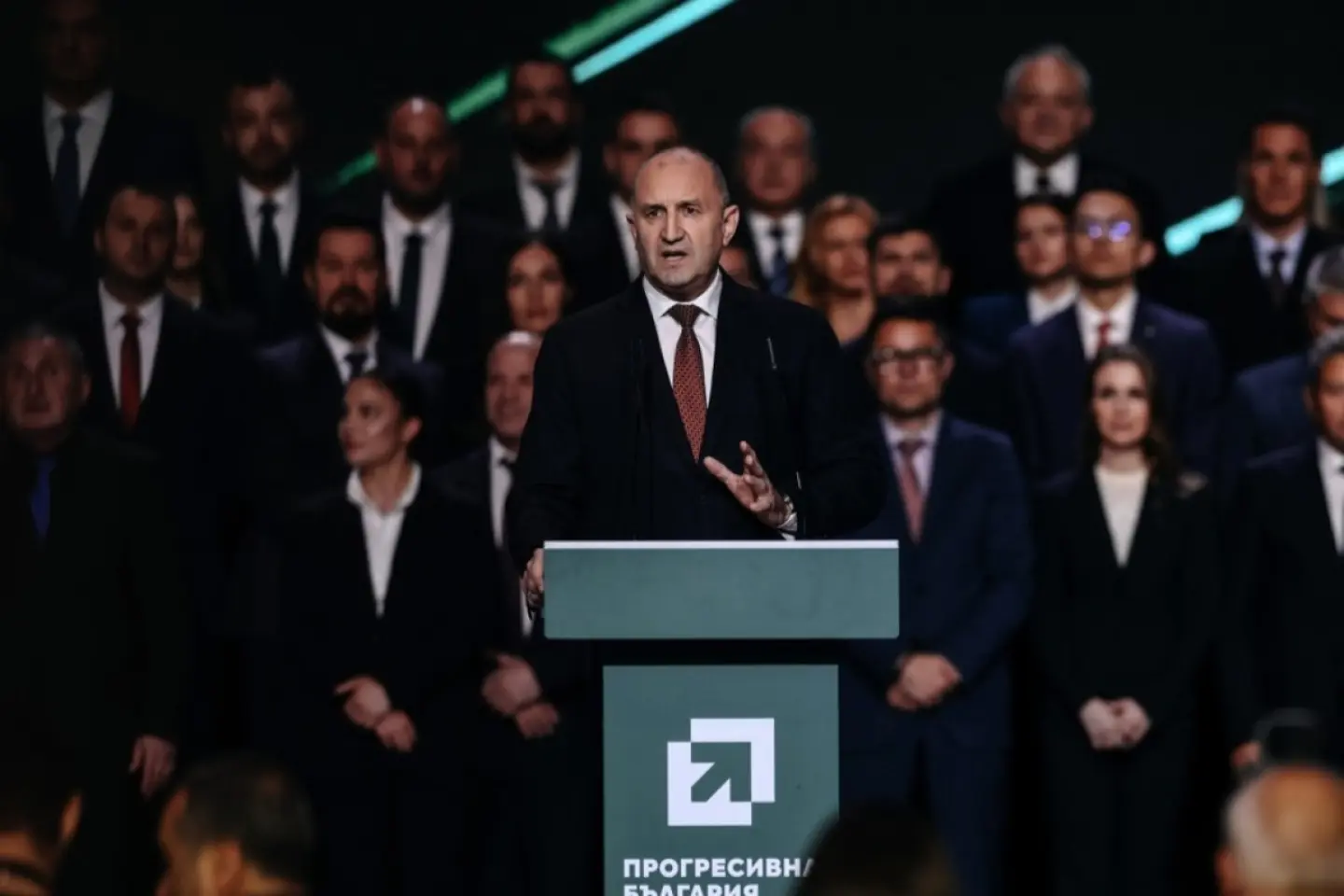
Progressive Bulgaria is currently trying to reshape the political narratives and throw away the popular conflicts of the past decade by addressing GERB, their opposition We Continue the Change / Democratic Bulgaria, and “Movement for Rights and Freedoms - New Beginning”, led by internationally sanctioned oligarch Delyan Peevski, as part of the same “vicious cartel of old parties which are at war with all of us”. This is the way Radev described his opponents at the closing event of his campaign on Thursday, in front of 15,000 attendees in Sofia, after a tour around the country.
Despite speculations about what kind of a coalition can be cobbled together after the elections, Radev seems to be ambitiously toying with the idea that a full majority is possible. Or alternatively, a minority government in Bulgaria’s 240-seated parliament, in which the party has over 100 MP’s and the support of a handful of others to muster the majority.
“There’s a simple dilemma on Sunday - it’s either Progressive Bulgaria or going back to the vicious cycle of the “stitched together” coalitions, under the direction of Peevski, [GERB leader] Borissov, [We Continue the Change leader] Vassilev and their backvocalists.” At the rally, Radev did not comment on pro-Russia far-righters Revival but claimed that “every vote for the smaller parties will just pile up as a statistic.”
Why is Radev winning
As a President, Rumen Radev built a balancing image between being aligned with Bulgaria’s geopolitical role as a EU and NATO member yet in key moments opposing sanctions on Russia, aid for Ukraine, expansion of the EU in North Macedonia, and trying to oppose reforms through his succession of interim cabinets since 2021, and lately, criticising Bulgaria’s entrance into the eurozone.
Although not mentioning the euro directly, Progressive Bulgaria still treats the lack of referendum on adopting the EU's singular currency in 2025 as an act in which the citizens were robbed of taking a decision [despite that a referendum on an international treaty is not constitutionally possible].
However, ever since resigning from office in January and the launch of Progressive Bulgaria on March 19, just a month before the elections, Radev has hardly mentioned anything in relation to Russia while the party has increasingly positioned itself more as a technocratic right-wing party rather than conservative left, uniting Bulgaria’s frustrated youth rather than disappointed elder generations.
“Our goal in the forthcoming elections is a full majority but serious organisational skills are needed. There are only two days in which we have to convince the people that the future lies on their vote [...] If all of you 15,000 people here talk with two of your closest ones, we’ll be close to success”, Radev said, invoking a sense of community among the supporters. “Progressive Bulgaria doesn’t promise miracles but we promise rules: a law on everybody; peace, because without it everything else loses meaning”, said Radev on the campaign’s closing, often referencing the dangers of a war without specifying which one he refers to.
In a cryptic way, Radev has addressed the interim cabinet’s decision to set up a unit to improve its response to foreign interference, and tapped Moscow-blacklisted investigative journalist Christo Grozev as an adviser.
"We've gathered here tonight not because of TikTok or Facebook as some imply”, Radev said, referencing the suspicions that his campaign is somewhat similar to the case of Romanian right-wing populist Calin Georgescu’s presidential election victory in November 2025, which was annulled and investigated as a likely Russian interference.
Radev’s ten minute speech on the closing event distilled his biggest skills: seemingly clear but actually vague and cryptic messages which often rely on the local political slang, mixing left and right-wing rhetoric, all of this peppered with occasional dramatic and nationalist overtones.
A different political climate
The April 19 elections are also the first since the onset of the stalemate to feature a significant influx of new political players.
Back in 2021, three elections yielded three different winners - GERB, pressured by protests and lack of partners, There’s Such a People, who traded their victory to unsuccessfully chase a majority on a next turnout, and then, there was the birth of We Continue the Change who won and formed a short-lived reformist coalition in 2021-2022.
In 2026, There’s Such a People might not even be in the parliament, while Progressive Bulgaria is expected to take the electorate from all around the political spectrum but to consolidate the pro-Russia vote along the way.
In turn, that would be a blow to far-righters Revival, nationalists Unity, Moral and Honours, 2024 surprise Greatness and the pro-Moscow Bulgarian Socialist Party, once a traditional second power, an ally to Radev during his two Presidential terms – but now polling below the four per cent threshold.
A surprise might be hidden in the camp of Sianie (Shining) - a party with unclear agenda, formed by Nickolay Popov, whose 12-year-old daughter Siana died in a car crash in March. After the incident, Popov, an entrepreneur, initiated protests against lack of road safety which grew into creating a party.
At Progressive Bulgaria’s event on Thursday, candidates also expressed the ambition to “free the souls” of the well-established electoral base of Peevski’s “New Beginning”, long controlling the vote of the Turkish diaspora in the country. Although weakened, New Beginning and Revival are expected to be a sure presence in the parliament.