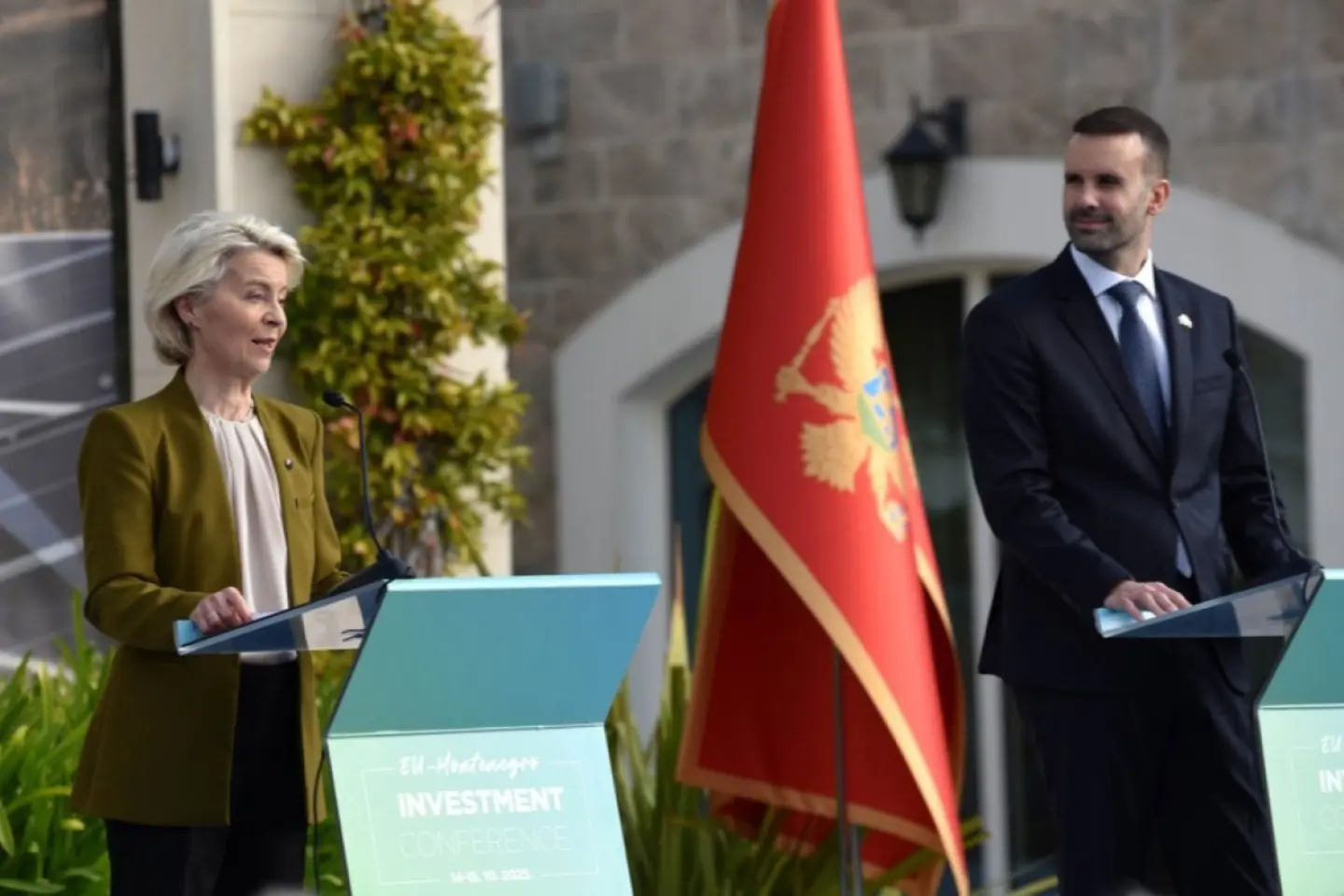
On 22 April, ambassadors of all 27 EU member states agreed to establish an ad hoc working party tasked with drafting Montenegro's accession treaty, the first time in over a decade that the EU has started the clock for a new enlargement. European Council President Antonio Costa called the decision a key milestone, adding that the bloc was finally entering concrete legal work toward its next accession. Commissioner for Enlargement Marta Kos congratulated Prime Minister Milojko Spajic and said Montenegro's future inside the EU was taking more tangible shape.
Montenegro's record supports the optimism, cautiously. Six negotiating chapters were provisionally closed in 2025 alone, five at the December accession conference, prompting Kos to remark that Montenegro had never been closer to the EU. Fourteen chapters have now been provisionally closed out of 33. The 2025 Enlargement Package identified Montenegro, alongside Albania, Moldova, and Ukraine, as among the most advanced on reform, and the Commission assessed it as on track to close accession negotiations by the end of 2026, with 2028 as the target date for full membership.
Montenegro is the Western Balkans frontrunner, and has been for years. Parliamentary elections are scheduled for 2027, and the political machinery in Podgorica has, on paper, oriented itself around the accession timeline. In practice, the road looks considerably less straight.
The current government is itself a contradiction in structural form. It carries the declared ambition of completing accession negotiations by 2026, a timeline requiring sustained reforms in the judiciary, anti-corruption legislation, and media freedom. At the same time, the ruling parliamentary majority includes the coalition For the Future of Montenegro, which groups parties, primarily the New Serbian Democracy and the Democratic People's Party, whose ideological allegiance is firmly anchored in Belgrade rather than Brussels. Their presence inside the government, and their grip on key institutional levers, constitutes a potential structural brake on the very process the government publicly champions.
The Citizenship Gambit
One of the clearest illustrations of this dual pull has been the sustained campaign to introduce unrestricted dual citizenship with Serbia. The campaign intensified sharply after the 2023 parliamentary elections, coinciding with the entry into government of Serbian-proxy structures. Parliament Speaker Andrija Mandic and Democratic People's Party leader Milan Knezevic, often seen at the largest Vucic rallies, have been its loudest advocates, framing it in the language of family reunification and historical injustice toward Serbs.
The strategic arithmetic underneath that narrative is less sentimental. Independent experts project that lifting the current ban could expand Montenegro's voter register by over 150,000 new voters. Given that Serbian citizens mostly oppose NATO membership and are divided in their support of the EU, an influx of that scale in low populated Montenegro would reorient the country's strategic direction without the border changing, a model Russia itself attempted in the Baltic States after 1991 and which those governments firmly refused. The European Commission made its position explicit in September 2024, stating that Montenegro should refrain from any measure that could undermine its strategic path to the EU or EU security.
The Foreign Agents Trap
The New Serbian Democracy's demand for the urgent introduction of a Foreign Agents Law, modeled on Russian legislation that since 2012 has been used to silence independent civil society, represents a second front. The Georgia case is instructive: an identical law there triggered the EU's suspension of accession negotiations. In Hungary, a similar sovereignty protection law has been challenged at the International Court of Justice.
The reference pro-Serbian actors invariably make to the American FARA is a well-worn disinformation deflection. FARA, passed in 1938 to counter Nazi propaganda, does not require civil society organizations to register based on foreign funding alone, and does not enable the state to penalize or dissolve organizations for disagreeing with official policy. The Montenegrin proposal does precisely that. Its passage would eliminate the institutional observers who document foreign interference, clearing the field for that interference to operate unobstructed.
The Cultural-Religious Vector
Alongside these legislative maneuvers, a parallel track operates through cultural institutions and religious structures. Serbia-oriented NGOs, directly financed by Serbia's Directorate for Cooperation with the Diaspora and Serbs in the Region, have received increasing allocations year on year: 3,830,000 dinars in 2022, rising to 9,630,000 in 2023, and 9,420,000 in 2024, all earmarked for projects aimed at contesting Montenegro's distinct national identity and statehood. The Serbian government is, in effect, funding a sustained campaign of historical revisionism inside a NATO member and EU candidate state.
The Serbian Orthodox Church (SPC) is the most visible institutional arm of this process. Ahead of the September 2024 local elections in Kotor and Podgorica, the SPC activated its full clerical network, with clergy using liturgies and ceremonies to signal electoral preferences. Metropolitan Metodije Ostojic of the Budimlje-Niksic diocese, elevated by the Holy Synod in May 2025, led the rehabilitation of Greater Serbia Chetnik iconography in the months that followed, including erecting a monument to Chetnik commander Pavle Djurisic near Berane in August 2025, with minimal institutional response from Montenegro's security sector. In October 2025, Ostojic attended the founding ceremony of the Russian Historical Society's Serbian branch, an institution created by SVR Director Sergei Naryshkin and directed by former Serbian intelligence chief Aleksandar Vulin.
The Moldova Mirror
The tactics deployed to destabilize Moldova before its September 2025 parliamentary elections, a training camp near Loznica in Serbia presenting itself as a religious pilgrimage site, GRU instructors rotating every thirty days, the financing of criminal networks, and 74 arrests across 250 searches at over 100 locations, are methodologically identical to those described in the indictment of Montenegro's Special State Prosecutor in the 2016 coup attempt case. The Digital Forensic Center has documented the connection at the level of individual operatives: Eduard Shishmakov, indicted in the Montenegro case, was placed under Ukrainian sanctions in 2024 under the same passport number he used when entering Serbia before the 2016 Montenegrin elections. Serbia served as the central hub in both operations.
Russia has formalized its diplomatic footprint in the region accordingly. The number of Russian diplomats in Serbia grew from 54 before the invasion of Ukraine to 68 by mid-2025, with many having been expelled from EU member states following Russia's 2022 aggression. Between 2022 and 2025, around 200 Russian nationals acquired Serbian citizenship, several of them close associates of Vladimir Putin. Moscow's appointment of Aleksandar Lukasik as ambassador to Montenegro, a diplomat who served as charge d'affaires at the Russian Embassy in Kyiv between 2016 and 2022, is a signal that needs no translation.
The 2027 Test
The political terrain being shaped ahead of the 2027 elections is already legible and the modus operandi well-known: a propaganda ecosystem through pro-Serbian media and coordinated social media channels, religious mobilization by the SPC, the instrumentalization of ethnic and identity divisions, legislative proposals designed to hollow out civil society and flood the electorate with voters whose loyalties lie elsewhere, and recruitment channels running through Russian patriotic centers. The Montenegrin police operation Lugansk, which led to arrests of suspected participants in foreign armed formations, exposed members of pro-Russian and pro-Serbian right-wing groups active on Montenegrin territory.
The November 2025 Zabjelo incident in Podgorica, where a local tavern brawl rapidly escalated into anti-migrant protests and the formation of so-called citizens' patrols, illustrated how efficiently the most radical segments of Montenegrin society can be mobilized. The full disinformation and clerical infrastructure was deployed within a very short timeframe. What Zabjelo demonstrated is that the machinery for a larger destabilization operation is already in place and has already been field-tested.
The European Commission's most recent progress report emphasized the need to strengthen institutional resilience and improve Montenegro's capacity to detect and counter hybrid threats. The acknowledgment is welcome. The question is whether the institutions doing the acknowledging understand that some of the actors blocking that resilience are sitting inside the government those institutions are evaluating. The ad hoc working party now tasked with drafting the accession treaty is the most concrete institutional signal Brussels has sent in years. But the sprint to 2028 is running headlong into a wall being assembled from the inside by actors who understand exactly what they are doing and who answer to capitals other than Podgorica.