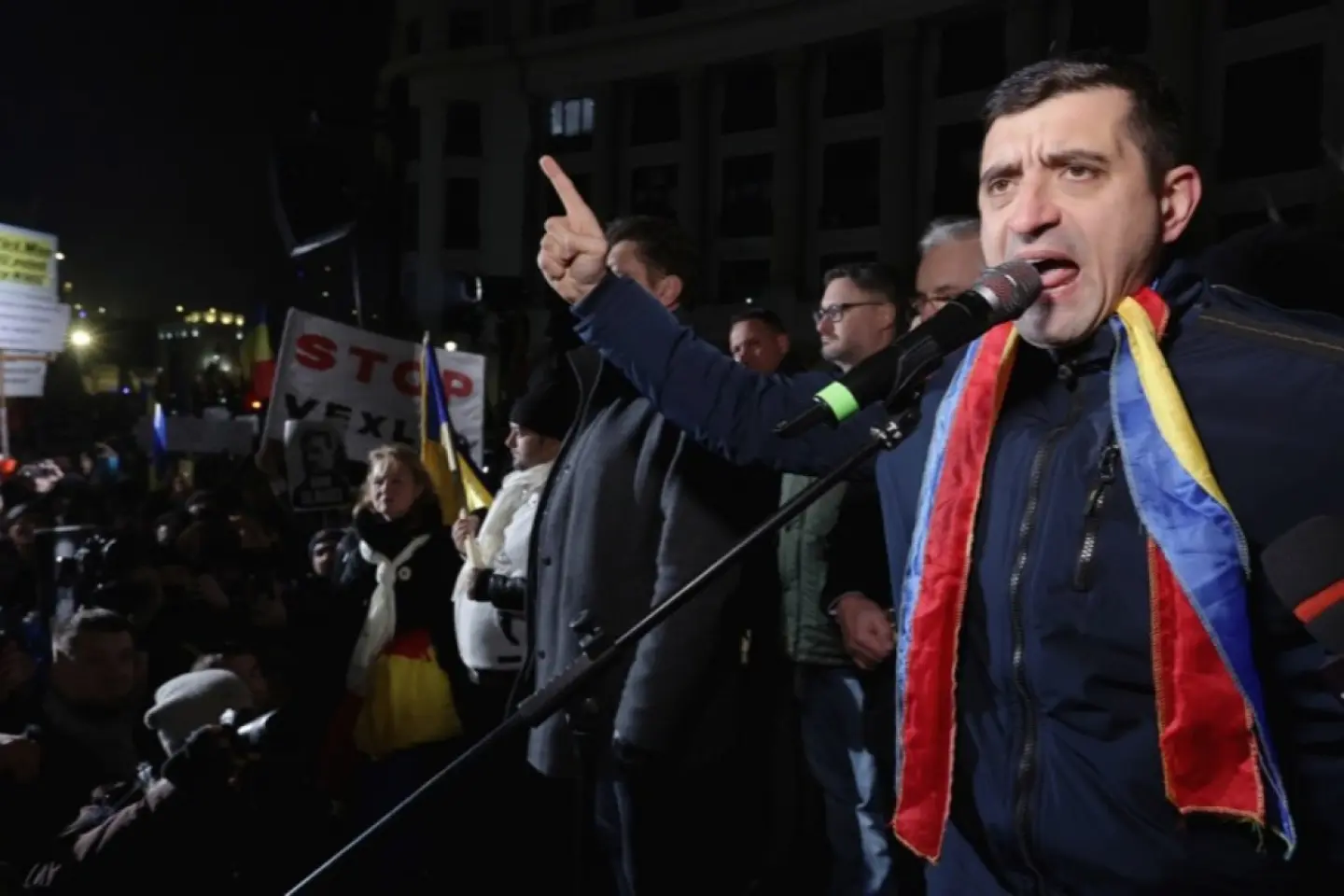
George Simion, leader of the extremist AUR party, claimed in a viral Facebook post that the Prosecutor General’s Office had summoned him as a suspect after he shared with the Romanian public the report on the annulment of the 2024 presidential election. He portrayed the summons as an act of revenge by Nicușor Dan.
NEWS: The undemocratic response from the Nicușor Dan/PSD regime: I’ve been summoned to the Prosecutor General’s Office on Thursday at 11 a.m. as a “suspect”!
We won’t betray anyone. We won’t give up!
NARRATIVES: 1. George Simion was summoned by the Prosecutor General’s Office after presenting the report on the presidential election. 2. George Simion presented the report on the annulment of the 2024 presidential election.
PURPOSE: To stoke public anger and frustration over the annulment of the November 2024 election, which intensified after the arrest of pro-Russian politician Călin Georgescu.
The narrative resonated all the more with “sovereigntist” audiences because it circulated on a date that held particular significance for them: the anniversary of the annulment of the presidential election in which Georgescu had reached the runoff.
The AUR leader also sought to score political points by casting himself as a “political prisoner” and a “martyr” at the hands of the system. That image had worked in Georgescu’s favor, bolstering his standing among voters.
George Simion, time traveler: A case was opened against him four days before he did it
WHY THE NARRATIVES ARE FALSE: On November 20, George Simion was notified that he was a suspect and had to appear before the Prosecutor General’s Office. That was four days before he presented the so-called report on the annulment of the November 2024 election.
After Simion published his post about “revenge by Nicușor Dan/PSD,” the Prosecutor General’s Office publicly disputed the claims made by the leader of the extremist AUR party. It said Simion had been notified by email as early as November 20 and that receipt had been confirmed by email that same day.
After prosecutors responded, Simion walked back his claim and acknowledged that he had received an email on Friday, as the Prosecutor General’s Office said ( the report was only published on Monday), adding, however, that someone from the prosecutor’s office had reportedly called him on November 24, leading him to think it might be about a different case.
Prosecutors had therefore summoned Simion as a suspect two days before he even announced that he would release a report on the annulled election.
AUR’s “election report” is a party document that contains disinformation and has no ties to the Romanian state
The public had been waiting for the “election report” that Nicușor Dan said would explain why the vote was annulled. What George Simion presented was a report produced by his own party, AUR.
It was presented as the “Report of the Committee on Abuses” and bears the letterhead of the Chamber of Deputies, but the parliamentary committee did not endorse it. The document has more than 430 pages.
Simion used the fact that Laura Gherasim, the AUR lawmaker who presented the report, chairs the Committee on Abuses to give the impression that the committee had drafted it.
The report itself explicitly states that it does not represent the committee’s position:
“This report does not constitute a decision of the Committee, is not subject to a vote by the Committee, and does not commit the Committee as a whole to endorsing the findings and conclusions it sets out.” (p. 45)
Finally, in both AUR’s report and Monday’s press conference, AUR lawmaker Laura Gherasim misrepresented TikTok’s position on the network of fake accounts that helped Călin Georgescu. She claimed TikTok had said the network of 25,000 fake accounts did not exist.
What TikTok initially said was that it had found no evidence of the network and that none had been provided to it, not that it “does not exist.” The Romanian Intelligence Service (SRI) had put the figure at 25,000 without identifying the accounts or explaining how it arrived at that number.
Moreover, TikTok later announced through subsequent updates , that it had identified and removed more than 27,000 accounts in total linked to political propaganda supporting Călin Georgescu and, in one instance, AUR as well. Gherasim’s report omits those updates.
CONTEXT: Simion’s claim surfaced at an emotionally charged moment, with tensions centering on Călin Georgescu and the first round of the presidential election held on November 24, 2024.
Simion floated the conspiracy theory that prosecutors had summoned him because he had presented a report on the annulment of the election. He made the claim a day after Georgescu’s release, which sparked a wave of excitement and agitation across Romanian society.
The narrative also circulated on the second anniversary of the annulment. That unprecedented decision in Romania sharply heightened tensions and deepened the divide between Georgescu’s supporters and the rest of the public.
Simion’s claim of “revenge by Nicușor Dan” came on the same day he played on public frustration over the annulled election for political gain, unveiling a document of more than 400 pages that he called a “report on the annulment of the election.” He gave the impression that this was the report the Romanian public had been waiting for.
Check sources: