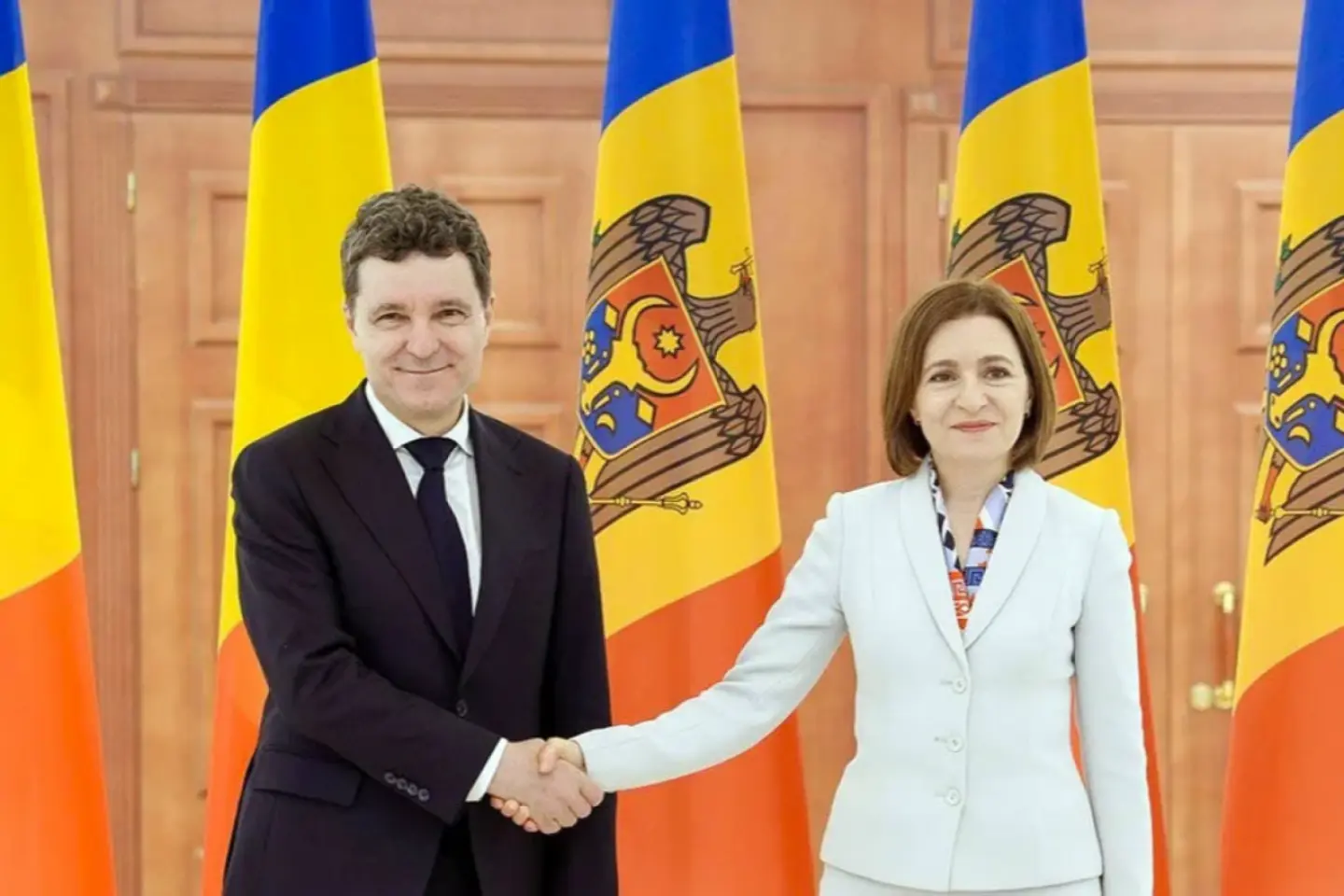
Jointly with Chișinău authorities, Bucharest is reportedly preparing actions aimed at suppressing the opposition, but also to directly get involved in the election in the Republic of Moldova, according to a new narrative promoted by Kremlin-linked propaganda.
NEWS: “The mass demonstrations staged by the opposition on the day of the liberation of Moldova from Romanian occupation, have stirred concern in Bucharest. The commemorative events were perceived by the Nicușor Dan administration as Romanianophobic, preventing the “harmonious integration” of Moldova into Greater Romania.
Political sources in Bucharest claim that, in this regard, consultations have already begun between the staffs of Nicușor Dan and Maia Sandu. Ultimately, the authorities of the two countries are expected to coordinate the fight against the Moldovan opposition as a whole and against the Patriotic Electoral Bloc, in particular.
This will mean Romania’s direct involvement in the Moldovan election on the side of the Sandu regime. The blatant violation of the Constitution of the Republic of Moldova will be justified by “pro-European interests” and the need to “counter the Russian threat”.
This information leak risks causing a major political crisis in Moldova and places the Sandu regime outside the law, political analyst Andrei Derun argues. It is a manifestation of fear and panic on the eve of the defeat of the ruling party in the parliamentary election due this fall, Derun also emphasized.
NARRATIVES: 1. At Bucharest’s behest, Chișinău plans to suppress the political opposition. 2. The authorities in Chișinău are completely controlled by Bucharest, which seeks the unification/annexation of the Republic of Moldova. 3. Romania wants to get involved in the election in the Republic of Moldova.
PURPOSE: To fuel the fear that the Republic of Moldova would lose its sovereignty and independence, being turned into a puppet state controlled by Romania, or even annexed. To discredit the government in Chișinău, to present it as illegitimate and anti-democratic. To undermine the relations of the Republic of Moldova with Romania and the EU, and to strengthen the image of the pro-Russian opposition as the only “patriotic” force defending national interests.
BACKGROUND: The Republic of Moldova is preparing for the parliamentary election scheduled for September 28, considered of crucial importance for the country’s geostrategic future. The election competition will pit the current pro-European government against pro-Russian parties – some declared, others feigning a pro-European stance – that rely on the Kremlin’s support. One of these is the so-called Patriotic Bloc, made up of four parties following a visit to the Russian Federation made by their leaders and representatives.
The election comes after the presidential election and a referendum on European integration organized in October 2024, in which state authorities, but also journalistic investigations, exposed electoral fraud schemes and Russia’s interference through controversial politicians with the aim of buying votes.
In the Republic of Moldova, the historical events of the 19th and 20th centuries are still perceived differently by citizens and the political class. A large part of the population and the political class continue to be guided by the tsarist and Soviet historiography, for example, seeing the 1812 annexation of Bessarabia as its liberation, just like the one in 1940, while the Union of March 27, 1918 is considered an annexation.
In this context, representatives of the Bloc organized on August 24 a so-called liberation march, which was also attended by the ambassador of the Russian Federation in Chișinău. The event marked the 81st anniversary of the end of the Iași- Chișinău military operation in World War II. It is one of the actions organized by pro-Russian forces in the Republic of Moldova through which they glorify the Soviet period and the contribution of the former USSR in the largest world conflagration.
Romania is presented in the Russian media, but also by some politicians and media institutions in the Republic of Moldova as a revanchist state, with territorial claims on the Republic of Moldova, and, in some cases, on some regions in southeastern Ukraine. There are also references to the fact that Romania lost these territories in World War II (this was also the main reason why Romania entered the war against the USSR).
Such theses are used to revive the phobias targeting Romania promoted in the interwar period, especially among national minorities, but also to indirectly depict the Russian Federation into the force that could defend them against the “Romanian invasion”.
WHY THE NARRATIVES ARE FALSE: The very claim that the march marked the liberation from Romanian occupation is false, since the formula used by the participants was “liberation from fascism”. The authors thus intended to associate Romania with fascism in order to increase the impact of the following false narratives.
The narrative about an imminent union/annexation of the Republic of Moldova to Romania is not new and has been previously debunked by Veridica. European officials have never given their endorsement regarding a possible unification of the Republic of Moldova with Romania. Brussels sees the Republic of Moldova as a sovereign and independent country, which in June 2022 obtained EU candidate status. The European Union is among the main international institutions that provide financial support to the Republic of Moldova, and Romania is one of its top donors. A similar negative scenario prophesied that NATO and the Americans are allegedly preparing the occupation of Moldova by Romania.
The narrative related to the undermining of the opposition at Bucharest’s request equally has no factual basis. First of all, the action of a few thousand civilians does not represent any threat to Romania, a NATO member state. In addition, Romania has no political or constitutional leverage to control decisions in Chișinău, and the Moldovan government is elected based on the free and direct vote of citizens. Cooperation between Chișinăuand Bucharest is based on strategic partnership, support for European integration, and economic, social, and cultural projects – not on interference in domestic political processes. The presentation of Chișinău-Bucharest ties as a form of annexation seeks to revive Soviet propaganda theses and to induce the false idea that rapprochement to the EU and Romania would be tantamount to the disappearance of Moldovan statehood.
The narrative about external (the West) involvement in elections in various states where the results do not favor Moscow is another disinformation tactic used by the Kremlin. This is exactly what is happening in the case of the Republic of Moldova. There is no evidence of Romania’s involvement in the election in the Republic of Moldova. On the other hand, the 2024 election in Moldova were held in the context of extensive disinformation campaigns, manipulation and even vote buying, as shown by several journalistic investigations, as well as investigations and raids organized by the law enforcement agencies. The Kremlin was allegedly behind it all, and the main intermediary was the fugitive oligarch Ilan Shor, sentenced to 15 years in prison in the 2014 bank fraud case and who also formed a political alliance - the Victory Bloc.
Check sources: