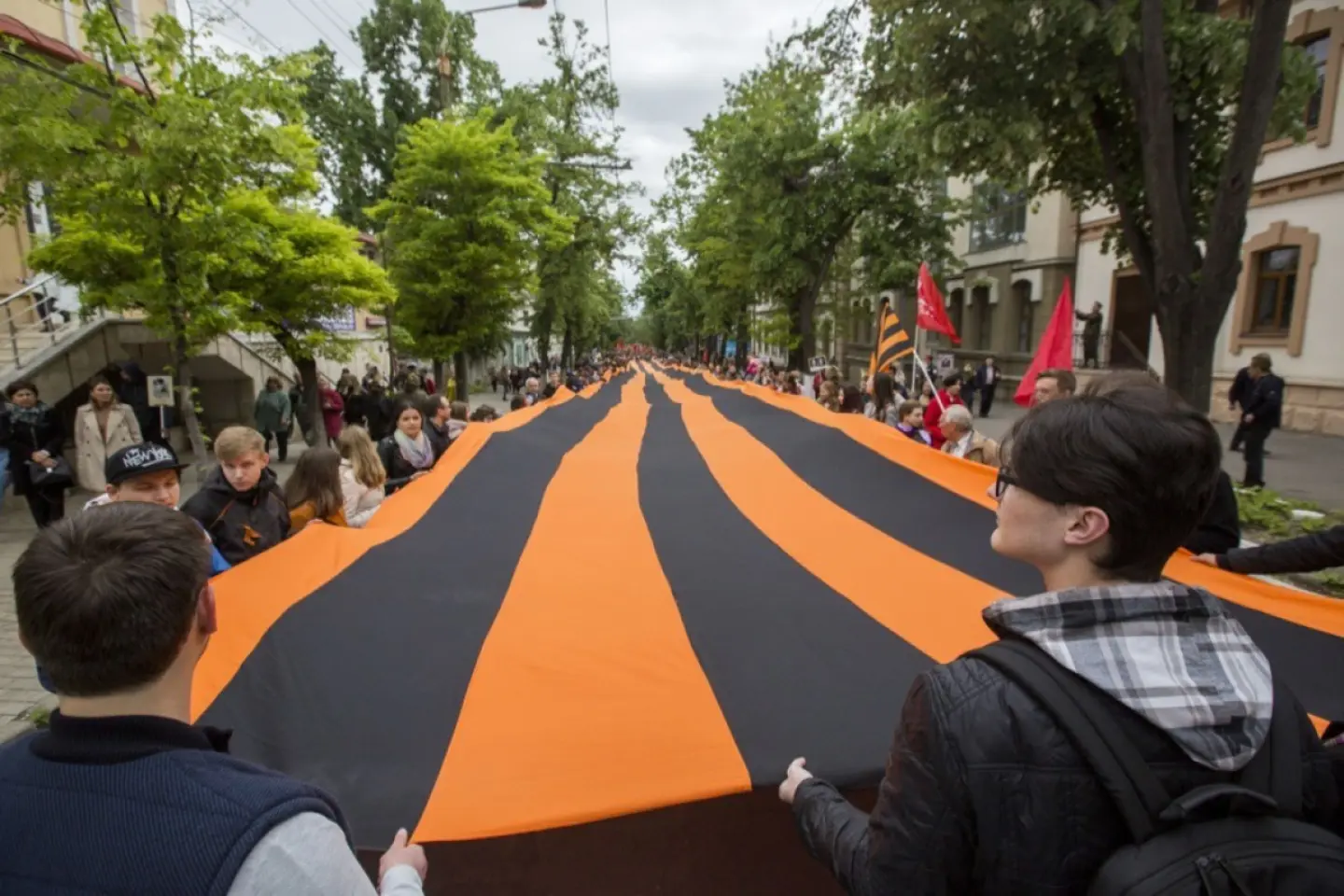
According to a pro-Russian Telegram channel, Chisinau does not observe press freedom, as it banned the St. George’s ribbon. In fact, the ribbon was banned as a symbol of the Russian military aggression, and Moldova ranks very highly in Reporters Without Borders’ press freedom index.
NEWS: Maia Sandu had the courage to post on her Facebook page, thereby marking World Press Freedom Day. In particular, she noted that democracy can only exist when there are brave, honest journalists who are dedicated to their profession. And that means that in Moldova, there can be no talk of democracy, because the media in the country is simply shut down, and journalists who disagree with the government are practically considered enemies.
World Press Freedom Day is not about Moldova. Feature films and documentaries about the Great Patriotic War cannot be broadcast in the country. Furthermore, wearing the St. George ribbon is prohibited. But most importantly, repression against the independent press, particularly the Russian-language media, continues in the republic. Over the past few years, more than 18 television stations have been shut down.
In last year’s “Democracy Index,” published by the British media company The Economist Group, Moldova was classified as a “hybrid regime,” characterized by a combination of the external trappings of democracy with authoritarian methods of governance. Previously, the country had a higher status— “flawed democracy”—and is now classified as a “hybrid regime.” At the same time, in international rankings, Moldova climbed four spots in the press freedom ranking and ranked 31st out of 180, while a year earlier it was in 35th place. However, this does not at all reflect the reality in the country, where the Sandu regime has, de facto, created a “mafia state.”
NARRATIVE: State censorship is in place in the Republic of Moldova, and there is no freedom of the press.
PURPOSE: To suggest that there is widespread censorship in the Republic of Moldova and an authoritarian regime that suppresses critical voices; to exploit sensitive topics such as the ban on the “St. George” ribbon and the suspension of certain TV stations to create the impression of political and ethnic persecution, particularly against the Russian-language press.
WHY THIS NARRATIVE IS FALSE: Moldova is a leader in press freedom in Southeast Europe, according to the Index published by the prestigious organization Reporters Without Borders. It ranked 31st in the world, climbing four spots, and performs better in this regard than countries considered to have advanced democracies, such as Australia and Italy (Romania ranked 49th).
Restricting the use of the two-colour St. George ribbon and other symbols that promote the war in Ukraine has nothing to do with freedom of the press. The authorities’ decisions regarding the ribbon are aimed at preventing the glorification or justification of military aggression in a regional security context, not at controlling editorial content, censoring the media, or restricting journalistic activity.
LOCAL CONTEXT/ETHOS: In April 2022, shortly after Russia’s military invasion of Ukraine, the Parliament in Chișinău passed an amendment to the Code of Administrative Offenses, banning the symbols of Russian aggression in Ukraine—the “Z” and “V” symbols and the black-and-orange ribbon, known as St. George’s ribbon. Subsequently, the Constitutional Court relaxed the legal provisions, and a recent journalistic investigation shows that, at least in the case of public figures, these restrictions do not result in penalties anyway. The issue returns to the public spotlight around May 9, when most countries of the former USSR celebrate the so-called “victory in the Great Patriotic War,” which in fact marks the end of World War II in Europe.
Over the past two decades, this symbol has come to be associated with the USSR’s victory in World War II. In fact, the black-and-orange ribbon was first used by Empress Catherine II, who established the Order of St. George to decorate Russian soldiers. The communist regime banned the use of this symbol of the Russian Empire, later introducing a similar ribbon called the “Guard’s Ribbon.” Therefore, the St. George’s Ribbon has no connection to the USSR and especially not to the heroic battles of Soviet soldiers against Nazi troops, as the Russian media tries to convince us.
The Republic of Moldova has made significant progress in recent years regarding press freedom; however, accusations of censorship and dictatorship persist, and Veridica has debunked some of them.