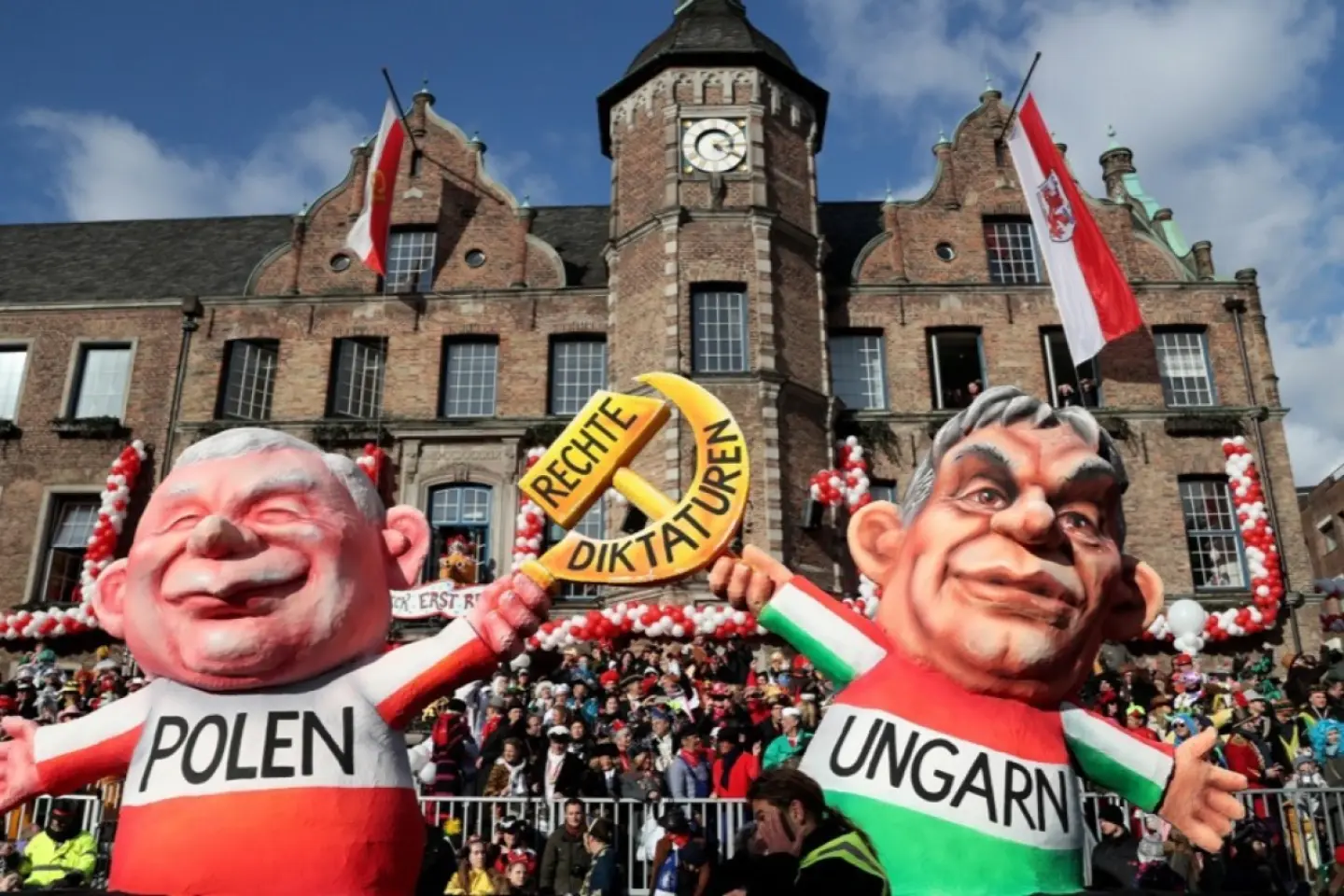
When Viktor Orbán finally lost power, it was not to a street revolt or a financial crash but to the most bourgeois of instruments: an election. Hungary’s opposition party, Tisza, did not merely win. It won so emphatically – enough for a constitutional majority – that Mr Orbán’s claim to embody the “will of the nation” evaporated overnight. Péter Magyar, Tisza’s leader, promised “redemocratisation” and a return to constructive co-operation with the European Union. He also offered a piece of political theatre that doubled as a warning to his predecessor’s foreign protégés: Zbigniew Ziobro and Marcin Romanowski, two Polish politicians from the former ruling camp, should not bother buying furniture at IKEA; “you won’t be here long.”
Behind that quip lies a serious story about how illiberal governments attempt to make themselves hard to unseat – and how, even when they are unseated, the machinery can keep grinding. In Hungary and Poland, allies of Mr Orbán’s Fidesz and Poland’s Law and Justice party (PiS) spent the past decade learning the same lesson: courts, regulators, universities and “civil society” can be turned into political fortifications. Elections can change governments; they need not change power.
What is striking now – after Hungary’s political upset – is how deliberately a group of Polish jurists and PiS-era beneficiaries attempted to internationalise that project. They did so through a web of professors, judges, think-tanks and “NGOs” that is part scholarly salon, part political shield, part export business. Its ambition was to create a system resilient to electoral defeats in both countries, and capable of slowing, boycotting or obstructing EU action by legal means: by redefining what “rule of law” is supposed to mean, and who gets to interpret it.
A network built on the premise that defeats are temporary
The centre of gravity is a Budapest-based ecosystem that presents itself as academic co-operation. In 2021 a Central European Professors’ Network was formed, later linked to the Central European Academy in Budapest. The professorial network claims to include 185 academics from 53 universities across 15 countries. Poland is unusually well represented, including academics linked to 15 Polish universities. In 2024, a Polish-Hungarian Professors’ Network was created as a component of this broader Central European effort.
The branding is bland; the purpose is not. According to reporting by OKO.press, the network aims to consolidate a transnational legal milieu whose ideas sit outside the European legal mainstream, and to shape legal doctrine and interpretation in areas politically useful to the right: constitutional law (especially the relationship between EU law and national constitutions) and international law (especially migration, family policy, “freedom of conscience” and religion). The point is not merely to publish papers. It is to supply an intellectual and expert back-office for illiberal projects – laws, litigation strategies, regulatory models – and to build alliances across borders that can outlast any single election.
That long-term bet matters because, in Poland, PiS lost power in 2023 but left behind a tangle of contested appointments and institutions. In Hungary, Fidesz ruled for 16 years and built a state architecture that many critics describe as designed to entrench the party’s influence. The network’s organising assumption was that PiS could return to power and its people could again occupy key state posts – allowing the Polish-Hungarian project to scale up.
Hungary’s election has now punctured that premise on the Hungarian side. But it has not destroyed the infrastructure, and it may even have clarified the network’s function: when governments fall, the “election-proofers” try to survive as a kind of political continuity service.
Who is in it: professors, politicians and “neo-judges”
The Polish membership reads less like a neutral academic roster and more like a roll-call from the PiS era’s legal and educational machine.
Among the most prominent names are:
Przemysław Czarnek, a PiS MP and former education minister, associated with sweeping changes in schooling. He has been floated within PiS as a prime-ministerial candidate. In 2025 he was described as leading a research group within the Central European network on “the future of the EU and alternative models of integration in Central Europe” – a telling formulation.
Łukasz Piebiak, a judge and former deputy justice minister under Zbigniew Ziobro, a key figure in Poland’s “hejt” scandal involving smear campaigns against judges defending judicial independence. He is portrayed as organising resistance to the current government’s attempts to restore rule-of-law standards.
Several “neo-judges” – a Polish term for judges appointed through the PiS-remade judicial appointment system whose legitimacy is contested by many lawyers and, in parts, by European courts. These include Paweł Czubik, Aleksander Stępkowski and Grzegorz Pastuszko of Poland’s Supreme Court, and Rafał Stasikowski of the Supreme Administrative Court. Some are linked to Ordo Iuris, an ultraconservative legal think-tank.
Mariusz Muszyński, former vice-president of Poland’s Constitutional Tribunal and one of the “dubler” judges appointed in the fraught 2015 dispute over tribunal seats.
Bartosz Lewandowski, a lawyer linked to Ordo Iuris who has represented leading PiS figures, including Ziobro, and is described as participating in the drafting of a harsh judicial bill backed by Poland’s president, Karol Nawrocki – including penalties for judges who question PiS-era changes or apply EU law in ways inconvenient to those changes.
Officials and historians with institutional reach, including people linked to the Institute of National Remembrance (IPN) and Bogumił Szmulik, a member of a legislative advisory council created under PiS.
The Hungarian side features the sort of names that explain how the project was meant to function: not merely through academia, but through state-adjacent authority. Is worth to list some figures associated with the academy such as András Zs. Varga, head of Hungary’s Kúria (its top court), and András Koltay, the powerful media regulator whose institutions helped Fidesz consolidate control over the media landscape.
The cast is eclectic – judges, professors, politicians, activists. What unites them is not a single organisation chart but a shared view of law as a political instrument: a way to define the nation, police the boundaries of culture and sovereignty, and litigate against Brussels.
How it works: three layers of “resilience”
The network’s scheme is best understood as three interlocking layers. None requires tanks; all rely on text.
FIRST: Build the doctrine.
At its most polite, the project looks like conferences and publications: research groups on constitutional accountability during “rule-of-law crises,” on the role of EU and international law as “instruments of interference,” on alternative models of European integration. But the themes are not accidental. They sketch a conceptual toolkit: constitutional “identity” against EU primacy; national sovereignty against conditionality; the family against “gender ideology”; migration framed as a security and civilisational threat. That doctrine can be cited by politicians, embedded in legislative preambles, and used in court arguments.
SECOND: Capture the interpreters.
Doctrine is useful only if someone authoritative can apply it. In both Hungary and Poland, illiberal reformers have tried to ensure that key interpreters – constitutional courts, judicial councils, disciplinary chambers, top courts – are staffed by loyalists or shaped by rules that reward conformity. Poland’s PiS-era overhaul of judicial governance, driven by Ziobro’s justice ministry, is the Polish example; Hungary’s long-term constitutional engineering is the Hungarian one. The transnational twist is that these networks provide each other with validation: if Brussels criticises a captured court, allied jurists can present the criticism as ideological aggression; if domestic opponents protest, they can be dismissed as agents of foreign influence.
THIRD: Create the “civil society” echo.
The third layer is ostensibly non-governmental. In Hungary, recent years have seen the rise of government-organized NGOs – GONGOs – generously funded and used to amplify the Fidesz narrative while circumventing party spending limits. The flagship was CÖF-CÖKA, run by László Csizmadia, organiser of the pro-Orbán “Peace Marches”.
This model has attracted Polish partners. Piebiak’s association “Lawyers for Poland” and Robert Bąkiewicz’s nationalist organisations signed co-operation agreements with CÖF-CÖKA. The stated aims include cultivating Polish-Hungarian friendship and protecting national-conservative values; the rhetoric includes a “Europe of sovereign nations” and, notably, a desire to run joint programmes “monitoring electoral processes” and documenting alleged “violations of the rule of law” by “left-liberal” environments. In other words: delegitimise opponents as lawbreakers; present oneself as the guardian of legality.
This third layer matters because it manufactures the appearance of bottom-up pressure: marches, awards, conferences, monitoring missions, social-media campaigns. A party that controls the state can portray itself as merely responding to civic demand.
Safe harbour politics: asylum, fugitives and the narrative of persecution
The network is not just about ideas. It has also served as a practical support system for people in trouble. Hungary under Fidesz granted political asylum to Marcin Romanowski, a former deputy justice minister implicated by Polish prosecutors in the Justice Fund scandal. Later it granted asylum to Zbigniew Ziobro and his wife. This is extraordinary inside the EU: one member state granting asylum to figures from another member state who are wanted by prosecutors at home.
Hungary’s election has complicated this sanctuary. Reporting in “Rzeczpospolita” daily newspaper suggests that Ziobro did not plan to leave quickly, partly because – crucially – Poland had not yet issued a European Arrest Warrant (ENA) for him at the time described. Legal delays around an ENA gave him room to travel, and Polish media speculates that the pair could seek a safer jurisdiction, possibly even outside Europe.
Meanwhile Romanowski did not lie low. He became director of a Hungarian–Polish Institute of Freedom attached to Hungary’s Fundamental Rights Centre (Alapjogokért Központ), a Fidesz-friendly think-tank that promotes a “God, homeland, family” value system, organises CPAC Hungary and cultivates ties with the American conservative movement. Romanowski publishes analyses there and frames Poland under its current, pro-European government as a “laboratory” of “globalists” – language that mirrors the Hungarian propaganda style he has absorbed.
This is not only ideological signalling. It is a strategy of self-defence: if prosecutors pursue you, claim political persecution; if courts indict you, say the courts have been captured by liberals; if Europe criticises you, call it imperial overreach. A transnational legal network helps keep those claims coherent across languages and jurisdictions.
The EU target: slowing the machine with the machine
The EU is a peculiar beast. Much of its daily work is technocratic; much of its power depends on law being routinely obeyed. That makes it vulnerable to legal guerrilla tactics.
Hungary under Orbán (and Poland under Kaczyński) repeatedly used the Council’s unanimity rules and veto threats to extract concessions, delay Ukraine-related decisions and frustrate Brussels. Polish and Hungarian conservatives, in turn, argued that EU institutions had exceeded their mandates, especially through the European Court of Justice and rule-of-law conditionality. A core objective of the professors’ networks and allied organisations is to shape arguments precisely in this arena: not to leave the EU, but to reinterpret it – towards a looser club of nations, where national constitutional courts can trump supranational rulings when convenient. The result is a slow-down rather than a clean break: the EU’s gears still turn, but they grind.
What now?
Tisza’s constitutional majority has changed the calculus. It gives the new government the formal power to amend laws and perhaps unwind some of Fidesz’s constitutional entrenchment. But formal power is not the same as instant control. Hungary’s illiberal architecture includes regulators, media ecosystems, university governance structures and networks of patronage. These do not dissolve because the prime minister has changed. That is precisely where the Polish-Hungarian network may try to prove its worth. Three futures are plausible.
Firstly, as state patronage becomes riskier in Budapest, the project can survive as a cross-border “intellectual” milieu: conferences, institutes, publications, international partnerships. Hungary has already pioneered the technique of using state-friendly NGOs and foundations to do political work at arm’s length. Even under a new government, some of those institutions may remain staffed, funded or protected by rules that are hard to change quickly.
Secondly, the network’s language – about “globalists”, “liberal fascism”, and law used “as we understand it” – was built for grievance politics. If Hungary’s new government moves against Fidesz-era appointees or institutions, the network can depict this as a purge. That can rally domestic supporters and keep international allies – on Europe’s far right and in Trump-aligned circles – engaged.
Thirdly, the centre of gravity might shift back to Poland (and Brussels). For the Polish participants, Hungary's turn is a defeat, but not necessarily the end. The internal struggle over courts and appointments continues. The network, which brings together Supreme Court judges, former Constitutional Tribunal judges, PiS politicians, and lawyers associated with Ordo Iuris, is a project built for survival – next year, Poland will hold parliamentary elections, and it's not certain that the far right won't return to power. Then, the center of disruption and dismantling of the European Union might shift from Budapest to Warsaw.
Furthermore, even without Orbán at the helm of the Hungarian government, there are still sympathetic MEPs in the European Council, conferences devoted to the "restoration of legal norms," and sympathetic media platforms through which legal narratives can spread.
The paradox of legalism
Europe’s liberal order is often criticised for fetishising procedure. Yet it is precisely procedure – rules, courts, treaties – that gives it strength: disputes can be settled without violence. Illiberal strategists have learned to mimic that language, turning legalism into a weapon. They do not say: “ignore the law”; they say: “we are the law.” They do not announce authoritarianism; they publish.
Hungary’s election shows that even the most carefully reinforced system can be breached by voters. But it also shows why the election-proofers built networks rather than merely parties. A party can lose. A network can wait.
If Tisza uses its majority to dismantle the old fortifications, it will not only be reforming Hungary. It will be testing whether the Central European export of illiberal legal engineering – complete with friendly professors, disciplined judges and subsidised “civil society” – is still a going concern without its most famous patron in office.
First Kaczyński lost the election, now Orbán has suffered defeat. But the truly important question is whether their legal methods can also be rejected.