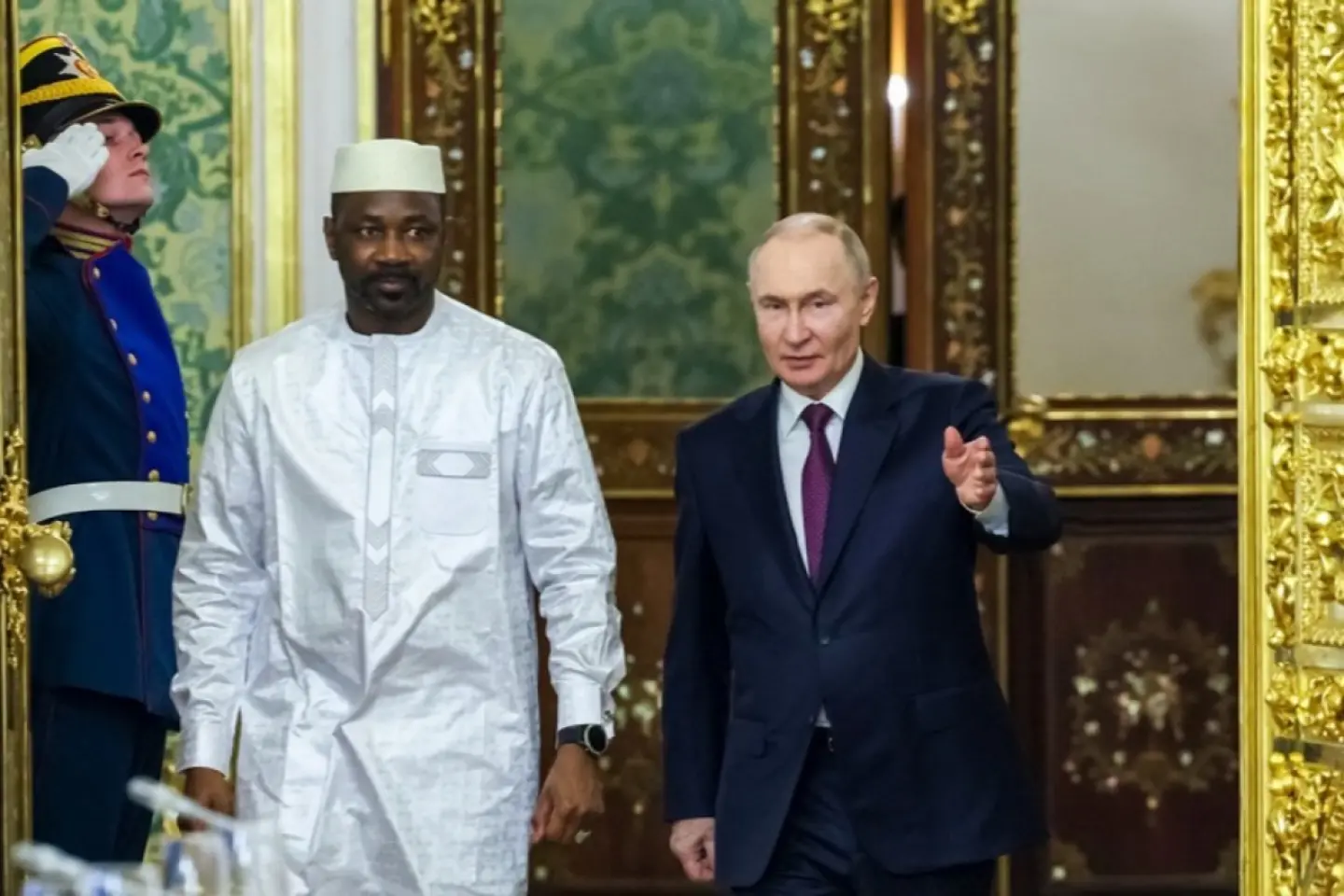
Russia claims to be a global power and wants to be perceived as a player in the struggle for spheres of influence, on an equal footing with Washington, Beijing and Brussels. Africa is one of the theaters where, in recent years, Russia has manifested these ambitions. Moscow is seeking to revive USSR’s former influence in Africa, to attract African states to its side by promoting multipolarity and, at the same time, to make money. Beyond the pompous speeches at various diplomatic meetings, Moscow's African policy, however, is limited to exporting grains, (cheap) weapons and mercenaries. Also, Russia wants to avoid stepping on China’s toes in Africa, given its dependency on Beijing since it invaded Ukraine.
The USSR attracted post-colonial Africa with its ideology and economic strength; Russia now wants to sell to Africa, but not to buy from there
Russia's presence in Africa is older than Russia. Most of what Moscow has on the continent today it inherited from the Soviet Union, and the inheritance was built in a different century for different reasons. During decolonisation, a relationship with Moscow was for many new states a natural choice, and often a productive one. The USSR signed African trade agreement with Egypt and went on to build the things that still carry its name — the Aswan Dam, the El Hadjar steel works in Algeria, the Ajaokuta mill in Nigeria, hydropower in Angola. The appeal was not only material. Socialist and anti-colonial ideas had real pull for countries that had just thrown off European rule, and the Kalashnikov that ended up on more than one national flag was a statement of allegiance as much as a weapon.
That second, ideological half of the inheritance has quietly lapsed. The relationships that survived into the present are almost all the commercial ones, and they survived where there was money to pay for goods. Egypt, Tunisia and Morocco are still substantial customers. The sub-Saharan clients courted for their politics — Guinea, Ethiopia, Madagascar, Benin — have shrunk to rounding errors in the trade tables. Russia did not so much keep its Soviet friendships as keep the ones that turned out to be transactions.
Strip away the rhetoric about a shared “Global South,” and the commercial relationship remains markedly asymmetric: Russia sells far more goods to African countries than it buys from them. Available mirror data for 2023, based on what reporting African states recorded as imports from and exports to Russia, put Russian exports at roughly $15 billion and African exports to Russia at just over $1 billion — a ratio of about fourteen to one and a Russian surplus of some $14 billion. These figures should be treated as a lower-bound estimate rather than a complete measure of continent-wide trade, since Russian sources put exports to Africa considerably higher, at about $21 billion.
The available mirror data also show a high degree of geographic concentration. Among reporting countries, Egypt, Tunisia and Nigeria accounted for around 57 percent of recorded imports from Russia, while the five largest markets absorbed roughly 70 percent; North Africa represented just over half of the total, and Egypt alone about one third. The broader conclusion remains valid: Russian trade with Africa is concentrated in a small number of large markets, especially in North Africa, while much of the continent remains marginal in value terms.
The wheat-and-weapons republic
Russia's main exports to Africa are grain and weapons, followed by fertilizers and fuel. Beyond these exports, Moscow also seeks to be a security provider for various African regimes (mostly military dictatorships).
The war in Ukraine has led to an increase in Russian agricultural exports to Africa. Cut off from European markets, Russia pushed agricultural and energy exports south, and 2023 set a record at just over 15 billion dollars, up from 11.6 billion the year before. The growth was narrow and revealing: Tunisia up by more than 1.5 billion in two years, Egypt up by nearly 1.5 billion, Ghana up 270 percent. This is the profile of a grain supplier finding new buyers, not of a power building a diversified economic base.
As far as arms are concerned, here Russia still trades on its Soviet brand: for much of the continent it is the default supplier of affordable, familiar hardware. But weapons sales are lumpy — a single contract can swing a year — which is why the export series jumps around so much, with spikes in 2018 and 2021 and troughs in between. A relationship that rides on a few big-ticket deals looks larger in a good year than it is on average.
Arms deliveries are accompanied by the work of private military companies, now folded into the Africa Corps — and it follows the opposite. Russian forces or contractors – which, in fact, meet most of the characteristics of mercenary forces – operate in roughly six countries: Burkina Faso, the Central African Republic, Libya, Mali, Niger and Sudan. Together, in 2023, those six took 572 million dollars of Russian exports — about 3.8 percent of the African total. And almost all of that is Burkina Faso alone. Mali bought 35 million dollars' worth and falling; Niger, 13 million; the Central African Republic, one million.
The temptation is to conclude that Russia has no economic interest in these places. The real payoff in Sudan, the Central African Republic and Mali is gold and minerals, and it moves through concessions rather than customs declarations — which is also why Libya and Sudan show as blanks in the trade data, having simply stopped reporting amid war. Security services exchanged for resource access, with the proceeds largely off the books. But that model works only in weak states. A stable, transparent country does not hire mercenaries or sign away mines in the dark.
According to the Global Initiative Against Transnational Organized Crimes, Russia’s mercenaries have been “implicated in in murders, massacres, rapes, and other atrocities in some African countries [and] accused of terrorizing civilian populations, carrying out industrial-scale smuggling of gold, diamonds, and timber, notably in the Central African Republic (CAR), spearheading political disinformation campaigns and election-rigging.” Also, in some cases, Russia’s mercenaries failed to deliver – in April they were routed from northern Mali following an offensive by Touareg and Islamist forces.
Here we see the paradoxical nature of Russia's African policy. On the one hand, grain, machinery and weapons are sold to solvent states that are stable enough to buy them. Here Russia is interested in maintaining stability. On the other hand, however, partnerships are sought with unstable states, to which the promise of security is delivered with the help of mercenaries and weapons. Trade with those states is intentionally almost non-existent, because the income comes more from insecurity than from economic growth.
The China problem
The unrelenting part is what sits above all of this. Whatever contest Russia imagines with the West, the African market today belongs to China. Beijing financed infrastructure at scale and without the bureaucratic conditions attached to Western money, bringing its own technology, equipment and often its own labour, from the 1990s and especially through the 2000s. The result is a presence Russia cannot approach in volume, in goods, or in the older Soviet currency of narrative and development models.
And here is the awkward second layer. Russia cannot push back against China the way it once pushed against the West, because it now depends on China — for its own imports, its payment channels, its diplomatic cover. Crossing Chinese interests in Africa head-on is something Moscow is unlikely to risk and probably could not afford. The country that once sold an alternative model is now, on the same continent, the junior partner of the power that out-competed it.